133bn-riyal investment, AI doctors propel Saudi healthcare onto global stage
Saudi Arabia says more than 133 billion riyals in health investments are accelerating AI care, robotics and virtual hospitals under Vision 2030.
Intelligence analysis by GPT-5.4 Mini
Saudi Arabia is recasting healthcare around prevention, early diagnosis and digital services. The push spans AI tools, robotic surgery, virtual care and major infrastructure spending, with several hospitals and Hajj services presented as proof points.
Saudi Arabia is turning its hospitals into smarter places with robots, computer helpers and online doctor services. It is like upgrading an old bus system into a fast metro: more people can get help, and some treatments can be done faster and with less pain.
Analysis
Saudi Arabia’s health sector is being positioned as a flagship for Vision 2030, according to the Saudi Press Agency. The report says the Kingdom has moved away from a purely treatment-based model toward one centered on prevention, early diagnosis and digital care, backed by large-scale investment and integrated services.
AI and digital care
The Ministry of Health has launched AI-based tools such as an AI Physician project to support diagnosis and clinical decisions. It has also rolled out a Smart Health Coach inside the Sehhaty app, developed with Google, to offer personalized health guidance.
A major part of that shift is the Virtual Hospital network, which SPA describes as one of the world’s largest. It connects 242 hospitals inside and outside the Kingdom and serves more than 597,000 beneficiaries, expanding access to specialized care and easing pressure on large hospitals.
Big money, robotics and record surgeries
Healthcare investments announced at the Global Health Exhibition 2025 topped 133 billion Saudi riyals. The report breaks that down into 31 billion riyals for infrastructure, more than 12 billion for venture capital and strategic funds, and 2.3 billion for life sciences.
Hospitals are also adopting robotic systems including Da Vinci, ROSA and CORI across heart surgery, transplants, cancer care, spine work and joint replacement. King Abdullah Medical City in Makkah introduced the Da Vinci Xi system, which SPA says enables highly precise operations through very small incisions.
King Faisal Specialist Hospital and Research Centre is highlighted for two global firsts: a fully robotic heart transplant and a fully robotic liver transplant. The hospital also reportedly completed seven cardiac procedures in one robotic operation in 2026 on a patient with multiple complex conditions.
Hajj and specialty care
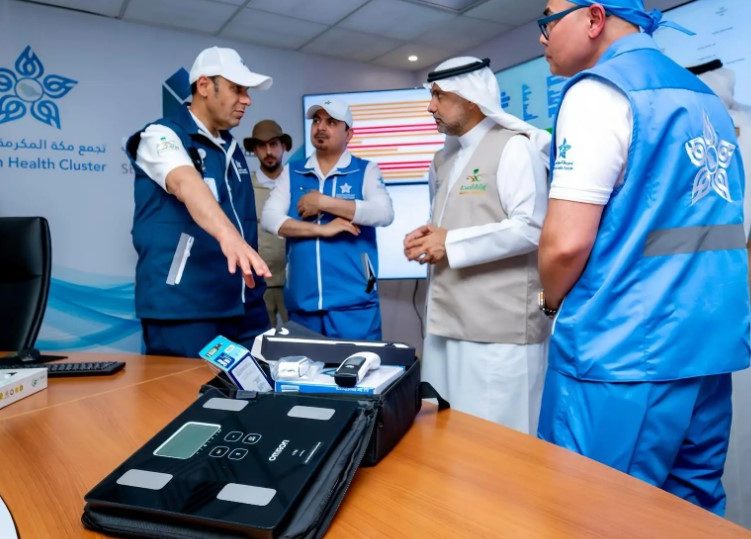
The article says smart health tools have been especially useful during Hajj. The Makkah Health Cluster used AI systems such as i-Selfie for contactless vital-sign checks and cardiac assessment, cutting evaluation time by 70 percent. Other services included multilingual digital guidance, mobile stroke and cardiac units, and pharmacy services in 11 languages.
Saudi National Guard Health Affairs and King Khaled Eye Specialist Hospital are also presented as leaders in smart, AI-enabled care. SPA says continued spending on digital infrastructure, local talent and international partnerships is helping Saudi Arabia build a regional model for modern healthcare.
Key points
- Saudi Arabia says it has surpassed 133 billion riyals in healthcare investments tied to Vision 2030.
- The Ministry of Health is using AI tools for diagnosis support and personalized health guidance.
- The Virtual Hospital network connects 242 hospitals and serves more than 597,000 beneficiaries.
- Hospitals are expanding robotic surgery, including globally notable transplant procedures at King Faisal Specialist Hospital.
- AI-powered systems were also used during Hajj to speed up screening and support multilingual health guidance.
If the program continues as described, Saudi Arabia could broaden access to specialist care and reduce strain on major hospitals. The article suggests AI tools, virtual services and robotic surgery are already making care faster, more precise and more reachable.
The article also shows how dependent the model is on heavy spending, advanced equipment and complex digital systems. If those investments slow down or the tools are hard to scale evenly, the gap between showcase hospitals and ordinary care could remain wide.