A Bitcoin 'Volmageddon' May Be Brewing, Key Indicator Suggests
Bitcoin's 30-day implied volatility index, BVIV, is hovering between 34% and 38%, a range that has been followed by a volatility boom and a price slide in recent years. This could be a sign of a 'volmageddon' or a volatility surge that is often accompanied by price declines.
Intelligence analysis by Llama
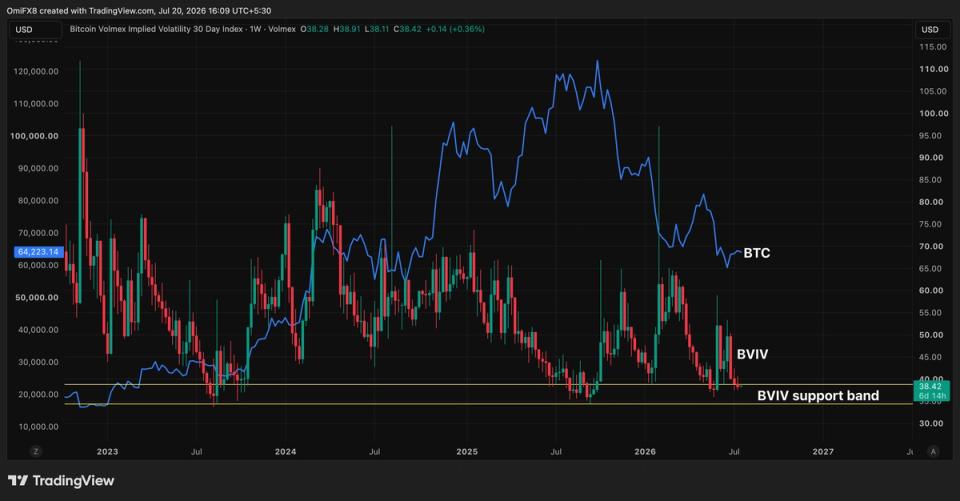
Bitcoin's volatility index, BVIV, is at a historically reliable support zone, suggesting it could be set to rise, which means another round of turbulence. This could lead to a price slide, as seen in previous instances when the index reached this zone.
Imagine you're on a rollercoaster, and the ride is getting bumpier and bumpier. That's what's happening with bitcoin's price. The 'volmageddon' is like a big storm that's brewing, and it could make the price go down. It's like when you're on a seesaw, and someone gets off, and it makes the other side go down. That's what's happening with bitcoin's price, and it's making people worried.
Analysis
A Bitcoin 'Volmageddon' May Be Brewing, Key Indicator Suggests
Bitcoin's 30-day implied volatility index, BVIV, is currently hovering between 34% and 38%. This range has been a reliable indicator of a potential volatility surge and price decline in the past. For instance, in late May, the index reached this zone, and what followed was a drop from $74,000 to under $60,000 in less than a week, and an upswing in the BVIV. A similar pattern played out just before the early February crash and during the correction following the record highs reached in October.
While past patterns are never a guarantee of future performance, volatility metrics are widely known to be mean-reverting. This cyclical nature suggests that periods of below-average volatility are often followed by higher turbulence, while above-average volatility paves the way for market stability. Currently, the index is trading below both its 30-day and 200-day simple moving averages. In essence, volatility is relatively 'cheap' and sitting at a historically reliable support zone, suggesting the measure could be set to rise, which means another round of turbulence.
For now, bitcoin continues to trade just above $64,000, maintaining the range-bound price action that has persisted since last Wednesday. While some analysts have noted two consecutive weeks of spot ETF inflows, the capital movement is tiny compared with the billions yanked from the market during the preceding eight-week outflow streak. Global volatility gauges in traditional markets are currently offering mixed signals. South Korea's KOSPI VIX is currently above 70%, its highest level since the 1990s. Meanwhile, Wall Street's VIX jumped over 12% to reach 18% on Friday, where it continues to hover. However, these levels have been in the play for months, which means that stocks are anything but panicked. Additionally, the MOVE index, the 30-day volatility gauge for U.S. Treasury notes that underpins global finance, remains steady around 70%, as it has since April, offering a constructive cue for risk assets.
Stay alert! Read more: For analysis of today's activity in altcoins and derivatives, see Crypto Markets Today. For a comprehensive list of events this week, see CoinDesk's 'Crypto Week Ahead.'
Key points
- Bitcoin's 30-day implied volatility index, BVIV, is hovering between 34% and 38%.
- This range has been a reliable indicator of a potential volatility surge and price decline in the past.
- The index is trading below both its 30-day and 200-day simple moving averages.
- Volatility is relatively 'cheap' and sitting at a historically reliable support zone.
- The market is currently offering mixed signals, with South Korea's KOSPI VIX and Wall Street's VIX showing high levels of volatility.
If the volatility surge plays out positively, it could lead to a more stable market, and the price of bitcoin could rise. However, this is a long shot, and the current situation is more likely to lead to a price decline.
The realistic downside risks or failure modes are that the volatility surge could lead to a price decline, and the market could become more unstable. This could be a result of the increased demand for options, which could drive up the price of bitcoin.
Market signals
- BTC Escalation drives safe-haven demand for bitcoin, per the article's framing of investor reaction.
AI-generated analysis of potential market relevance. Not financial advice.