A new order in West Asia
Iranian media outlets are discussing Iran's strategic efforts to establish a new regional order in West Asia by asserting control over the Strait of Hormuz, a move reportedly accepted by the US due to geopolitical pressures.
Intelligence analysis by Gemini 2.5 Flash
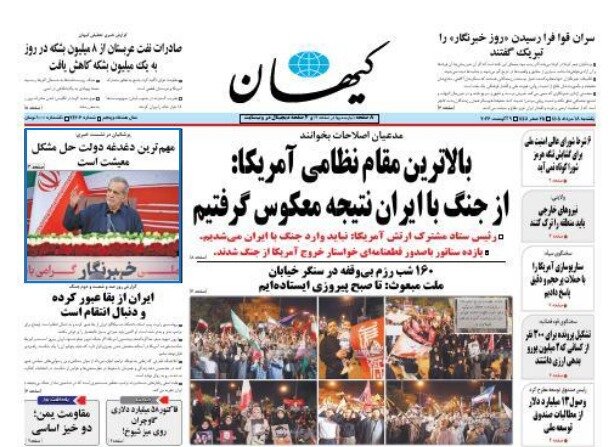
Iranian newspapers analyze Tehran's push to redefine its sovereignty over the Strait of Hormuz, aiming to dictate maritime passage and establish a new regional order. This initiative, involving negotiations with Oman, is framed as a significant geopolitical shift, with the US reportedly acknowledging Iran's dominant role amidst strategic deadlocks and energy market sensitivities, desp…
Imagine a very important sea road where lots of big ships carry oil to different countries. Iran wants to be the traffic cop for this road, deciding which ships can pass and which can't, especially if they've worked with certain countries Iran doesn't like. Other big countries, even America, are starting to agree to this because they really need the oil to keep flowing, and Iran has shown it can make things difficult if they don't. It's like Iran is saying, "I'll manage this road my way, and everyone else needs to follow my rules if they want to use it safely."
Analysis
The article, drawing insights from various Iranian newspapers, outlines a significant shift in Iran's regional strategy, centered on asserting unprecedented control over the Strait of Hormuz. This move is presented not merely as a defensive measure but as the foundation for a 'new regional order in West Asia.' The core of this strategy involves Iran dictating which vessels can traverse the Strait, specifically excluding those that have cooperated with the United States and Israel, while guaranteeing safe passage for compliant ships. This proactive stance aims to leverage Iran's geographical advantage to reshape geopolitical realities, moving beyond traditional notions of sovereignty to active management of a critical international waterway.
Strait of Hormuz
Iran's proposed new order for the Strait of Hormuz is a bold assertion of its strategic power. The Tehran Times commentary, referencing Kayhan, suggests that Iran has demonstrated its capability to close the Strait and now seeks to refine this control by selectively opening it. This selective passage would be granted only to vessels that align with Iran's desired order, effectively creating a managed corridor under Iranian oversight. The article highlights that this control is not expected to be achieved through negotiation with the United States, as Iran believes it does not require external agreement to exercise its sovereignty. This approach signals a unilateral redefinition of maritime security in the Persian Gulf, with profound implications for global shipping and energy security.
Gholamreza Karimi
International affairs expert Gholamreza Karimi, as cited by Etemad, characterizes the current developments as an "unprecedented turning point" from a geopolitical perspective. Karimi suggests that Washington has effectively accepted a plan recognizing Iran's dominant role over the entrance to the world's most important energy corridor. This acceptance by the US is attributed to several factors, including America's strategic deadlock, reduced missile stockpiles, the energy market's sensitivity to ongoing conflict, and the vulnerability of US allies like Saudi Arabia. Karimi's analysis underscores the idea that the US is being compelled by circumstances to acknowledge Iran's enhanced regional influence, turning Iran's control over Hormuz into a lasting pressure lever, much to the dismay of Israel and hardline factions in the US.
Mecca Pact
The article also introduces the "Mecca Pact," an alliance formed among Saudi Arabia, Turkey, and Pakistan, as a potential indirect facilitator in Iran-US relations. While primarily described as a defensive pact, its members' close ties with the US and its policies position them as potential intermediaries. The expectation is that these countries could exert pressure on the US to soften its stance, thereby enabling negotiations and understanding with Iran to proceed. This suggests a multi-faceted diplomatic landscape where regional powers, even those not directly involved in the Strait of Hormuz negotiations, play a role in shaping the broader geopolitical environment and influencing the trajectory of Iran-US interactions.
Key points
- Iran aims to establish a new regional order in West Asia by asserting control over the Strait of Hormuz.
- This control involves selectively allowing passage only for vessels not cooperating with the US and Israel.
- The US is reportedly accepting Iran's dominant role due to strategic pressures and energy market sensitivities.
- Negotiations with Oman are underway to stabilize a new entry route within Iranian waters for security reasons.
- The 'Mecca Pact' (Saudi Arabia, Turkey, Pakistan) is seen as a potential intermediary to facilitate Iran-US understanding.
If Iran's managed passage system for the Strait of Hormuz is successfully implemented and accepted, it could lead to a more predictable and stable flow of energy, potentially reducing regional tensions and paving the way for a broader revival of understanding between Iran and the US.
Should the US reject Iran's new control over the Strait of Hormuz or if Iran's proposed routes are not adhered to, it could escalate into military confrontation, particularly if the southern route becomes a target, leading to severe disruptions in global energy supplies and heightened regional conflict.
Market signals
- OIL Iran's assertion of control over the Strait of Hormuz and potential for conflict could disrupt oil flow, increasing prices due to supply-route risk and energy market sensitivity.
AI-generated analysis of potential market relevance. Not financial advice.