Air India Express ordered to pay Rs 27,000 after bicycle put on baggage belt despite special care fee
A Karnataka district consumer commission ordered Air India Express to pay Rs 27,000 to a passenger after his bicycle, for which special handling was paid, was placed on a regular baggage belt.
Intelligence analysis by Gemini 2.5 Flash
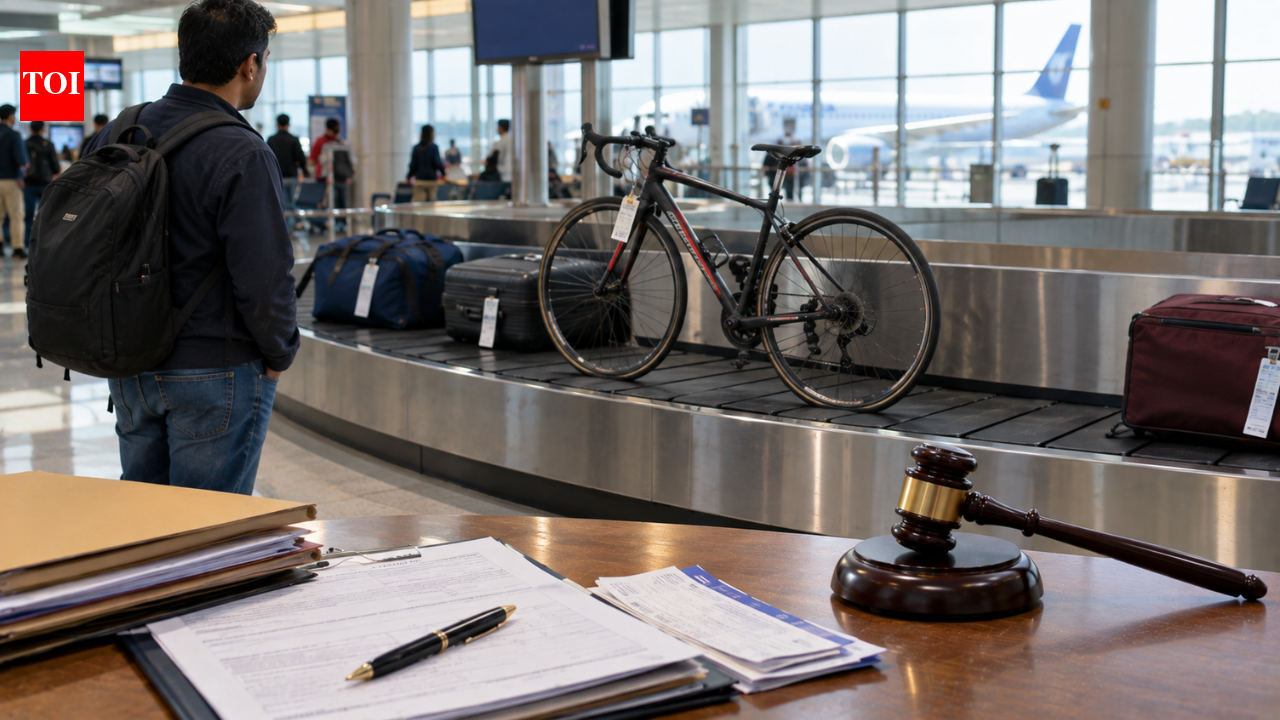
The passenger, Sushanth N.G., paid an extra Rs 2,000 for special handling of his valuable bicycle but found it on the standard baggage carousel. Despite the airline's defense that there was no damage, the commission ruled it a deficiency in service and unfair trade practice, ordering a refund and compensation.
Imagine you pay extra money for your special toy, like a fancy bike, to be carried very carefully on an airplane, maybe even by hand. But then, when you land, you see your special toy just rolling around on the normal luggage belt with all the other bags, even though it didn't get broken. A special judge said that even if the toy wasn't broken, the airline didn't keep its promise to handle it specially, so they have to pay back the extra money and some more for the trouble.
Analysis
Rs 27,000
The district consumer commission in Karnataka mandated Air India Express to pay a total of Rs 27,000 to passenger Sushanth N.G. This sum comprises a Rs 2,000 refund for the special equipment handling fee, Rs 20,000 as compensation for the deficiency in service, mental agony, and inconvenience, and an additional Rs 5,000 to cover litigation costs. This financial penalty underscores the commission's firm stance on upholding service agreements and consumer rights, particularly when airlines charge extra for specialized services.
The ruling sets a precedent for accountability, indicating that even without physical damage to an item, a failure to adhere to promised service standards constitutes a deficiency. The interest clause, stipulating a 6 percent annual interest if the amount is not paid within 45 days, further emphasizes the urgency and seriousness of the commission's directive. This ensures that the airline cannot unduly delay compliance with the order, reinforcing consumer trust in the legal redressal system.
Sushanth N.G.
Sushanth N.G.'s complaint stemmed from his experience on a Chennai-Mangalore flight where he had paid an additional Rs 2,000 for the special handling of his bicycle, valued at approximately Rs 3 lakh. Despite assurances from airline staff that the equipment would be handled with care, he discovered his bicycle on the regular baggage carousel upon arrival in Mangalore. This direct contradiction of the paid-for service prompted his immediate complaint to airport staff and a subsequent email to the airline.
His persistence in pursuing the matter, even after the airline initially closed his case, highlights the challenges consumers often face in seeking redress. The evidence he provided, including photographs, email correspondence, and a video recording of the bicycle on the baggage belt, proved crucial in substantiating his claim before the consumer commission. His case serves as a significant example of a consumer successfully navigating the legal system to enforce service agreements.
Air India Express
Air India Express defended its actions by arguing that the Rs 2,000 fee did not guarantee manual handling at every stage and that special items could ordinarily be delivered via the regular baggage belt unless oversized. The airline also contended that its staff promptly removed the bicycle once noticed and, crucially, that the bicycle was delivered without any damage, thus implying no loss or deficiency. This defense attempted to minimize the airline's responsibility by focusing on the outcome (no damage) rather than the process (failure of special handling).
However, the consumer commission meticulously examined the airline's own terms and conditions for special equipment handling, which explicitly stated an undertaking to exercise "care and caution." The video evidence submitted by Sushanth N.G. directly contradicted the airline's claim of due care, demonstrating that the bicycle was indeed placed on the regular belt. The commission concluded that this failure to adhere to its own agreed-upon terms, despite the absence of damage, constituted a clear deficiency in service and an unfair trade practice.
Key points
- Air India Express was ordered to pay Rs 27,000 to a passenger by a Karnataka district consumer commission.
- The passenger, Sushanth N.G., paid Rs 2,000 for special handling of his bicycle but found it on the regular baggage belt.
- The airline argued the bicycle was undamaged and the fee didn't guarantee manual handling at every stage.
- The commission found a deficiency in service and unfair trade practice, citing the airline's failure to adhere to its own terms for special care.
- The total payment includes a Rs 2,000 refund, Rs 20,000 compensation, and Rs 5,000 for litigation costs.
This ruling could encourage airlines to strictly adhere to their special handling policies and improve staff training, leading to better service quality for passengers who pay extra for specific care. It also empowers consumers to seek redress for service deficiencies, fostering greater accountability within the aviation sector.
Airlines might respond by increasing special handling fees to cover potential compensation costs, or they might make the terms and conditions for such services more ambiguous, potentially making it harder for consumers to prove a deficiency in the future.