Alibaba unit says 5-in-1 AI gives robots unified brain, body and limbs
Alibaba's Amap unit introduced ABot, a new AI framework that integrates a robot's perception, movement, and manipulation into a single, self-evolving system. This 5-in-1 approach aims to overcome the limitations of independently operating AI models in robotics.
Intelligence analysis by Gemini 2.5 Flash
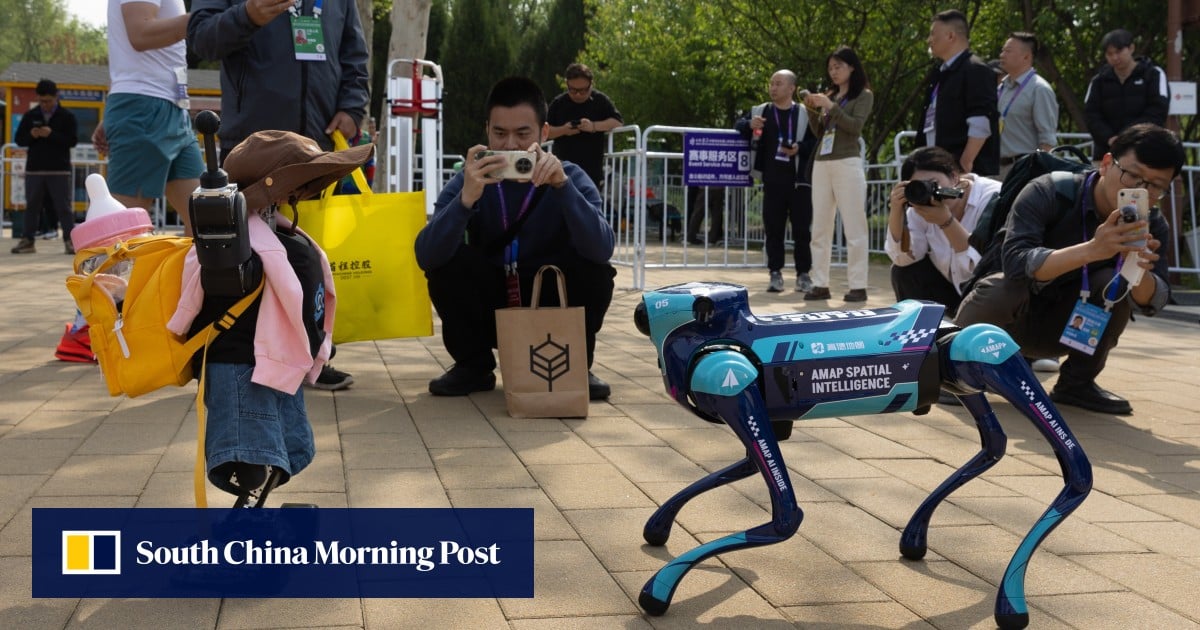
Amap, Alibaba's mapping division, has launched ABot, an advanced AI framework designed to give robots a unified "brain, body, and limbs." This system combines five specialized AI models to enable more sophisticated navigation and manipulation capabilities, addressing the industry's challenge of fragmented AI solutions for embodied intelligence.
Imagine a robot that usually has separate brains for walking, seeing, and picking things up. Alibaba made a new super-brain system called ABot that connects all these parts so the robot can think, see, walk, and grab things all at once, like a person. It helps robots move around cities without getting lost and even pick up toys while walking, making them much smarter and more helpful.
Analysis
Unifying Robot Intelligence
Alibaba's Amap unit has introduced ABot, a groundbreaking technology framework that aims to integrate a robot's core functions into a single, cohesive system. This "5-in-1" approach seeks to unify a robot's "feet, hands, brains, central nerves and motor nerves," moving beyond the traditional siloed development of individual AI models for specific tasks. The company asserts that this framework is the world's first of its kind, addressing a critical industry challenge. The prevailing issue in robotics AI has been the independent operation of models for navigation, operation, and reasoning, which lack shared data and experience. ABot's design directly tackles this fragmentation by allowing its five specialized foundation AI models to work in concert. This integrated system is intended to foster a self-evolving capability, enabling robots to continuously improve their performance and adaptability.
Advanced Capabilities and Efficiency
The ABot framework comprises five distinct models: ABot-N1, ABot-M0.5, ABot-ER, ABot-AgentOS, and ABot-C0, each contributing to the robot's enhanced functionality. A notable component, ABot-N1, employs an "eyes guiding feet" methodology for autonomous navigation. This model boasts an impressive 92.9 percent outdoor success rate in city-scale environments, crucially achieving this without the need for expensive high-definition maps, relying instead on standard cameras and basic road networks. Another key innovation is ABot-M0.5, which enables robots to "use hands and feet simultaneously." This model separates movement functions from manipulation tasks, allowing a robot to seamlessly grasp objects while in motion. Such a capability represents a significant leap forward in robotic dexterity and coordination, paving the way for more fluid and efficient task execution in dynamic settings.
The Broader Embodied AI Race
Amap's ABot system is positioned within a broader competitive landscape, reflecting the intense efforts by Chinese tech players to advance embodied intelligence. This field focuses on equipping machines with the necessary "brains" and physical components to interact with and complete tasks in complex real-world environments. The pursuit of embodied AI is seen as crucial for developing truly autonomous and versatile robots capable of operating beyond controlled industrial settings. The emphasis on a unified, self-evolving system underscores a strategic shift in robotics research and development. By integrating multiple AI functionalities, companies like Alibaba are aiming to create robots that are not only more capable but also more adaptable and less reliant on constant human intervention or pre-programmed scenarios. This holistic approach could accelerate the practical application of robots in various sectors, from logistics to service industries.
Key points
- Alibaba's Amap unit launched ABot, a 5-in-1 AI framework unifying a robot's "brain, body, and limbs."
- The system addresses the industry problem of fragmented AI models operating independently.
- ABot comprises five specialized AI models, including ABot-N1 for navigation and ABot-M0.5 for simultaneous movement and manipulation.
- ABot-N1 achieves 92.9% outdoor navigation success using standard cameras, bypassing costly high-definition maps.
- ABot-M0.5 allows robots to grasp objects while walking, enhancing dexterity and coordination.
This integrated AI framework could lead to robots that are significantly more autonomous and adaptable, capable of performing complex tasks in dynamic environments with greater efficiency and less reliance on costly infrastructure like HD maps. It could accelerate the deployment of versatile robots across various industries, from logistics to personal assistance.
While promising, the complexity of integrating five distinct AI models into a truly seamless and self-evolving system presents significant engineering challenges. Potential failure modes could include unforeseen interactions between models, difficulties in scaling the system to diverse real-world scenarios, or limitations in its ability to learn and adapt as effectively as claimed.