All Systems Go: Global PC App Ecosystem Ready for NVIDIA RTX Spark
NVIDIA announced the upcoming launch of RTX Spark laptops, a new PC category combining gaming, creative, and AI capabilities, alongside significant software updates and optimizations for local AI agents.
Intelligence analysis by Gemini 2.5 Flash
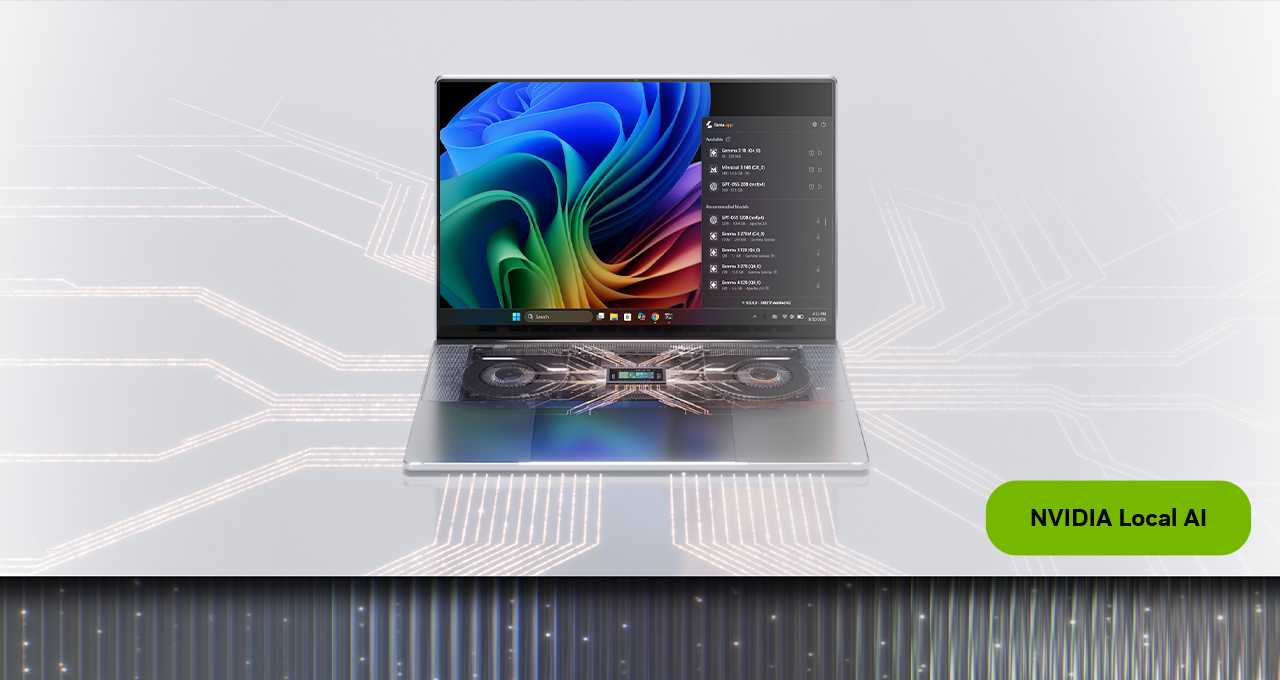
NVIDIA is preparing for the October 16 launch of its RTX Spark laptops, which are designed to be personal AI supercomputers. The company, in collaboration with Microsoft and other partners, is rolling out extensive software updates, new AI models like Nemotron 3.5 Bolt 74B, and developer tools to ensure a robust ecosystem for local AI agents, creative applications, and gaming.
Imagine your computer getting a super-smart brain that lives right inside it, not far away on the internet. NVIDIA's new RTX Spark laptops are like that, making your computer a personal AI helper for games, art, and even coding. They're releasing lots of updates so that cool AI apps can run super fast and safely on these new computers, making them smarter and more helpful than ever before.
Analysis
NVIDIA's announcement regarding the RTX Spark laptops and the accompanying software ecosystem marks a pivotal moment for the integration of advanced AI capabilities directly into personal computing. The RTX Spark is positioned as a versatile superchip, merging the functionalities of a high-end gaming PC, a professional creative studio, and a personal AI supercomputer. With up to 128GB of unified memory and 1 petaflop of AI compute, it aims to deliver a full stack of NVIDIA RTX and CUDA technologies, fundamentally altering how users interact with their PCs through powerful local AI agents. The readiness of a broad application ecosystem, including updates to top agent apps, creative software, and developer tools, underscores NVIDIA's strategy to make local AI both accessible and highly performant from day one.
Nemotron 3.5 Bolt 74B
A cornerstone of NVIDIA's local AI strategy for RTX Spark is the introduction of the Nemotron 3.5 Bolt 74B-A9B 24GB model. This new large language model (LLM), purpose-built for running local agents on RTX Spark, is slated for release on October 15. It is a 74-billion parameter, 9-billion active-parameter mixture-of-experts (MoE) model, optimized to fit into 24GB of memory using 2-bit quantization techniques. This design aims to strike an optimal balance between speed and intelligence, promising performance faster than many popular dense models while being smarter than most popular MoE models. The availability of such a powerful, locally runnable LLM is crucial for enabling complex agentic AI tasks directly on the user's device, enhancing privacy, reducing latency, and allowing for free iteration without cloud costs.
OpenShell and MXC
Security and ease of use are paramount for the widespread adoption of local AI agents, and NVIDIA addresses this through its OpenShell and Microsoft Execution Containers (MXC) technologies. From the initial boot of an RTX Spark laptop, users will be guided to install their preferred agent app, which will benefit from these new, secure sandboxing technologies. MXC provides operating system-level security, creating isolated environments for agents, while OpenShell simplifies the adoption of MXC for developers and adds advanced capabilities such as credential protection and security monitoring. Key agent apps like Hermes, OpenClaw, and GitHub Copilot are already integrating or will soon integrate these security features, ensuring that local AI agents can operate effectively and securely on the RTX Spark platform. This focus on robust security infrastructure is vital for building user trust and facilitating the seamless integration of AI into daily computing workflows.
DLSS 5
Beyond AI agents, NVIDIA is also significantly enhancing the gaming and creative aspects of RTX Spark with updates like DLSS 5. This new AI model, arriving on October 16, promises to be twice as fast as its predecessors, further boosting performance in hundreds of top games. Additionally, a new Performance Mode for DLSS Frame Generation is already available via the NVIDIA App beta, offering immediate benefits to gamers. For creators, DLSS Ray Reconstruction will be integrated into Blender 5.3 in November, improving interactivity in 3D viewport rendering. These advancements, coupled with optimizations for Adobe's top apps and new features in NVIDIA Broadcast 2.3, demonstrate a comprehensive approach to leveraging AI across all facets of the RTX Spark experience, ensuring that the platform delivers cutting-edge performance and capabilities for a diverse user base.
Key points
- NVIDIA RTX Spark laptops, combining gaming, creative, and AI capabilities, will be available starting October 16.
- New software updates and performance optimizations are rolling out for local AI agents, creative apps, and developer tools.
- The NVIDIA Nemotron 3.5 Bolt 74B model, purpose-built for local AI agents, releases on October 15.
- Security for local AI agents is enhanced with NVIDIA OpenShell and Microsoft Execution Containers (MXC).
- DLSS 5, a 2x faster AI model, and other gaming enhancements are also part of the launch updates.
The launch of RTX Spark and its robust software ecosystem could significantly accelerate the adoption of local AI agents, offering users enhanced privacy, lower latency, and greater creative freedom without constant reliance on cloud services. This could lead to a new era of personalized and powerful computing experiences.
Market signals
- NVDA The launch of RTX Spark laptops and associated software updates are expected to drive demand for NVIDIA's hardware and AI ecosystem, potentially boosting revenue and market position.
AI-generated analysis of potential market relevance. Not financial advice.