Amazon vs. Booking: Comparing Revenue Trends Between a Retail Giant and a Travel Titan
Amazon and Booking Holdings have different revenue trends, with Amazon seeing a 17% year-over-year increase in its most recent quarter, while Booking's revenue grew 16% year over year. Amazon's revenue is significantly higher than Booking's, with Amazon operating at a vas…
Intelligence analysis by Llama
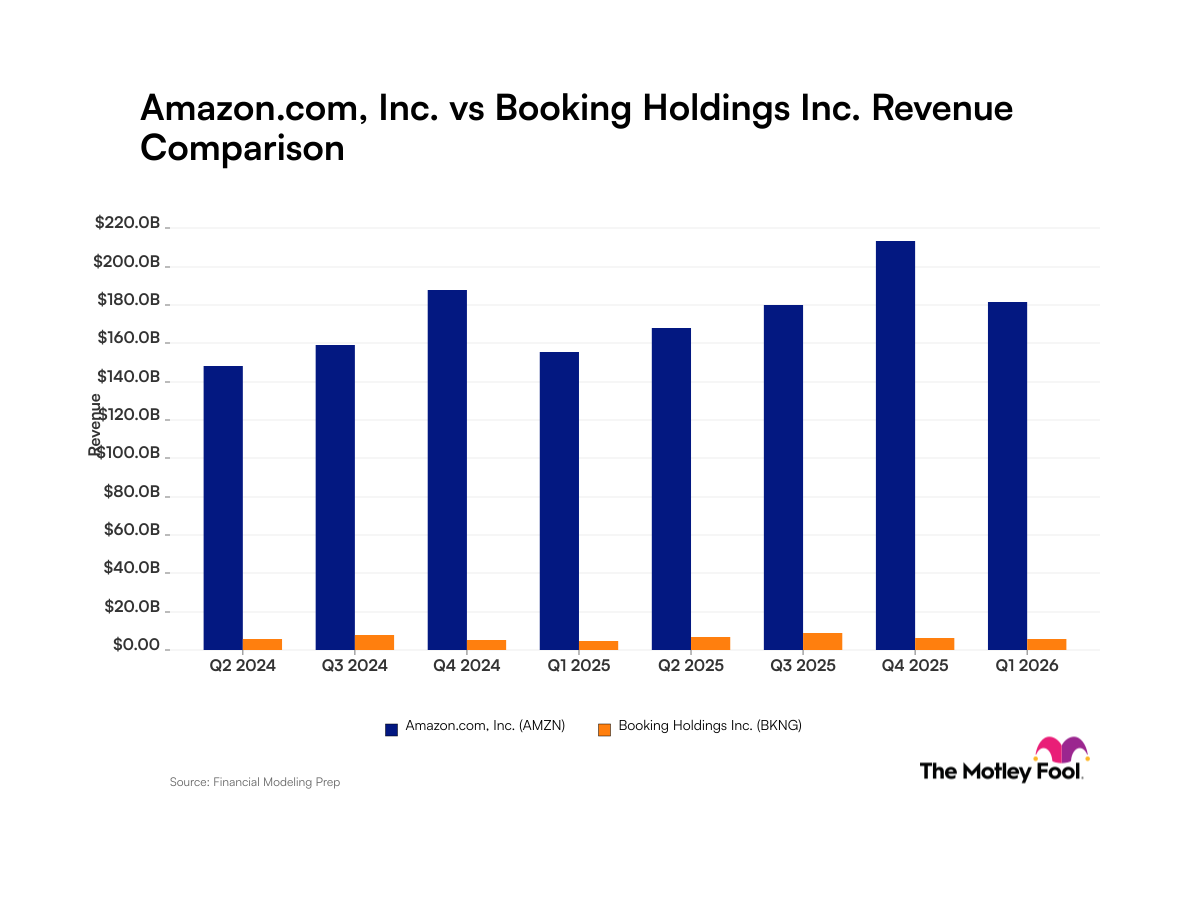
The article compares the revenue trends of Amazon and Booking Holdings, highlighting the differences in their businesses and revenue growth. Amazon's revenue is significantly higher than Booking's, and both companies are seeing strong sales expansion. However, Booking's stock price dropped to a 52-week low due to concerns about the impact of the US conflict with Iran on its sales.
Imagine you have two big companies, Amazon and Booking. Amazon sells lots of things online and provides cloud computing services. Booking helps people book travel and hotels. Both companies are growing, but Amazon is much bigger. Amazon's revenue is like a big mountain, while Booking's is a smaller hill. But Booking's stock price went down because of a problem with a war, and that made it a good time to buy.
Analysis
A $60B Vote of Confidence
Amazon's revenue has consistently outpaced Booking's over the past eight quarters, with a significant financial advantage. This is largely due to Amazon's diversified business model, which includes e-commerce, cloud computing, and advertising. In contrast, Booking's revenue is primarily driven by its online travel booking platform. Despite this, both companies have demonstrated strong sales expansion, with Amazon's revenue growing 17% year over year in its most recent quarter and Booking's revenue growing 16% year over year.
Why Cursor?
Booking's stock price dropped to a 52-week low in May due to concerns about the impact of the US conflict with Iran on its sales. This has created a buy opportunity for investors. Amazon's share price also fell due to its massive capital expenditures to provide the tech infrastructure needed to grow its artificial intelligence business. However, this expense is helping to fuel its AWS cloud computing division's revenue growth, which rose 28% year over year in Q1.
The Road Ahead
Both Amazon and Booking Holdings are well-positioned for future growth, with a strong track record of revenue expansion. However, investors should be aware of the potential risks and challenges facing each company, including the impact of the US conflict with Iran on Booking's sales and Amazon's massive capital expenditures.
Key points
- Amazon's revenue is significantly higher than Booking's.
- Both companies have demonstrated strong sales expansion.
- Amazon's revenue grew 17% year over year in its most recent quarter.
- Booking's revenue grew 16% year over year in its most recent quarter.
- Booking's stock price dropped to a 52-week low due to concerns about the impact of the US conflict with Iran on its sales.
If Amazon's revenue growth continues, its stock price could rise. Additionally, Booking's stock price may recover if the US conflict with Iran does not have a significant impact on its sales.
If the US conflict with Iran has a significant impact on Booking's sales, its stock price could continue to fall. Additionally, Amazon's massive capital expenditures could lead to a decrease in its free cash flow.