America cannot turn a failed policy into a winning card
Iran's state media asserts that the US "maximum pressure" policy, particularly new economic sanctions threatened by Donald Trump, is a recycled and failed strategy that will not compel Iran to yield.
Intelligence analysis by Gemini 2.5 Flash
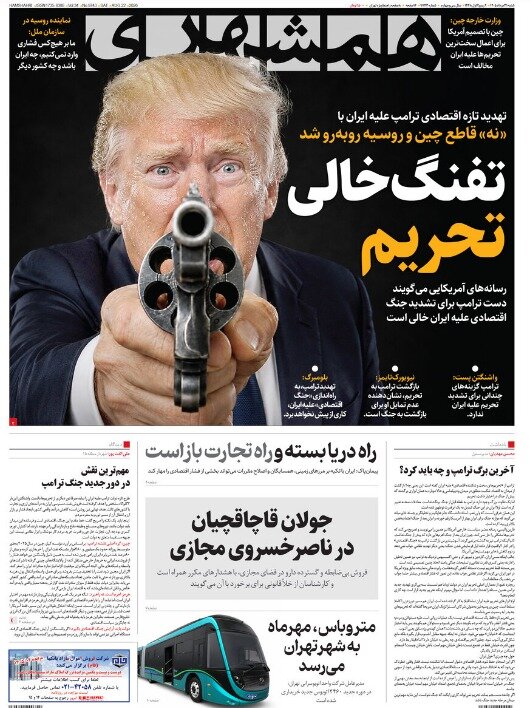
The article, drawing on analyses from various Iranian newspapers, argues that Washington's attempts to isolate Iran economically and militarily are doomed to fail, as major powers like China and Russia oppose the sanctions, and Iran is preparing to counter these pressures through a combination of heightened tensions and diplomatic leverage.
Imagine two kids, America and Iran, are playing a game. America keeps trying the same old trick to make Iran do what it wants, but it never works. Iran says, "You can't win with the same old failed trick!" Other big kids, like China and Russia, agree with Iran. Now, America is trying to stop Iran from selling its oil, but Iran says it will protect its sea path and wants to talk about old agreements to solve things, not fight.
Analysis
The Tehran Times article, synthesizing views from several Iranian newspapers, presents a unified front against renewed US pressure, particularly the "maximum pressure" policy associated with Donald Trump. The core argument is that this strategy, characterized by severe economic operations and attempts to isolate Iran, is not a new initiative but a repetition of decades-old, failed policies. This framing suggests that Iran views the US approach as predictable and ineffective, bolstering its own resolve to resist.
Maximum Pressure
Washington's strategy of "maximum pressure" is portrayed as an attempt to economically isolate Iran by threatening countries, banks, and companies that maintain cooperation with Tehran. However, the article highlights that this strategy has already encountered significant obstacles, with China and Russia openly criticizing the repetition of White House sanctions policies and refusing to align with Washington's approach. This international dissent undermines the US's ability to create a truly global economic blockade, suggesting that the policy's reach and impact are inherently limited by geopolitical realities.
Even American and Western media are cited as describing Trump's sanctions options as a repetition of past failures, a strategy that has not succeeded in forcing the Islamic Republic to yield. This internal and external critique, as presented by the Iranian media, serves to delegitimize the US policy, framing it as an exercise in futility rather than a viable path to achieving its objectives. The article implies that the US is stuck in a cycle of ineffective coercion, unable to adapt its approach to the evolving regional and international landscape.
Strait of Hormuz
The security of the Strait of Hormuz emerges as a critical point of contention and a potential flashpoint. Ham-Mihan's commentary on a NATO virtual meeting regarding the strait underscores the international community's concern for freedom of navigation, yet Iran consistently emphasizes that security in this vital waterway must be ensured through cooperation among littoral states, explicitly excluding military intervention by external powers. This position highlights Iran's assertion of sovereignty and its rejection of foreign military presence in its immediate vicinity, setting the stage for potential confrontations if external powers attempt to impose their own security arrangements.
Khorasan's analysis further suggests that Iran's plan for confronting Trump's strategy will likely involve heightened tensions and an offensive posture, potentially employing a military strategy to break any blockade in the Strait of Hormuz. This indicates a willingness to escalate if necessary, while simultaneously insisting on the provisions of the Islamabad memorandum as a basis for future negotiations. The dual approach of military readiness and diplomatic leverage reflects Iran's strategy to both deter aggression and shape the terms of any eventual resolution, recognizing that neither side has a purely military solution.
Islamabad Memorandum
The Islamabad memorandum is presented as a crucial historical document that continues to hold relevance for shaping future agreements between Iran and the United States. Khorasan emphasizes the importance of adhering to this memorandum, viewing it as a potential playing field for negotiations. The article suggests that if Iran can prevent a US victory in the new phase of hybrid conflict, it might even use this document to achieve a better agreement in the future, implying that past diplomatic frameworks can be reactivated and leveraged.
International affairs analyst Heshmatollah Falahatpisheh, in an interview with Arman-e-Melli, echoes this sentiment, suggesting that an optimistic scenario could involve a return to the Islamabad agreement, leading to a lifting of the economic siege and the reopening of the Strait of Hormuz. This perspective underscores the belief within Iranian analytical circles that diplomacy, grounded in existing agreements, remains a viable path to de-escalation and resolution, despite current tensions. However, the article also notes a cooling attitude of mediators and new tensions, suggesting that the diplomatic path faces significant challenges.
Key points
- Iran's state media views US "maximum pressure" as a failed, recycled policy that will not force Iran to yield.
- China and Russia have criticized US sanctions and will not align with Washington's approach, undermining economic isolation efforts.
- Iran asserts that security in the Strait of Hormuz must be ensured by littoral states, rejecting external military intervention.
- Iran may adopt an offensive military strategy to counter blockades while also leveraging the Islamabad memorandum for future negotiations.
- Diplomacy, potentially returning to the Islamabad agreement, is seen as an optimistic path, though current tensions reduce its likelihood.
An optimistic scenario, as suggested by analyst Heshmatollah Falahatpisheh, could see Iran and the United States reaching an agreement, leading to the lifting of the economic siege on Iran and the reopening of the Strait of Hormuz through an arrangement with Oman. A two-month ceasefire extension could facilitate further negotiations, potentially returning to the framework of the Islamabad agreement.
The article implies a pessimistic outlook if the US continues its "maximum pressure" policy, potentially leading to heightened tensions and Iran adopting an offensive military posture to break any blockade in the Strait of Hormuz. New tensions, such as the dispute over Iranian pilots in Qatar, also suggest that the diplomatic path faces less optimism, increasing the risk of confrontation.
Market signals
- OIL The article's discussion of potential Iranian military strategy in the Strait of Hormuz and intensified economic siege implies supply route risks, which typically drive oil prices higher.
AI-generated analysis of potential market relevance. Not financial advice.