Ancient Persian-translated Quran unveiled at Iran National Library
A high-quality facsimile edition of the 'Zaferani Quran', the oldest known complete and dated manuscript of the Holy Quran accompanied by a Persian translation, was unveiled at the National Library and Archives of Iran. The manuscript was copied in 546 AH (1151-52 CE) by …
Intelligence analysis by Llama
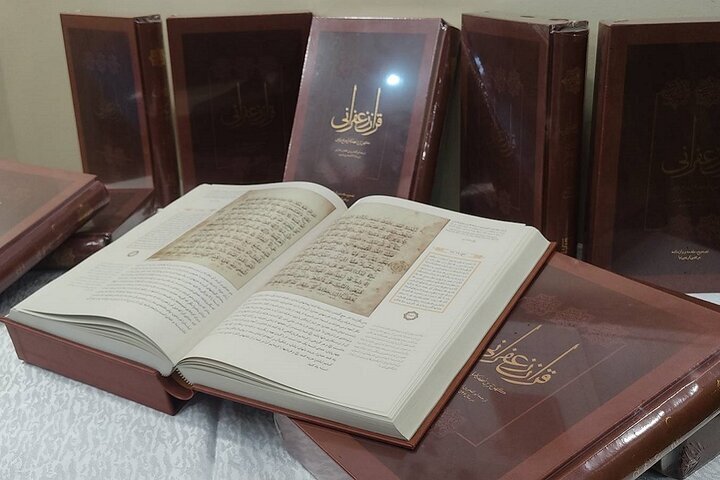
The unveiling of the 'Zaferani Quran' facsimile edition at the National Library and Archives of Iran highlights the significance of the manuscript as a valuable source for the study of Quranic translation and the historical development of the Persian language.
Imagine a very old book that contains the Quran, the holy book of Islam, written in Arabic and translated into Persian. This book is special because it's one of the oldest and most complete copies of the Quran with a Persian translation. It's like a time capsule that shows how people understood and translated the Quran a long time ago.
Analysis
A Treasure of Iran's Written Heritage
The unveiling of the 'Zaferani Quran' facsimile edition at the National Library and Archives of Iran marks a significant milestone in the preservation and publication of one of Iran's most valuable Quranic manuscripts. The manuscript, copied in 546 AH (1151-52 CE) by Abolfazl Zaferani in the city of Rey, is recognized by scholars as the oldest known complete and dated manuscript of the Holy Quran accompanied by a Persian translation.
The manuscript's significance extends beyond its religious importance, as it provides valuable insight into medieval translation practices, manuscript production, and the intellectual currents of the Seljuk period. The interlinear format of the manuscript, with the Persian translation written in smaller script between the lines of the Arabic text, is a notable feature that reflects the close relationship between Islamic scholarship and the growth of Persian literary culture.
A Golden Age for Persian Quranic Exegesis
The sixth century AH is considered a golden age for Persian Quranic exegesis and translation. The 'Zaferani Quran' is a testament to the remarkable achievements of scholars during this period, who played a crucial role in legitimizing the translation of the Quran into Persian. The manuscript's preservation and publication offer a rare opportunity for scholars and the public to study one of the earliest surviving Persian translations of the Holy Quran without compromising the preservation of the original.
A Living Witness to Iran's Intellectual and Cultural History
Manuscripts like the 'Zaferani Quran' should not be viewed merely as museum artifacts, but as living witnesses to Iran's intellectual and cultural history. The preservation, publication, and introduction of such works to new generations are essential for safeguarding the nation's cultural identity. The 'Zaferani Quran' reflects centuries of scholarly endeavor and demonstrates the deep connection between the Persian language and the Islamic sciences.
Key points
- The 'Zaferani Quran' is the oldest known complete and dated manuscript of the Holy Quran accompanied by a Persian translation.
- The manuscript was copied in 546 AH (1151-52 CE) by Abolfazl Zaferani in the city of Rey.
- The 'Zaferani Quran' is a valuable source for the study of Quranic translation and the historical development of the Persian language.
- The manuscript's preservation and publication are essential for safeguarding Iran's cultural identity.
The publication of the 'Zaferani Quran' facsimile edition is expected to make one of Iran's most valuable Quranic manuscripts more accessible to scholars of Islamic studies, Persian literature, codicology, and manuscript conservation. This could lead to a greater understanding of the historical development of the Persian language and its connection to Islamic scholarship.
The preservation and publication of the 'Zaferani Quran' facsimile edition may be hindered by the challenges of reproducing the manuscript's distinctive colors and physical characteristics. Additionally, the manuscript's age and fragility may pose risks to its preservation and conservation.