Andy Burnham arrives in Ukraine with plans to share UK blueprints for long-range missiles - Europe live
UK Prime Minister Andy Burnham arrived in Kyiv for Ukraine's 35th Independence Day, pledging to allow MBDA to share UK-made components of Storm Shadow/Scalp missiles. The EU separately approved €6.1bn ($7.1bn) in military aid as European leaders gathered for a Coalition o…
Intelligence analysis by Llama
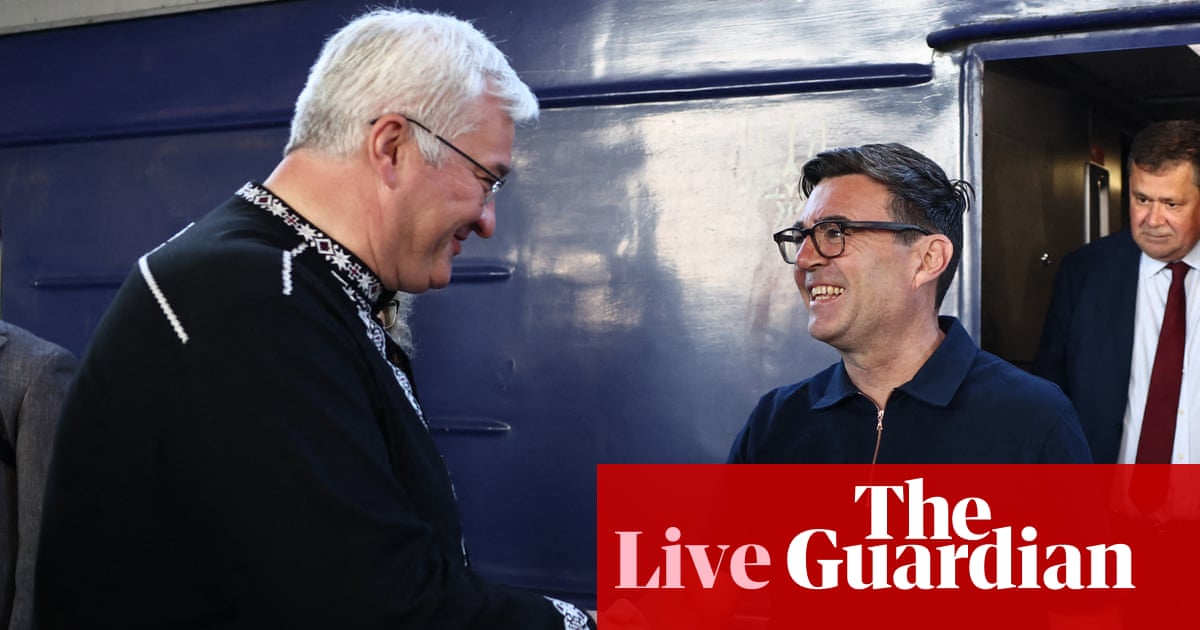
UK PM Andy Burnham landed in Kyiv on Ukraine's 35th Independence Day, announcing plans to declassify UK missile components to help Ukraine build its own Storm Shadow/Scalp variants, while the EU approved €6.1bn in fresh military aid. The visit coincides with 1,643 days of full-scale war and a Coalition of the Willing summit chaired by Burnham.
The UK prime minister went to Ukraine on its big birthday and said the UK will help Ukraine learn how to build its own super-long missiles, the kind that can hit faraway targets. Other European countries also promised a lot of money to help Ukraine defend itself against Russia.
Analysis
MBDA and the Storm Shadow/Scalp blueprint
The most concrete announcement from Burnham's Kyiv visit is the UK government's decision to allow MBDA, the European defence company, to declassify information about UK-made components of the Anglo-French Storm Shadow/Scalp long-range missile so that Ukraine can build its own version. According to the Guardian's live blog, this represents "a major boost to the country's capacity in weapons development at a crucial time in the war." The significance lies less in the immediate transfer of hardware and more in the transfer of know-how: production capacity inside Ukraine would reduce dependence on delivery schedules from Paris and London, and insulate at least part of Kyiv's deep-strike capability from the kind of political hesitation that has periodically constrained allied arms deliveries since 2022. MBDA is jointly owned by Airbus, BAE Systems, and Leonardo, meaning the declassification decision effectively unlocks intellectual property held across three of Europe's largest defence primes.
The €6.1bn EU aid package
Hours before Burnham's arrival, European Commission president Ursula von der Leyen announced on X that the EU had approved €6.1bn (around $7.1bn) in military assistance for Ukraine, earmarked for "air and missile defence systems, missiles, ammunition and radars." The framing — "Europe stands with you today, tomorrow, and for as long as it takes" — is deliberately timed to coincide with Independence Day messaging and the Coalition of the Willing meeting that Burnham is chairing. €6.1bn is a sizable tranche by recent EU standards, and its explicit concentration on air and missile defence addresses the category of capability that has been most visibly under strain as Russia has stepped up long-range strikes on Ukrainian cities and energy infrastructure over the past year.
1,643 days of full-scale invasion
The Guardian's framing of Burnham's visit lands on a stark milestone: "the 35th anniversary of Ukraine's Independence Day, a holiday that understandably means so much more during the 1,643 days of the full-scale Russian invasion – and counting." Zelenskyy's own address leaned into that arithmetic, telling Ukrainians that "as long as the enemy does not break this circle of ours, Ukraine will not fall" and taunting Putin directly: "Putin hopes that we are tired. But we know that he is mortal. He never understood us. Now he will not have time to." His pointed line about Russians "standing in lines for gasoline" points to a campaign of strikes on Russian oil refining that Kyiv has visibly escalated. Against that backdrop, the convergence of a UK prime minister, the European Council president, and the leaders of Luxembourg, Moldova, and Estonia in Kyiv on the same day reads less as a routine diplomatic visit than as a coordinated show of resolve at a moment when the war's industrial and energy dimensions are visibly shifting.
Key points
- UK PM Andy Burnham arrived in Kyiv on the 35th anniversary of Ukraine's Independence Day, joined by European Council president António Costa and the leaders of Luxembourg, Moldova, and Estonia.
- Burnham plans to allow MBDA to declassify UK components of the Storm Shadow/Scalp missile so Ukraine can build its own long-range variant.
- The EU approved €6.1bn (around $7.1bn) in military aid for Ukraine, focused on air and missile defence systems, missiles, ammunition, and radars.
- Burnham is set to chair his first meeting of the Coalition of the Willing during the visit.
- Zelenskyy used his Independence Day address to push for more allied support, telling European leaders Ukraine is "not asking you to fight for us" but to provide the means to end the war, now in its 1,643rd day.
If implemented as described, the MBDA declassification could give Ukraine a sovereign production line for Storm Shadow-class missiles, reducing its reliance on allied delivery schedules and adding a long-range strike option that has proven difficult to scale. Combined with the €6.1bn EU aid tranche, the package strengthens Kyiv's position in any future negotiation by demonstrating that allied industrial support, not just rhetoric, is still expanding.
Sharing missile blueprints is a politically sensitive step that Russia is likely to frame as NATO escalation, potentially inviting retaliatory strikes or accelerated production of counter-systems. Implementation risk is also real: transferring advanced manufacturing know-how takes months or years, and the aid may not arrive quickly enough to affect the frontline situation before winter. Domestic political backlashes in any of the contributing European capitals could also complicate the long-term execution of the program.