Another ‘DeepSeek moment’? Huawei milestone alters China trajectory in chip race: analysts
Huawei unveiled a chip workaround it says could narrow China’s gap with leading semiconductors and weaken U.S. export-control leverage.
Intelligence analysis by GPT-5.4 Mini
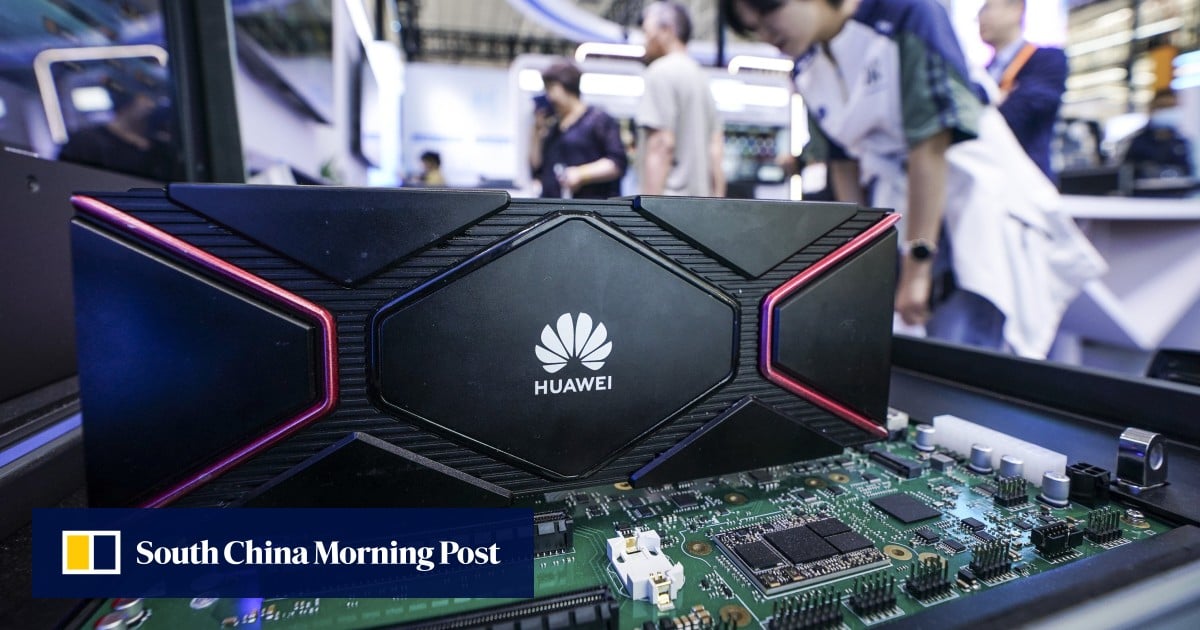
Huawei’s new Tau Scaling Law is being cast as a major step toward China’s chip self-reliance. Analysts say it could reduce the impact of U.S. sanctions if the approach works in practice.
Huawei says it found a new way to make computer chips better without needing a special machine that the U.S. has blocked it from buying. That matters because chips are like the engines inside phones and AI systems.
If the idea works, China could make stronger chips on its own. It would be a bit like finding a new road around a closed bridge.
The story says experts think this could reduce U.S. pressure, but they also warn it still needs to work in real life before anyone knows how big the change really is.
Analysis
What Huawei announced
Huawei introduced a new Tau (τ) Scaling Law, which it says creates a path to transistor density equivalent to a 1.4-nanometre process in high-end chips by 2031. The company is presenting it as an architectural workaround designed to reduce reliance on the most advanced manufacturing tools blocked by U.S. sanctions.
Why analysts think it matters
Analysts quoted in the story describe the move as a significant step toward China’s semiconductor self-sufficiency. Gary Ng of Natixis said the U.S. would have less leverage over export controls as China becomes more self-sufficient, while also warning that the claim still needs to be tested in practice.
The key constraint Huawei is trying to sidestep is access to EUV lithography machines. Those tools are central to making chips at 3nm and below, and U.S.-led sanctions have kept them out of China’s reach. Huawei’s pitch is that its new trajectory could avoid that bottleneck.
AI and chip implications
The company says the new law is aimed at boosting performance in both smartphone chips and AI computing systems. If the method works, it could improve the supply side of China’s AI stack by giving domestic firms a route to more advanced compute without depending on the most restricted foreign equipment.
The article frames the announcement as a possible inflection point for China’s broader tech strategy. For now, though, it remains a claim about future capability, not a proven manufacturing result.
Key points
- Huawei unveiled a new Tau Scaling Law as a workaround to U.S. chip sanctions.
- The company says it could reach transistor density equivalent to 1.4nm by 2031.
- Analysts say the move could improve China’s semiconductor self-reliance.
- The approach is meant to reduce dependence on EUV lithography machines.
- Experts caution the claim still needs to be proven in practice.