Asian stocks stutters after rout, Fed leaves markets guessing on rates
Asian stocks struggled for direction in choppy trading on Thursday after a week of market turbulence sparked by artificial intelligence jitters, as a divided Federal Reserve stood pat on rates and left bond markets uncertain about the next move.
Intelligence analysis by Llama
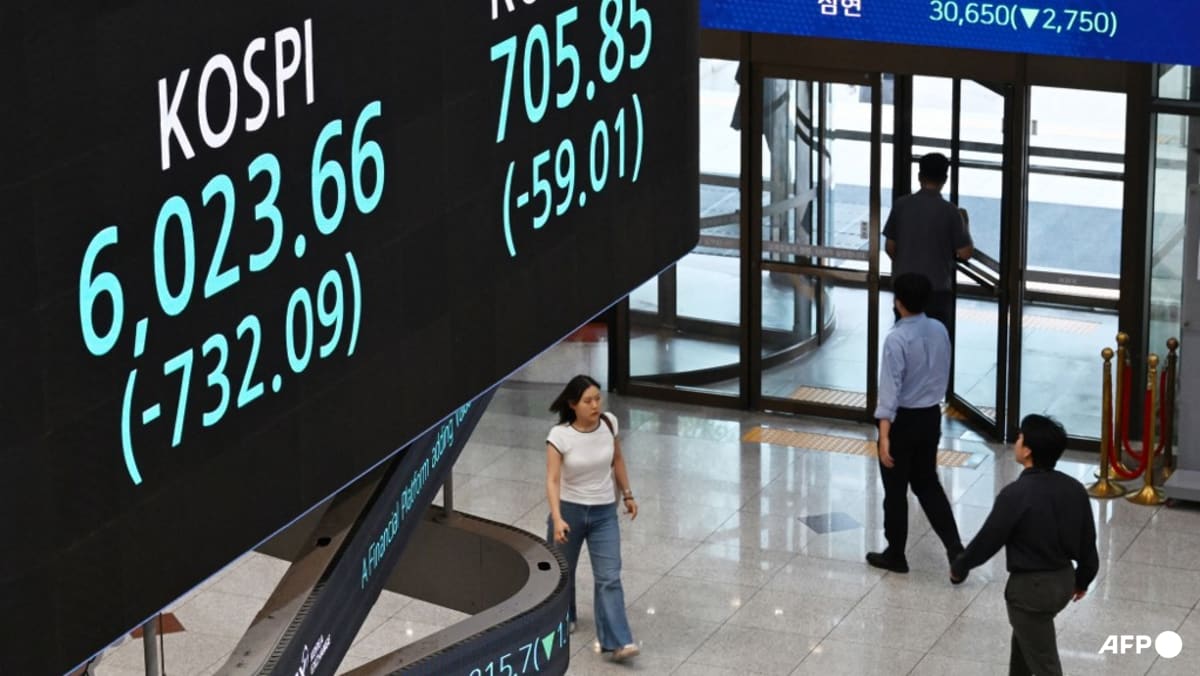
Asian stocks struggled for direction in choppy trading on Thursday after a week of market turbulence sparked by artificial intelligence jitters, as a divided Federal Reserve stood pat on rates and left bond markets uncertain about the next move.
Imagine you're playing a game where the rules keep changing. That's what's happening in the stock market right now. Some people are worried about a new technology called AI, which is making it hard for companies to make money. This is causing the stock market to go up and down a lot, and it's making it hard for people to know what to do.
Analysis
A Week of Market Turbulence
Asian stocks struggled for direction in choppy trading on Thursday after a week of market turbulence sparked by artificial intelligence jitters, as a divided Federal Reserve stood pat on rates and left bond markets uncertain about the next move. The market volatility has been driven by concerns over the impact of AI on the economy, as well as the sharp steepening of the Treasury yield curve and growing tensions in the Middle East.
The Fed's Decision
The Federal Reserve's decision to hold rates steady has left investors confused about the next move. Fed Chair Kevin Warsh vowed to contain inflation but gave no indication of the steps the central bank might take. The split decision has led to a rise in yields on longer-dated US Treasuries to 19-year highs.
The Impact on Asian Markets
The market turbulence has had a significant impact on Asian markets, with the KOSPI down 0.6 per cent in choppy trading, on track for a 15 per cent weekly slump. The MSCI's broadest index of Asia-Pacific shares outside Japan was flat after swinging wildly between gains and losses. Japan's Nikkei was 1.2 per cent higher, but set for a 3.7 per cent drop in the week.
The Role of AI
The sharp selloff in South Korean equities has heightened investor anxiety over the payoff from huge AI investments. Asian chipmakers have been at the centre of attention this week, with concerns over the impact of AI on the semiconductor industry. The rollout of single-stock leveraged ETFs has also led to market-stabilisation measures.
The Road Ahead
The market volatility is likely to continue in the near term, with uncertainty about US monetary policy and the sharp steepening of the Treasury yield curve. Investors will be closely watching the developments in the Middle East and the impact of AI on the economy. The fundamental thesis remains intact, but there appears to be an irrational, panic-like element to the current selling.
Key points
- Asian stocks struggled for direction in choppy trading on Thursday after a week of market turbulence sparked by artificial intelligence jitters.
- A divided Federal Reserve stood pat on rates and left bond markets uncertain about the next move.
- The market volatility has been driven by concerns over the impact of AI on the economy, as well as the sharp steepening of the Treasury yield curve and growing tensions in the Middle East.
- The rollout of single-stock leveraged ETFs has led to market-stabilisation measures.
- The fundamental thesis remains intact, but there appears to be an irrational, panic-like element to the current selling.
If the market turbulence subsides and investors regain confidence, Asian stocks could see a rebound in the coming weeks. The fundamentals of the economy remain strong, and the tech sector is expected to continue growing.
However, if the concerns over AI and the sharp steepening of the Treasury yield curve persist, the market volatility could continue, leading to further losses for investors.