Bachelet-led panel urges Latin America not to choose sides in US-China rivalry
A high-level commission co-chaired by former Chilean president Michelle Bachelet and former Colombian president Ivan Duque urges Latin American countries to resist pressure to choose between the United States and China, and to use their vast reserves of lithium, copper, a…
Intelligence analysis by Llama
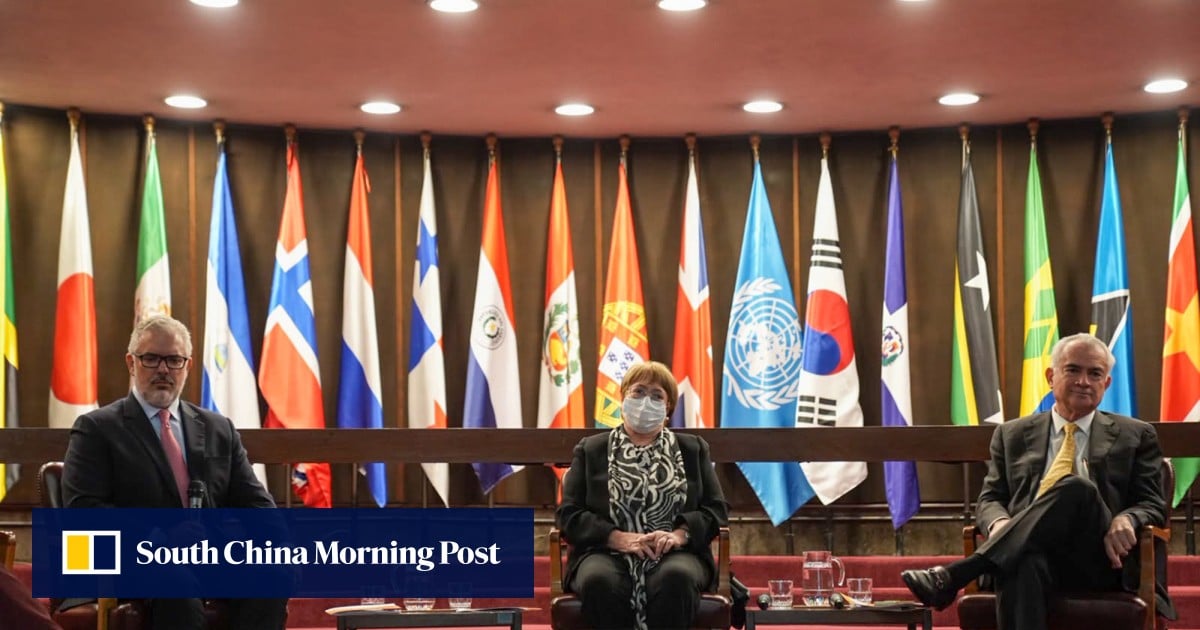
A Bachelet-led panel advises Latin America to maintain its independence in the face of US-China rivalry, leveraging its critical minerals to negotiate with both powers.
Imagine you're a country in Latin America, and you have a lot of valuable resources like lithium and copper. A group of smart people, led by Michelle Bachelet and Ivan Duque, are saying that you should use these resources to be friends with both the US and China, but on your own terms. This way, you can get the best deals and stay independent, rather than being forced to choose between two big powers.
Analysis
A New Era of Geopolitical Flexibility
The report released by the UN Economic Commission for Latin America and the Caribbean, co-chaired by Michelle Bachelet and Ivan Duque, marks a significant shift in the region's approach to global politics. By urging Latin American countries to resist pressure to choose between the US and China, the panel acknowledges the region's unique position in the face of intensifying competition among global powers.
The Value of Strategic Resources
The report highlights the region's vast reserves of lithium, copper, and other strategic resources as a key factor in its newfound leverage. As the world becomes increasingly dependent on these resources, Latin America has gained a bargaining chip in its negotiations with both the US and China. By diversifying its trade and investment, the region can strengthen its negotiating power and maintain its independence in the face of growing rivalry.
The Limits of Security Dominance
While the report acknowledges the region's growing influence, it also recognizes the limits imposed by US security dominance. In areas such as technology and critical infrastructure, Washington remains a dominant player, and the region's room for manoeuvre is sharply constrained. However, the panel argues that countries can work with different partners on different issues, maintaining security relationships with Washington while diversifying trade and investment towards China and other economies.
A Geopolitical Vision of Its Own
The report's recommendations are grounded in a vision of Latin America as a region with its own unique strengths and weaknesses. By embracing its independence and leveraging its strategic resources, the region can forge its own path in the face of growing global competition. As Duque noted, Latin America needs a 'geopolitical vision of our own, not dictated to us'. By taking control of its own destiny, the region can ensure its continued growth and prosperity in an increasingly complex and competitive world.
Key points
- A high-level commission co-chaired by Michelle Bachelet and Ivan Duque urges Latin American countries to resist pressure to choose between the US and China.
- The region should leverage its critical minerals to strengthen its negotiating power and maintain its independence.
- Countries can work with different partners on different issues, maintaining security relationships with Washington while diversifying trade and investment towards China and other economies.
If Latin America can successfully leverage its strategic resources and maintain its independence, the region could experience significant economic growth and increased influence on the global stage.
However, the region's room for manoeuvre is sharply constrained by US security dominance, and the panel's recommendations may be difficult to implement in practice.