Beijing decries ‘bullying’ US tech curbs that ensnare Chinese firms and products
Beijing has condemned the US's expanded 'Covered List' which now restricts Chinese-made power inverters and advanced robotics, calling it 'unilateral bullying' that distorts market rules.
Intelligence analysis by Gemini 2.5 Flash
China's state media, People's Daily, criticized Washington's latest tech curbs, which bar new models of foreign-made power inverters and advanced robotics from receiving FCC authorization. Beijing views these measures, framed by the US as national security concerns, as discriminatory suppression targeting Chinese firms and products.
Imagine two big kids, the US and China, are playing with cool new toys like robots and special power boxes. The US kid is worried that China's toys might have secret tricks, so they've made a list of toys from China that aren't allowed in their playground. China thinks this is unfair and mean, like bullying, because they believe their toys are good and follow the rules. This makes it harder for China to sell its toys and for the US to get them, causing a big argument over who gets to make and use the best new gadgets.
Analysis
Washington's Expanding Tech Front
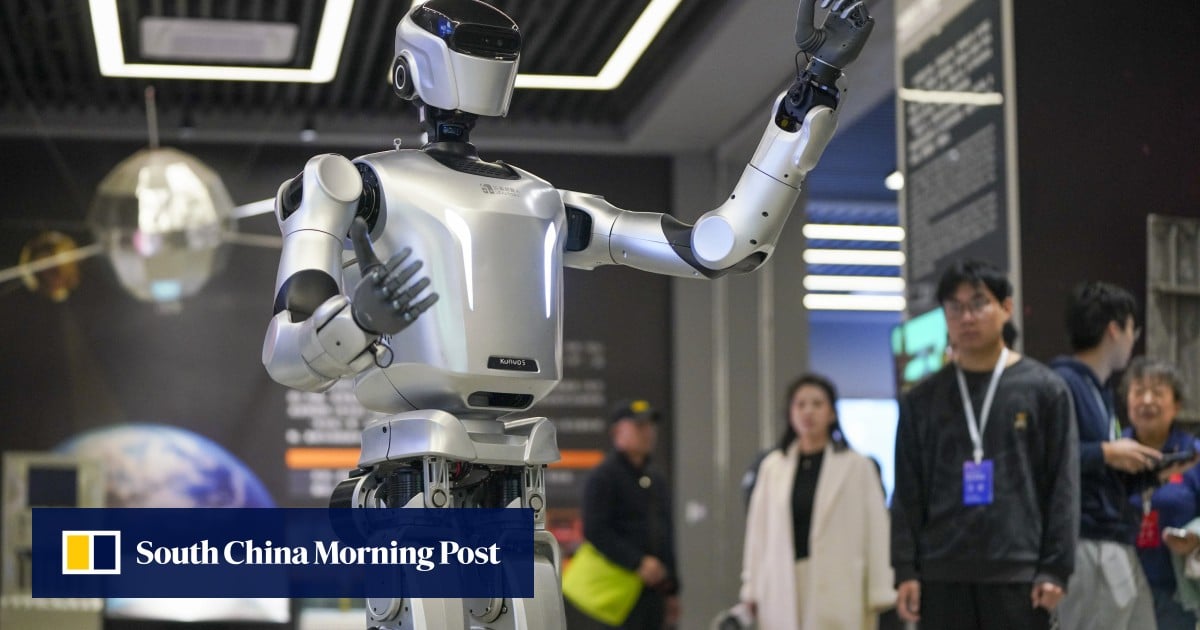
The United States, through its Federal Communications Commission (FCC), has significantly broadened its "Covered List," a regulatory tool designed to restrict Chinese technology. Initially targeting telecommunications and video surveillance, the list now includes foreign-made power inverters and advanced robotics, such as humanoids. This expansion signals a deliberate strategy by Washington to extend its technological containment efforts beyond traditional security concerns into emerging sectors like green energy and advanced manufacturing. The move directly impacts Chinese firms, which dominate global markets in these areas, with China supplying approximately one-third of US power inverter imports in 2024 and over 80% of global robot shipments in 2025.
This policy, while framed by the US under "non-discrimination" or "national security" banners, is perceived by Beijing as a direct assault on its industrial capabilities. The inclusion of green energy components highlights a growing concern in Washington over China's dominance in critical supply chains, even those vital for climate initiatives. By restricting access to the US market for these products, the FCC aims to curb the growth and influence of Chinese tech giants and potentially foster domestic alternatives, albeit at the cost of increased trade friction and potential supply chain disruptions.
Beijing's Decisive Rebuttal
China's ruling Communist Party, through its mouthpiece People's Daily, has vehemently condemned the US actions, labeling them "unilateral bullying that blatantly distorts market-economy rules and principles of fair competition." Beijing argues that these measures are discriminatory suppression specifically aimed at Chinese firms and products, despite the FCC not explicitly naming China. This strong language underscores China's frustration with what it views as an unfair weaponization of regulatory power to stifle its economic and technological ascent.
The commentary from People's Daily also urged Washington to shift its approach from restriction to cooperation, advocating for an expansion of collaborative lists rather than the prohibitive "Covered List." This stance reflects China's desire to maintain access to global markets and technology flows, even as it simultaneously pushes for greater self-reliance in critical technologies. Beijing's defense of its open-source AI models, mentioned in the article's sub-headline, further illustrates its commitment to fostering its own tech ecosystem while navigating international pressures.
Escalating Stakes in Global Tech Rivalry
The latest US tech curbs represent a significant escalation in the ongoing technological rivalry between the two global powers. By targeting sectors like green energy and advanced robotics, Washington is not only addressing immediate national security concerns but also attempting to shape the future landscape of critical industries. This strategy risks fragmenting global supply chains and creating parallel technological ecosystems, potentially leading to higher costs and reduced innovation globally. The "bullying" accusation from Beijing suggests a hardening of positions, making de-escalation more challenging.
The long-term implications include increased pressure on Chinese firms to innovate domestically and reduce reliance on foreign components, potentially accelerating China's drive for technological self-sufficiency. Conversely, US companies and consumers might face higher prices or limited choices as they seek alternatives to cost-effective Chinese products. This tit-for-tat dynamic could lead to a more entrenched tech cold war, impacting global trade, investment, and the pace of technological advancement across various sectors. The dispute highlights the complex interplay of economic competition, national security, and geopolitical influence in the 21st century.
Key points
- The US Federal Communications Commission (FCC) expanded its 'Covered List' to include foreign-made power inverters and advanced robotics.
- Beijing's state mouthpiece, People's Daily, decried these US actions as 'unilateral bullying' and 'discriminatory suppression' against Chinese firms.
- China argues the US measures distort market-economy rules and principles of fair competition, despite being framed as national security concerns.
- Chinese manufacturers are significantly impacted, as they account for a large share of global power inverter and robot exports.
- Beijing urged Washington to expand cooperation rather than add to restrictive lists, highlighting the ongoing tech rivalry.
The expansion of US tech curbs risks further escalating trade tensions and accelerating a technological decoupling between the two global powers. This could lead to fragmented global supply chains, higher costs for consumers, and stifle innovation as companies are forced to choose sides or develop parallel systems.