BMA participates in international border management platform
South Africa's Border Management Authority (BMA) Commissioner, Dr. Michael Masiapato, is attending an international forum in China to discuss digitisation and integrated border management, sharing South Africa's experiences and seeking cooperation.
Intelligence analysis by Gemini 2.5 Flash
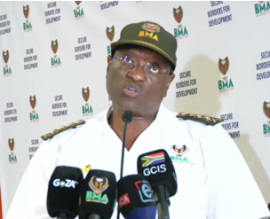
Dr. Michael Masiapato of South Africa's BMA will present on the criticality of digitisation in integrated border management at a global security conference in China. The forum aims to foster international cooperation, share best practices, and explore technological advancements to address complex migration and border security challenges.
Imagine South Africa's border boss is going to a big meeting in China to talk about how to make our country's gates super smart, like using computers to check people and goods quickly and safely. They want to share how South Africa uses technology and also learn cool new tricks from other countries, so everyone can travel and trade more easily and securely, just like a super-efficient airport security line.
Analysis
South Africa's Border Management Authority (BMA) is actively engaging on the global stage to advance its strategies for integrated border management, with a particular focus on leveraging technology. The participation of BMA Commissioner Dr. Michael Masiapato at the Sub-Forum on Migration Management Cooperation in China underscores a strategic move to both share South Africa's progress and absorb international best practices. This engagement is framed as essential for addressing the increasingly complex and evolving challenges associated with migration and border security in a globally interconnected world.
Dr Michael Masiapato
Dr. Michael Masiapato's role at the Sub-Forum is pivotal, as he is slated to deliver a presentation titled “The Criticality of Digitisation in the Implementation of an Integrated Border Management Model.” This presentation will highlight South Africa's practical experiences and advancements in using digital systems to enhance border management. His focus is not merely on technological adoption but also on the importance of an integrated approach that balances security imperatives with the facilitation of legitimate travel and trade.
Beyond showcasing South Africa's achievements, Dr. Masiapato's attendance is also an opportunity for the BMA to learn from its international counterparts. The Commissioner emphasized that modern border management necessitates countries working collaboratively, sharing vital information, and harnessing technology to secure borders while ensuring the smooth movement of people and goods. This reciprocal exchange of knowledge is expected to inform the BMA's future operational and strategic planning.
Lianyungang
The Sub-Forum, hosted in Lianyungang, Jiangsu Province, People’s Republic of China, serves as a critical platform for international dialogue. Held under the theme “Unity, Mutual Trust and Practical Cooperation: Forging a New Landscape for Global Immigration Governance,” it brings together global experts to strengthen cooperation on migration management and border security. The choice of location and the theme itself highlight a collective recognition of the need for coordinated global responses to shared security challenges.
This gathering in Lianyungang is designed to facilitate practical cooperation, allowing countries to explore innovative approaches to complex border issues. For the BMA, it represents a significant first step towards building stronger communication channels and fostering practical collaboration with entities like the National Immigration Administration of the People’s Republic of China. The aim is to forge meaningful, long-term partnerships in areas such as digitisation, immigration governance, skills development, and technical expertise exchange.
Border Management Academy
A key long-term aspiration for the BMA, potentially informed by this international engagement, is the establishment of a Border Management Academy in South Africa. The delegation's visit includes a stopover at the China People’s Police University, an institution renowned for its expertise in border management, security, and travel document verification. This visit is intended to provide the BMA with insights into the university’s institutional arrangements, training programmes, and specialised capabilities.
The insights gained from the China People’s Police University could be instrumental in shaping the curriculum and operational framework of a future South African academy. Such an institution would be crucial for strengthening the professional development and specialised training of immigration and border management officials within South Africa, potentially serving as a regional hub for expertise. This initiative underscores the BMA's commitment to continuous improvement and professionalization in the critical field of border security.
Key points
- BMA Commissioner Dr. Michael Masiapato to attend Sub-Forum on Migration Management Cooperation in China.
- South Africa will showcase its experience in using digitisation for integrated border management.
- The forum aims to strengthen dialogue, share best practices, and explore cooperation on migration and border security.
- BMA seeks to learn from international counterparts and establish long-term partnerships.
- The visit includes exploring the China People’s Police University and informing plans for a South African Border Management Academy.
South Africa's participation could lead to enhanced border security, more efficient trade, and improved migration management through international collaboration and the adoption of advanced digital technologies. The potential establishment of a Border Management Academy could also professionalize the field domestically and regionally, fostering a new generation of skilled officials.
While the forum aims for cooperation, practical implementation of shared strategies can be challenging due to differing national priorities, resource constraints, and the complex nature of cross-border challenges. The success of digitisation also depends on robust infrastructure and cybersecurity, which may face hurdles in various contexts.