BTC price risks $80K loss into FOMC, earnings: Three things to know in Bitcoin this week
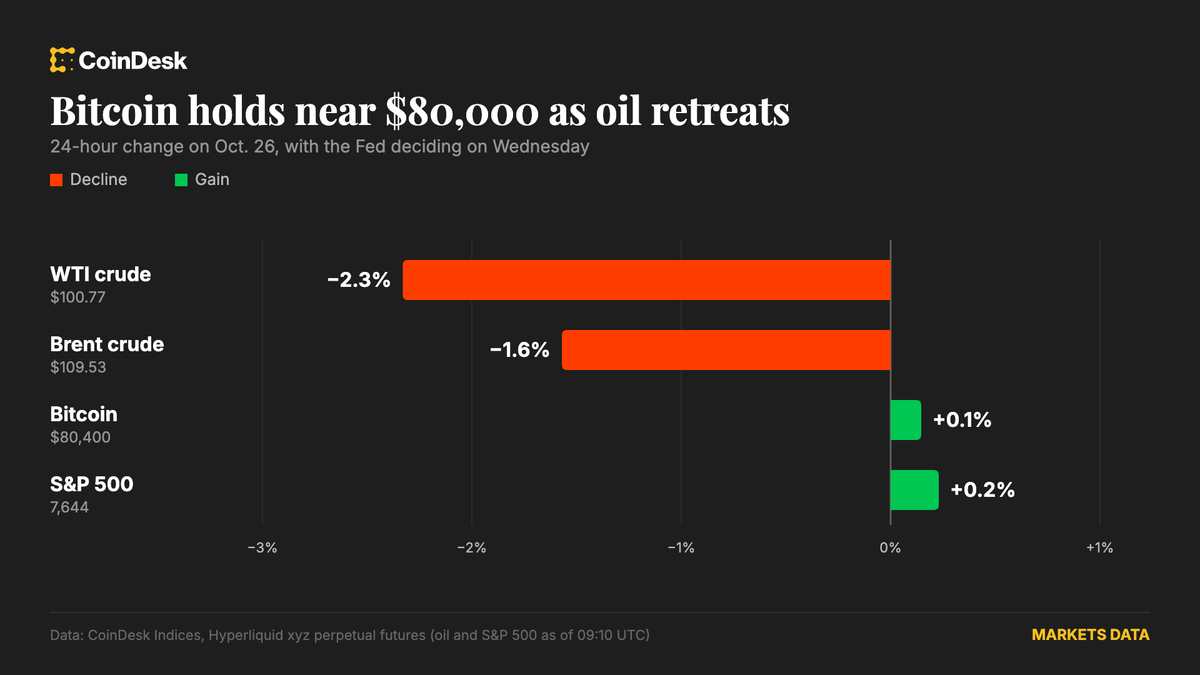
Bitcoin is struggling to maintain $80,000 support as markets anticipate a busy week of US macro data, including the Federal Open Market Committee (FOMC) meeting and major tech earnings reports.
Intelligence analysis by Gemini 2.5 Flash

Bitcoin faces potential losses, mirroring last year's 'Red October' trend, as investors brace for the Federal Reserve's interest rate decision, key inflation data, and a wave of corporate earnings from major US tech companies. The confluence of these macro events is putting pressure on risk assets, including cryptocurrencies and equities.
Imagine Bitcoin is like a popular toy, and its price usually goes up a lot in October, like a special 'Uptober' sale. But this year, and last year too, the toy's price isn't going up; it's actually going down a bit. This is happening because grown-ups are watching big news about how much money companies are making and what the central bank will do with borrowing costs, which makes them a bit nervous about buying risky things like our toy.
Analysis
Bitcoin's current market position is precarious, with the cryptocurrency fighting to hold the $80,000 support level amidst a confluence of significant macroeconomic events. The week's agenda includes critical US Federal Reserve decisions, inflation data, and a substantial round of corporate earnings, all of which are poised to influence investor sentiment across traditional and digital asset markets.
Federal Open Market Committee
This week, the US Federal Reserve's Federal Open Market Committee (FOMC) meeting is a central focus for macro analysts. Markets are largely anticipating that the Fed will maintain interest rates within their current 3.75-4% range, with over 90% odds favoring a pause. Economist Robin Brooks noted that this expectation provides a temporary reprieve for Fed chair Kevin Warsh, as external pressures for a rate hike have diminished compared to earlier in the year. Despite rising oil prices and geopolitical concerns in the Middle East, Brooks suggests that financial conditions are already tightening, making a rate hike unlikely to be considered by the Fed.
Beyond the rate decision, the Personal Consumption Expenditures (PCE) index, the Fed's preferred inflation gauge, is also due for release. Last month's PCE came in lower than expected at 3.4% year-on-year, though analysts attributed this to changes in calculation methods rather than a fundamental shift in inflationary pressures. The Fed's language at the accompanying press conference will be closely scrutinized for any hints regarding future monetary policy, particularly concerning a potential 0.25% hike at the December FOMC meeting, which FedWatch data currently indicates as a consensus.
KOSPI Composite Index
Equities markets are showing signs of stress, particularly in the tech sector, ahead of a major week for US corporate earnings. South Korea’s KOSPI Composite Index, a bellwether for Asian markets, closed down 1.5% on Monday, reaching levels not seen since late July. This decline follows significant tech-stock selling as foreign capital sought safer havens, and stronger-than-expected US earnings reports last week failed to lift overall market mood, with attention drawn to reduced capital expenditure from companies like Tesla.
The Nasdaq Composite Index also closed at its lowest daily level since early August, reflecting broader concerns about the AI sector. JPMorgan Asset Management’s Raisah Rasid commented that investors are now prioritizing return on capital over capital expenditure in the AI space, suggesting a shift in market valuation metrics. This week will see earnings reports from major tech giants including Microsoft, Alphabet, Amazon, and Intel, alongside the release of US Q3 GDP numbers. These reports will be critical in shaping market sentiment and could further impact equity performance, with around 20% of S&P 500 companies scheduled to report.
Uptober
Bitcoin's performance in October has defied its historical trend, commonly known as 'Uptober,' where the cryptocurrency typically sees significant gains. Data from CoinGlass indicates that since 2010, the average October upside for BTC/USD has been 26.1%. However, both this year and last, Bitcoin has bucked this trend, currently on track to end October down 4% if it closes near the $80,000 mark. This follows a 3.9% drop in October 2025, which was then succeeded by a substantial 17.5% loss in November, contrasting sharply with historical average November returns of 35%.
The failure of the $80,000 level to provide robust support on lower time frames is a concern for traders, despite its psychological significance. Recent market activity saw almost $150 million in long positions liquidated over a two-hour period on Saturday as Bitcoin briefly fell to $79,145. While CoinGlass shows a significant wall of bids around $79,300, indicating some buying interest, asks are centered around $81,000, suggesting resistance at higher price points. The deviation from historical 'Uptober' patterns highlights the current bearish sentiment and the influence of broader macro pressures on Bitcoin's price trajectory.
Key points
- Bitcoin is struggling to hold $80,000 support amidst upcoming US macro data and earnings reports.
- Markets anticipate the Federal Reserve will pause interest rate hikes at its Wednesday meeting, keeping rates at 3.75-4%.
- South Korea’s KOSPI Composite Index and the Nasdaq Composite have seen declines due to tech sector concerns.
- Bitcoin is on track to end October down 4%, defying its historical 'Uptober' trend of average 26.1% gains.
- Major US tech companies like Microsoft, Alphabet, Amazon, and Intel are set to report Q3 earnings this week.
If the Federal Reserve indeed pauses interest rate hikes, as widely expected, it could alleviate some pressure on risk assets like Bitcoin, potentially preventing further market tightening. Stronger-than-anticipated earnings from major tech companies could also boost overall market confidence, indirectly benefiting cryptocurrencies.
Bitcoin risks further declines if it fails to hold the $80,000 support level, potentially leading to a 'Red November' similar to last year's significant losses. Continued pressure on equities from disappointing tech earnings or hawkish signals from the Fed could exacerbate negative sentiment for digital assets.