Can Nvidia Become a $10 Trillion Stock by 2030?
Nvidia, currently valued at $5 trillion, shows strong potential to double its market capitalization to $10 trillion by 2030, driven by accelerating sales growth in the booming AI chip market.
Intelligence analysis by Gemini 2.5 Flash
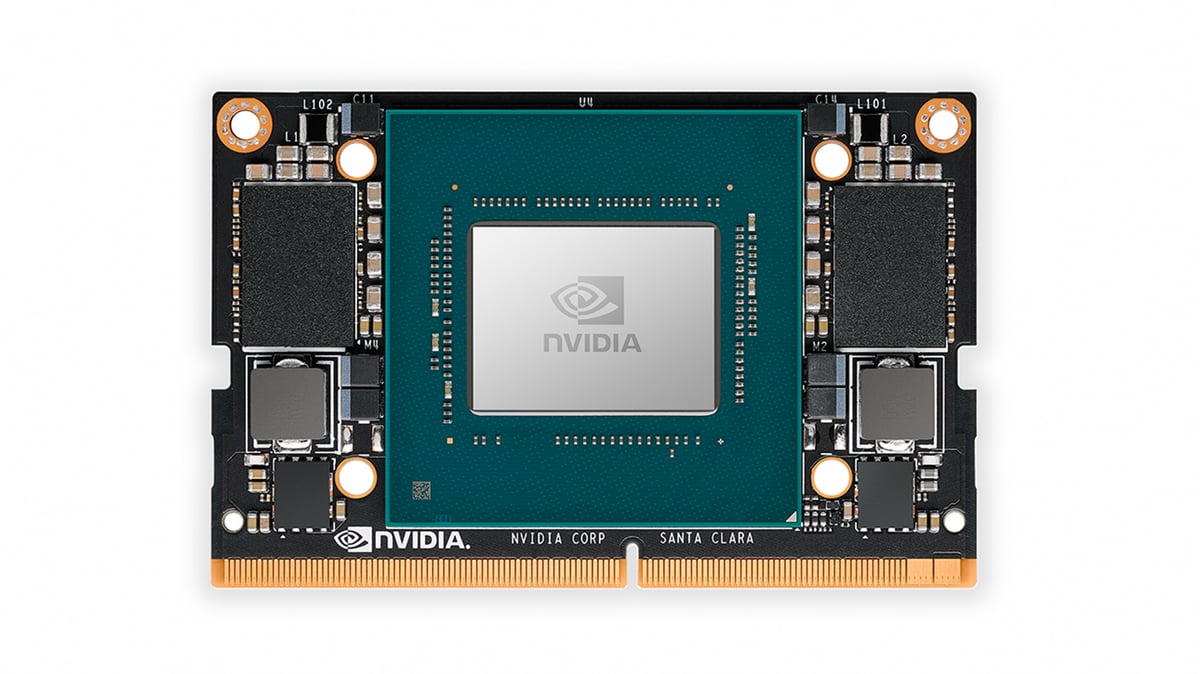
Despite its massive size, Nvidia continues to exhibit accelerating revenue growth, fueled by its dominant position in the artificial intelligence chip sector. Analysts project continued high growth rates, and even with potential valuation adjustments, a path to a $10 trillion market cap within the next six years appears plausible.
Imagine Nvidia is like the company that makes the super-fast brains for all the smart robots and computers that are learning new things, like talking or driving cars. Right now, they're already the biggest brain-maker in the world, worth $5 trillion! The article says they're selling more and more brains really fast, and if they keep growing, even if a little slower, they could be worth $10 trillion by 2030, which is like having twice as many super-fast brains out there.
Analysis
Nvidia's Dominance in AI
Nvidia has firmly established itself as the undisputed leader in the artificial intelligence chip market, commanding an impressive 80% to 90% share, according to Silicon Analysts. This dominance is a significant factor in its accelerating sales growth, with revenue increasing 85% year over year in the 2027 fiscal first quarter. Wall Street anticipates even higher growth, forecasting a 96% increase for the second quarter and 82% for the full year, a remarkable achievement for a company of Nvidia's scale.
The broader AI market is also experiencing rapid expansion, further bolstering Nvidia's prospects. JPMorgan Chase CEO Jamie Dimon projects AI spending to reach $1 trillion by 2027, indicating a massive addressable market for Nvidia's products. Furthermore, Taiwan Semiconductor Manufacturing, a crucial partner in producing Nvidia's chips, is investing $100 billion in a new Arizona facility, signaling robust long-term demand and supply chain commitment. While competitors like Advanced Micro Devices and specialized chips from Broadcom and Alphabet are emerging, Nvidia's CEO Jensen Huang views increased AI development as beneficial, as his company underpins much of the AI infrastructure.
The Growth Trajectory and Valuation Challenge
While Nvidia's current growth rates are exceptional, the article acknowledges that sustaining such acceleration becomes increasingly difficult as the company's revenue base expands. For instance, an 80% compound annual growth rate (CAGR) over the next four years would lead to an astounding $2.7 trillion in sales, making it the largest company globally by revenue. However, a more realistic scenario suggests that growth will likely decelerate over the coming years, and the stock's valuation will adjust accordingly.
Nvidia currently trades at a premium price-to-sales (P/S) ratio of 20. As growth moderates, it is probable that this multiple will also decline. The challenge for Nvidia to reach a $10 trillion valuation by 2030, therefore, involves not just continued revenue expansion but also how the market re-rates its stock in response to evolving growth dynamics. Investors must weigh the company's unparalleled market position against the natural slowdown that accompanies immense scale.
Path to $10 Trillion
The article outlines a plausible scenario for Nvidia to achieve a $10 trillion market capitalization by 2030. This projection hinges on the company maintaining a compound annual growth rate of 40% to 50% over the next four years, which would result in approximately $1 trillion in sales by 2030. This sales figure represents about four times today's trailing-12-month revenue, demonstrating significant, albeit decelerated, expansion.
Crucially, reaching the $10 trillion valuation also depends on a recalibration of its P/S ratio. If Nvidia were to achieve $1 trillion in sales by 2030 and its P/S ratio were to halve from its current 20 to 10, the stock's value would effectively double, leading to the $10 trillion market cap. This scenario, while rooted in realistic growth and valuation adjustments, highlights the dual factors of sustained revenue growth and market multiple stability that will determine Nvidia's ultimate valuation trajectory.
Key points
- Nvidia is currently the world's most valuable company with a $5 trillion market capitalization.
- The company's sales growth is accelerating, with revenue up 85% year over year in Q1 2027 and forecasts for higher growth.
- Nvidia holds 80% to 90% of the AI chip market, a dominant position despite emerging competition.
- A scenario for reaching $10 trillion by 2030 involves 40% to 50% compound annual growth and a halving of its price-to-sales ratio.
- JPMorgan Chase CEO Jamie Dimon predicts AI spending will reach $1 trillion in 2027.
Nvidia's continued dominance in the rapidly expanding AI chip market, coupled with accelerating sales growth, positions it strongly for significant future appreciation. If AI spending reaches projected levels and Nvidia maintains its market share, its revenue growth could continue to surprise, driving its valuation higher.
The primary risk lies in the inevitable deceleration of growth as Nvidia's revenue base becomes larger, potentially leading to a contraction in its premium price-to-sales ratio. Increased competition from other chipmakers could also erode its market share, making the path to a $10 trillion valuation more challenging.
Market signals
- NVDA The article projects Nvidia could reach a $10 trillion valuation by 2030, driven by continued dominance in the accelerating AI chip market.
AI-generated analysis of potential market relevance. Not financial advice.