Carney pushes idea of making Canada an ‘associate member’ of the EU: reports
Canada's Prime Minister Mark Carney is reportedly exploring an "associate member" status with the European Union amid an escalating trade dispute with the United States.
Intelligence analysis by Gemini 2.5 Flash
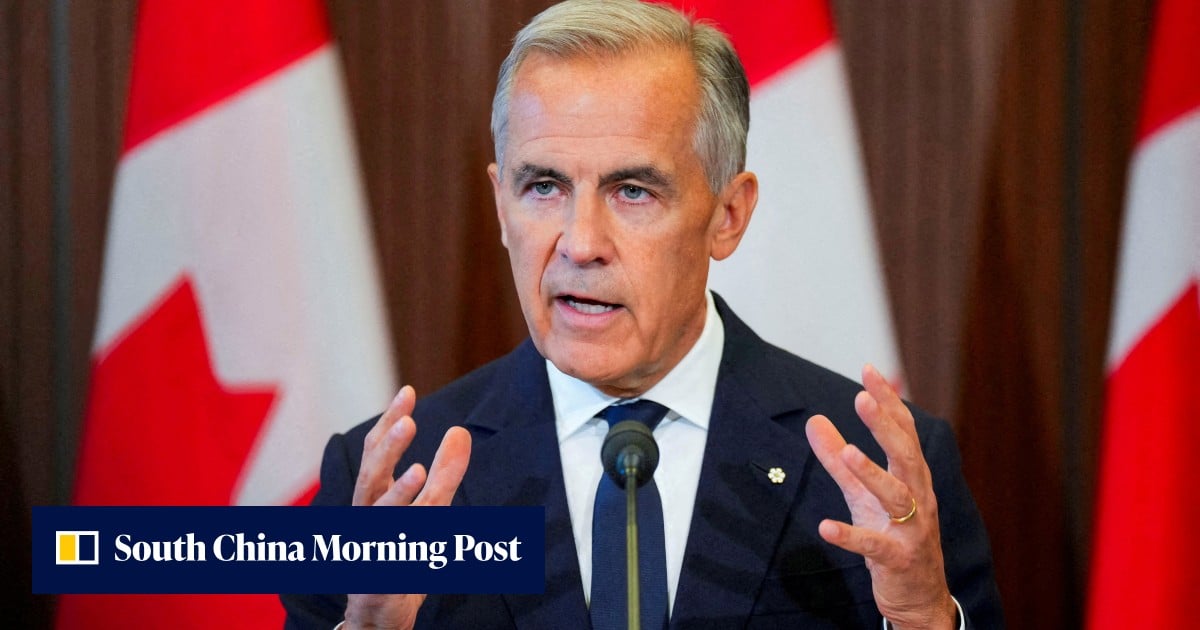
Reports indicate that Canadian Prime Minister Mark Carney is seeking a closer relationship with the European Union, including a potential new 'associate member' status, to mitigate the impact of a growing trade war with the US. Discussions involve free movement of goods, services, and workers in strategic supply chains, as well as joint infrastructure projects.
Imagine Canada and its big neighbor, the United States, are like two friends who used to play together all the time, but now they're having a big argument over toys and sharing. So, Canada's leader, Mark Carney, is looking for a new playmate, the European Union, to share toys and build cool stuff like secret clubhouses (data centers) and special paths (underwater cables). This way, Canada won't have to rely so much on its old friend if they keep arguing.
Analysis
The reported initiative by Canadian Prime Minister Mark Carney to pursue an 'associate member' status with the European Union marks a notable strategic pivot in global trade relations. This move is largely driven by Canada's deteriorating trade relationship with the United States, particularly since President Donald Trump's return to the White House. The ongoing trade dispute has resulted in tariffs impacting tens of billions of dollars in cross-border trade, compelling Canada to seek more stable and diversified economic partnerships.
Mark Carney
Prime Minister Mark Carney's administration is actively exploring innovative ways to deepen Canada's ties with the European Union. This includes discussions around a novel 'associate member' status, a concept the EU has reportedly shown openness to despite its historically rigid membership rules. Carney's push reflects a broader strategy to secure Canada's economic future by reducing reliance on its southern neighbor and fostering new avenues for trade and cooperation. The initiative underscores a proactive approach to foreign policy aimed at safeguarding national interests amidst geopolitical shifts.
The Canadian government's engagement with EU leaders, including France's Macron, highlights the high-level commitment to this strategic reorientation. The proposed associate membership would facilitate the free movement of Canadian goods, services, and workers within strategic supply chains, encompassing critical sectors such as energy, artificial intelligence, defence, and critical minerals. This effectively aims to integrate Canada more closely into the EU's economic sphere, creating a more resilient and diversified trade network for the North American nation.
European Union
The European Union's reported receptiveness to creating a new 'associate member' status for Canada indicates a potential evolution in its approach to external relations. While the EU has traditionally maintained strict criteria for full membership, the prospect of a tailored arrangement with a G7 economy like Canada suggests a pragmatic response to changing global dynamics. Such a status could offer a template for future partnerships with other like-minded nations, allowing for deeper integration without the full obligations of membership.
Discussions between Canada and the EU extend beyond trade to include significant infrastructure projects. These include plans for laying underwater cables, jointly constructing data centers, cloud storage facilities, and new satellite networks. Furthermore, there are talks about developing infrastructure to ship Canadian energy resources to the EU. These collaborative efforts underscore a comprehensive vision for a strategic partnership that enhances economic security and technological resilience for both parties, creating a robust transatlantic corridor.
Donald Trump
The return of President Donald Trump to the White House last year is cited as a primary catalyst for Canada's urgent strategic pivot. The re-escalation of trade disagreements and other issues between Ottawa and Washington has led to a sharp deterioration in bilateral relations. Trump's protectionist policies and willingness to impose tariffs have created significant economic uncertainty for Canada, prompting its government to actively seek alternatives to mitigate these risks.
This renewed trade dispute, characterized by tariffs on substantial cross-border trade, has underscored the vulnerability of Canada's economy to US policy shifts. The Canadian government's pursuit of closer ties with the EU is a direct response to this pressure, aiming to build economic resilience and reduce dependence on a volatile relationship. The situation highlights how the domestic political landscape of one major power can significantly influence the foreign policy and trade strategies of its closest allies, driving them to seek new international alignments.
Key points
- Canadian Prime Minister Mark Carney is exploring 'associate member' status with the European Union.
- This initiative is driven by an escalating trade dispute and deteriorating relations between Canada and the United States.
- The proposed status would allow free movement of goods, services, and workers in strategic supply chains like energy, AI, and critical minerals.
- Canada and the EU are discussing joint infrastructure projects, including underwater cables, data centers, and satellite networks.
- The Wall Street Journal reported that the EU is open to creating this new, yet-to-be-defined status.
If successful, Canada's pursuit of associate membership with the EU could significantly diversify its trade relationships and reduce economic vulnerability to US policy shifts. This new status could foster enhanced cooperation in strategic sectors like AI and energy, leading to increased economic stability and growth for Canada and strengthening the EU's global influence.
The EU's historical inflexibility on membership rules means the creation of a new 'associate member' status could face significant internal hurdles and take a long time to materialize. Furthermore, such a move could further strain Canada-US relations, potentially escalating the existing trade war and creating new economic challenges for Canada.
