Cathay Pacific, Google scale up AI tests to reduce aviation’s climate impact
Cathay Pacific and Google are expanding AI-powered flight trials to avoid contrail-forming zones, aiming to reduce aviation's climate impact. Early tests showed a 40% reduction in contrail warming, with new trials focusing on ultra-long-haul routes.
Intelligence analysis by Gemini 2.5 Flash
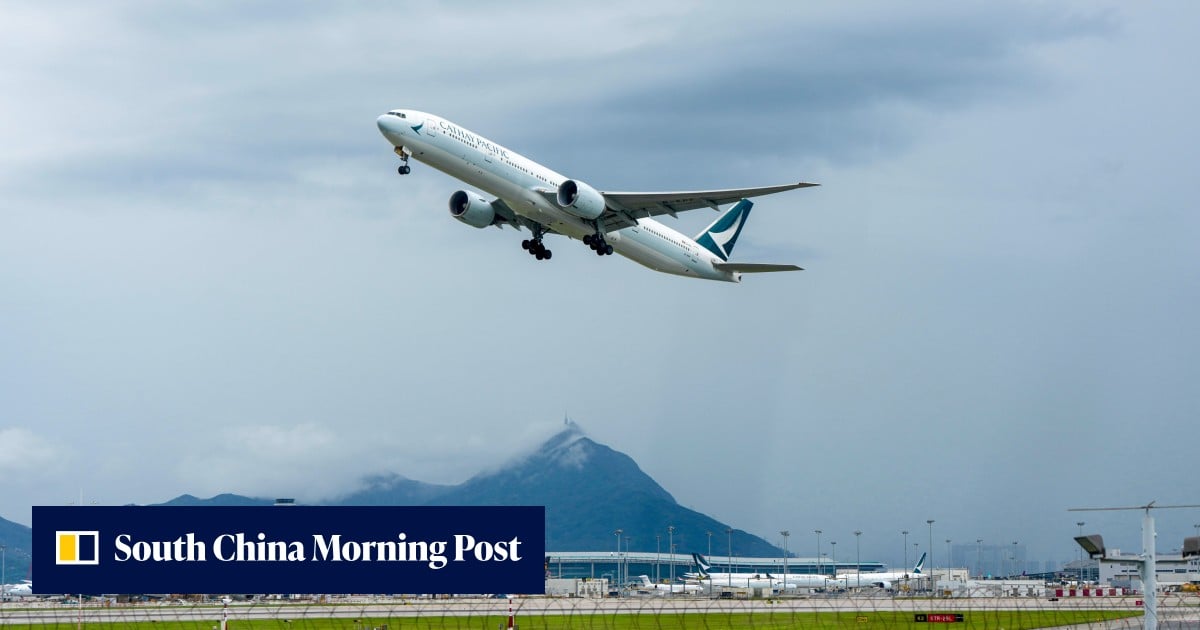
Hong Kong's Cathay Pacific and Google are scaling up their partnership to use artificial intelligence to guide aircraft away from atmospheric conditions that create contrails. These condensation trails are responsible for approximately one-third of aviation's total climate impact, and the expanded trials will target long-haul flights across Asia and transpacific routes.
Imagine airplanes leave white lines in the sky, like drawings. These lines, called contrails, can trap heat and make the Earth warmer, like a blanket. Cathay Pacific and Google are using a smart computer brain, called AI, to help planes fly around the parts of the sky where these lines are most likely to form. It's like using a weather app to find the clearest path, but for avoiding these heat-trapping clouds, so planes can fly without making the world too hot.
Analysis
Contrails.org
The second phase of the AI-powered flight trials, designed to mitigate aviation's climate impact, will involve a partnership with the non-governmental organization Contrails.org. This collaboration is crucial for conducting a randomized controlled trial, a rigorous scientific method to validate the effectiveness and scalability of the contrail avoidance technology.
The focus of these expanded trials will be on ultra-long-haul flights, specifically across Asia and transpacific routes. This particular emphasis is significant because longer flights typically spend more time at altitudes where contrails are likely to form, thus offering a more comprehensive testbed for the AI's predictive capabilities and operational integration.
Kemal Armada
Kemal Armada, Google's product manager for climate and AI, underscored the substantial environmental challenge posed by contrails, stating they account for roughly one-third of aviation's total climate impact. His insights highlight the urgency and potential impact of these trials in addressing a significant contributor to atmospheric warming.
Armada further elaborated on the expansion of the partnership into a new phase, which will encompass a much larger trial. This scaling up indicates a move beyond initial proof-of-concept, aiming for broader data collection and more robust validation of the AI's ability to predict and help aircraft avoid contrail-forming zones effectively.
Cathay Pacific
Cathay Pacific has taken a pioneering role in this environmental initiative, becoming the first commercial airline in the Asia-Pacific region to test Google's AI technology in live operations. This leadership position demonstrates the airline's commitment to sustainability and its willingness to integrate advanced technological solutions into its flight planning.
Furthermore, Cathay Pacific is also the first airline globally to trial contrail avoidance on ultra-long-haul routes, as noted by Michael Yue, managing director and general manager at Google Hong Kong. This dual distinction highlights the airline's unique contribution to the research and development of climate-friendly aviation practices, providing invaluable data from some of the most challenging flight profiles.
The collaboration offers a significant opportunity to leverage predictive AI to identify cost-effective and scalable methods for reducing the overall climate impact of contrails. The success of these trials could pave the way for wider adoption across the aviation industry, offering a tangible pathway towards more sustainable air travel.
Key points
- Cathay Pacific and Google are expanding AI-powered flight trials to avoid contrail-forming zones.
- Contrails are responsible for approximately one-third of aviation's total climate impact.
- The second phase of trials, in partnership with Contrails.org, will focus on ultra-long-haul flights across Asia and transpacific routes.
- Early tests demonstrated a reduction in contrail warming impact by about 40%.
- Cathay Pacific is the first commercial airline in Asia-Pacific and globally to trial contrail avoidance on ultra-long-haul routes.
If these AI trials prove successful and scalable, they could significantly reduce aviation's climate footprint by mitigating contrail formation. This could lead to widespread adoption of AI-powered flight planning across the industry, fostering a more sustainable future for air travel and potentially inspiring similar climate-tech innovations.
While promising, the widespread implementation of this AI technology could face challenges related to integration costs for airlines, potential impacts on flight efficiency or scheduling, and the complexity of maintaining accuracy across diverse global weather patterns. The initial 40% reduction, while significant, may also prove difficult to replicate consistently at a global scale.