Cetirizine allergy tablets recalled nationwide over Ranitidine contamination risk
The U.S. FDA has issued a nationwide alert to recall four production lots of a generic antihistamine due to the risk of Ranitidine contamination. Consumers are advised to inspect their medicine cabinets for affected products and discontinue use if found.
Intelligence analysis by Llama
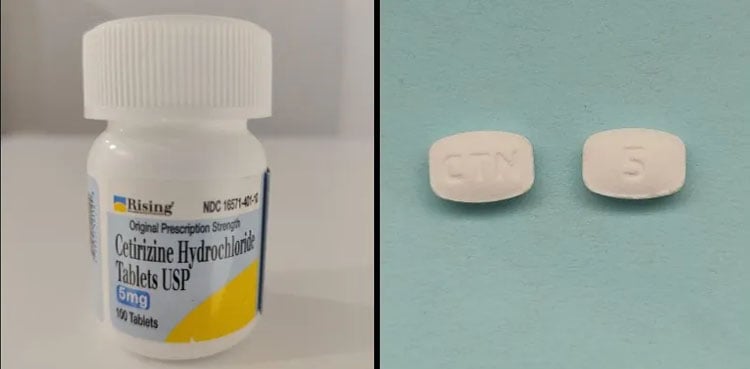
The FDA has recalled four lots of Cetirizine Hydrochloride Tablets USP, 5 mg, due to the risk of Ranitidine contamination. Consumers are urged to verify their bottle lot numbers and discontinue use if affected.
Imagine you have a medicine to help with allergies. But sometimes, this medicine can get mixed up with another medicine that's not good for you. If you take the wrong medicine, you might feel very sick or even have trouble breathing. That's why the FDA is telling people to check their medicine bottles and stop taking it if it's the wrong one.
Analysis
A Nationwide Alert: Cetirizine Recall Due to Ranitidine Contamination Risk
The U.S. Food and Drug Administration (FDA) has issued a nationwide alert to recall four specific production lots of the popular 5 mg generic antihistamine, Cetirizine Hydrochloride Tablets USP. The discrepancy came to light when a vigilant pharmacy technician noticed abnormal red spotting and general discoloration on the white 5 mg tablets while counting doses for a prescription.
The affected product carries the National Drug Code (NDC) 16571-401-10 and an expiration date of 10/2028. This recall specifically applies to four lot numbers: GY825029, GY825030, GY825031, and GY825032. Consumers and healthcare providers are urged to inspect their medicine cabinets for 100-count HDPE bottles of Cetirizine Hydrochloride Tablets USP, 5 mg, distributed by Rising Pharma Holdings Inc. and manufactured by Unique Pharmaceutical Laboratories.
Cetirizine is an over-the-counter and prescription antihistamine commonly used to treat seasonal allergies, hives, and allergic rhinitis. Ranitidine is an H2 blocker historically used to suppress stomach acid. For individuals with severe hypersensitivities or known allergies to ranitidine, accidental ingestion of cross-contaminated cetirizine presents a reasonable risk of triggering serious side effects, including anaphylaxis, hypotension, dyspnea, facial and throat swelling, hives, itching, or loss of consciousness.
Action Steps for Consumers and Patients Verify Your Bottle: Check the lot number printed on the side of your 100-count bottle label. Discontinue Use Immediately: If your bottle matches lot numbers GY825029, GY825030, GY825031, or GY825032, stop taking the medication. Contact Support: Consumers seeking return or reimbursement instructions can contact Rising Pharma Holdings Inc. at 1-844-874-7464 (Monday–Friday, 8 a.m. to 5 p.m. EST) or via email at [email protected] . Report Side Effects: Any adverse reactions should be reported directly to the FDA’s MedWatch Adverse Event Reporting program.
Key points
- The FDA has recalled four production lots of Cetirizine Hydrochloride Tablets USP, 5 mg, due to the risk of Ranitidine contamination.
- Consumers are advised to inspect their medicine cabinets for affected products and discontinue use if found.
- Affected products carry the National Drug Code (NDC) 16571-401-10 and an expiration date of 10/2028.
- Four specific lot numbers are affected: GY825029, GY825030, GY825031, and GY825032.
If the recall is handled efficiently, consumers will be able to safely return or dispose of the affected products, minimizing the risk of adverse reactions. Additionally, the FDA's alert will help raise awareness about the potential risks associated with cross-contamination.
If consumers do not properly verify their medicine bottles or fail to discontinue use of the affected products, they may experience serious side effects, including anaphylaxis or other life-threatening reactions.