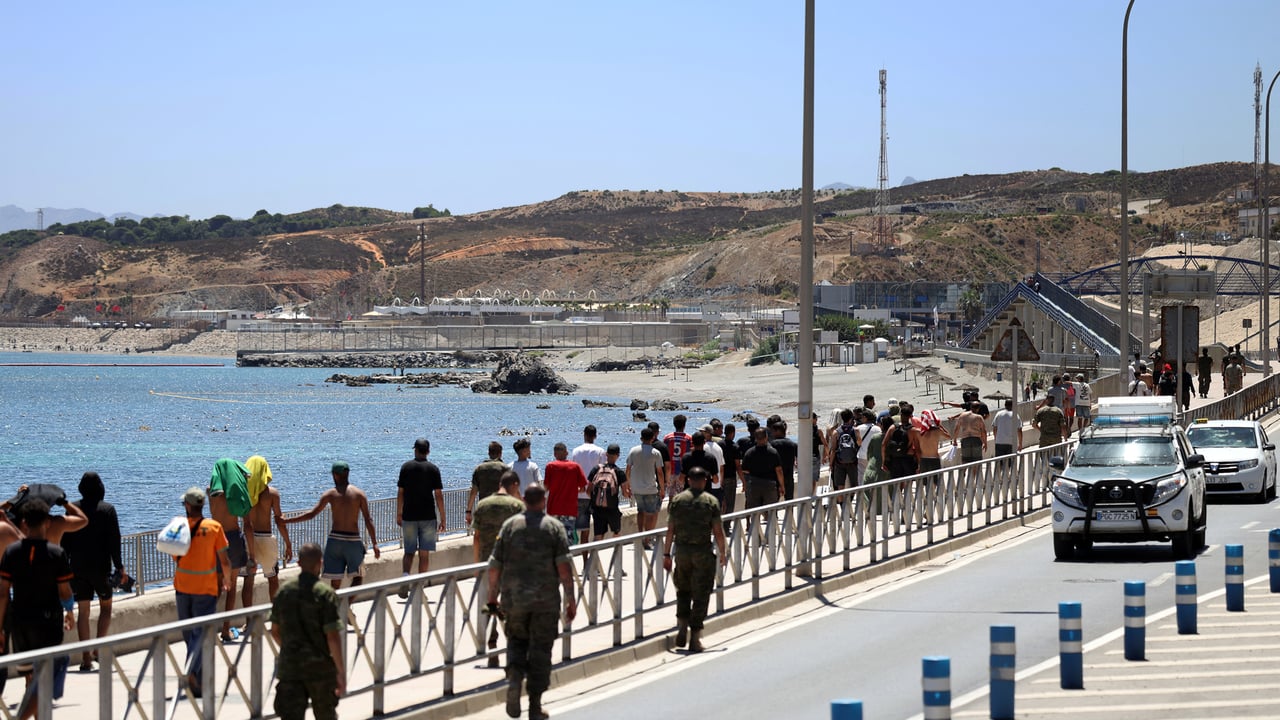
Ceuta Crisis: 'Morocco has changed a lot. But who benefits from this Morocco?'
The recent influx of Moroccan migrants into Ceuta is not merely a repeat of 2021, but rather a symptom of deep-seated social inequalities and a stagnant political discourse within Morocco, according to expert Khalid Mouna.
Intelligence analysis by Gemini 2.5 Flash
Khalid Mouna, a specialist in social mobilizations, argues that the latest wave of Moroccan migrants to Ceuta in July 2026 highlights profound social fragilities, ignored inequalities, and a lack of effective political debate in Morocco, rather than just a migratory crisis. He suggests the government's actions contradict the Palace's stated goals for a social state.
Imagine a big playground where some kids have lots of toys and others have very few, and the grown-ups in charge aren't listening to the kids who need help. When some kids try to sneak out of the playground to find a better one, it's not just about them wanting to leave; it shows that things inside the playground aren't fair, and the grown-ups need to do a better job of making sure everyone is happy and heard.
Analysis
Unpacking the Ceuta Influx
The recent surge of Moroccan migrants into the Spanish enclave of Ceuta in July 2026 is not a simple recurrence of the 2021 events, nor can it be solely categorized as a migratory crisis. According to Khalid Mouna, a professor at Moulay-Ismaïl University and an expert in social mobilizations, this phenomenon is a stark indicator of deeper, systemic issues within Moroccan society. Mouna posits that the influx reveals significant social fragilities, including persistent and often overlooked inequalities, a political landscape characterized by a lack of vibrant debate, and profound underlying tensions that simmer beneath the surface of the kingdom.
Contradictions in Governance
Mouna's analysis extends to a critical observation regarding Morocco's governance. He highlights a perceived disconnect between the stated intentions of the Royal Palace and the actual policies implemented by the government. Specifically, Mouna notes that while the Palace advocates for the establishment of a robust social state, the government's actions appear to move in the opposite direction. This divergence creates a vacuum of trust and effectiveness, contributing to the societal ills that drive such outward movements of people. The youth protest movement, GenZ212, is cited as another manifestation of this deep-seated discontent, underscoring a society that ultimately looks to the King to rectify failures of other institutions.
Societal Discontent and the Role of the Monarchy
The article, through Mouna's perspective, suggests that the Moroccan populace, particularly its youth, feels unheard by the authorities, leading to a sense of disillusionment. This lack of engagement and responsiveness from governmental bodies means that when crises or widespread discontent emerge, the ultimate appeal for resolution is directed towards the monarchy. This dynamic, where the King is seen as the final arbiter and problem-solver, points to a broader challenge in developing robust, accountable, and responsive democratic institutions capable of addressing the complex social and economic needs of a changing Morocco. The Ceuta crisis, therefore, becomes a potent symbol of these unresolved internal pressures.
Key points
- The July 2026 migrant influx into Ceuta is seen as a symptom of deep social inequalities and political stagnation in Morocco, not just a migratory crisis.
- Khalid Mouna, a social mobilization specialist, argues that the Moroccan government's actions contradict the Palace's stated goal of building a social state.
- The youth protest movement, GenZ212, is cited as evidence of deep societal discontent and a lack of governmental responsiveness.
- Moroccan society often turns to the King to resolve issues that other institutions fail to address, indicating a challenge in governance.
- The crisis highlights profound tensions within Moroccan society and its relationship with European enclaves like Ceuta.
The ongoing social fragilities and political stagnation highlighted by the Ceuta crisis could lead to increased internal unrest and further waves of migration, straining Morocco's social fabric and international relations. A continued disconnect between the Palace's vision and government actions risks deepening public disillusionment and hindering effective policy implementation.