China should lean into its defining AI advantage – accessibility
China's emerging AI advantage lies in providing capable and affordable intelligence, rather than solely focusing on top-tier performance, allowing it to gain significant global market share.
Intelligence analysis by Gemini 2.5 Flash
The global AI race is shifting from a contest of peak performance to one of market share, driven by affordability and accessibility. Chinese AI models are increasingly competitive in this new landscape, particularly in developing regions, by offering capable solutions at a lower cost.
Imagine everyone needs a car, but not everyone needs the fastest, most expensive race car. Many just need a reliable, affordable car to get around every day. China is focusing on making these 'everyday cars' for AI – good enough, but much cheaper. This means more countries, especially those that can't afford the super fancy ones, are choosing China's AI, helping China become a big leader in how the world uses smart computers.
Analysis
China's Accessibility Advantage in AI
The traditional view of the artificial intelligence race often centers on who possesses the most advanced chips or the most powerful frontier models. However, this article posits a strategic reorientation, suggesting that China's true competitive edge lies not in absolute peak performance, but in its capacity to deliver "capable intelligence at a price the global market can afford." This perspective reframes AI as an essential infrastructure, akin to electricity or cloud computing, where widespread adoption is driven by affordability, reliability, and broad reach, rather than solely by benchmark supremacy.
This shift in focus is particularly pertinent as AI transitions from a niche technology to an everyday utility embedded across various sectors, including businesses, public services, and consumer devices. In such an environment, the contest for market share becomes paramount. By prioritizing accessibility and cost-effectiveness, Chinese companies are positioning themselves to become major suppliers of the world's AI infrastructure, especially in regions where budget constraints and practical utility outweigh the need for bleeding-edge, often more expensive, solutions.
Evidence of Shifting Market Dynamics
Empirical data cited in the article supports the notion that cost is increasingly determining AI adoption. Platforms like OpenRouter show a significant surge in the processing of tokens by Chinese models, surpassing American counterparts by a substantial margin. In the second week of February, Chinese models processed 4.12 trillion tokens compared to 2.94 trillion for American models, escalating to 18 trillion tokens weekly by June – more than three times the American total on the platform.
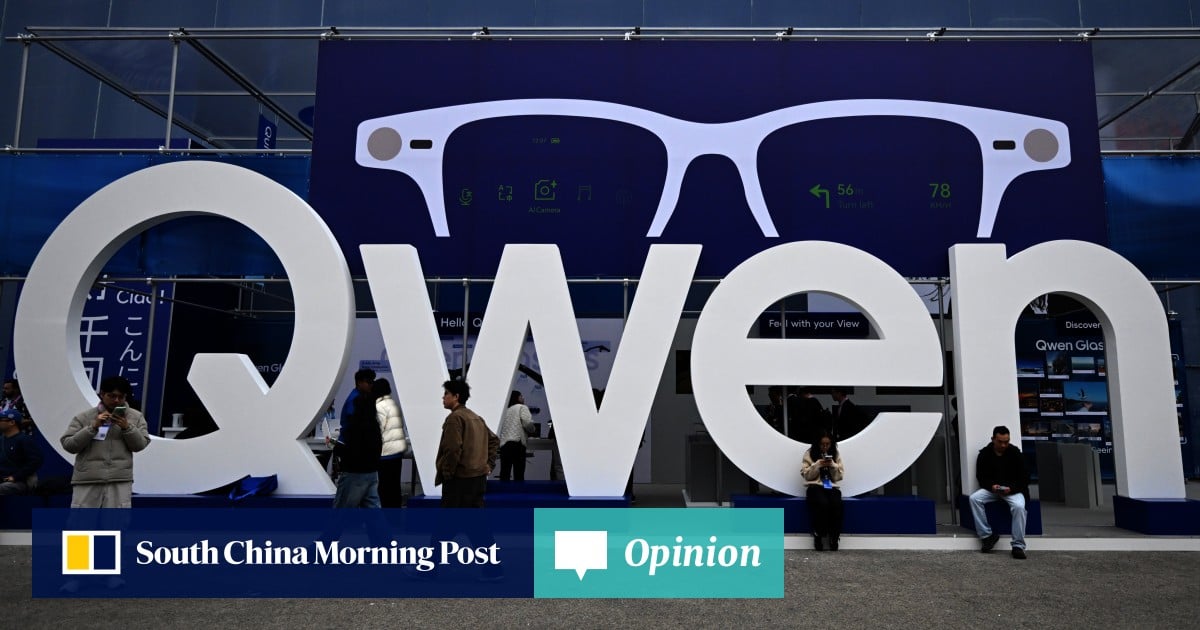
Furthermore, the article highlights the growing interest in Chinese open-weight models on developer platforms like Hugging Face, where they accounted for 41 percent of downloads in the year to February 2026, slightly ahead of American models at 36.5 percent. Alibaba’s Qwen model alone has achieved approximately 1 billion cumulative downloads, signifying strong developer engagement. The adoption of Chinese open-weight foundations for national AI initiatives in countries like Singapore and Malaysia further underscores their growing influence and the formation of new, China-centric AI ecosystems.
Implications for Global AI Adoption
The strategic emphasis on accessibility positions Chinese AI models to capture a significant portion of the next wave of global AI adoption, particularly in developing regions. Four-fifths of the world's population resides outside China and the United States, with substantial growth potential in Southeast Asia, South Asia, the Middle East, Africa, and Latin America. Entities in these regions, including governments, telecoms, universities, and start-ups, often prioritize models that are capable, affordable, adaptable to local languages, and deployable on existing local infrastructure, rather than those with the highest benchmark scores.
This approach fosters a virtuous cycle: increased deployments lead to local applications, generate valuable engineering feedback, and cultivate a developer base familiar with the specific technical stack. Consequently, market share evolves from merely being a reward for technological leadership into a proactive pathway towards achieving and solidifying that leadership. By embedding their technologies through widespread, affordable access, Chinese firms are not just selling products; they are building foundational ecosystems that could shape the future of global AI development and deployment.
Key points
- China's primary AI advantage is its ability to provide capable and affordable intelligence, not necessarily the best chips or frontier models.
- The AI race is shifting towards market share, with affordability, reliability, and reach becoming as important as peak performance.
- Chinese models are gaining significant traction on platforms like OpenRouter and Hugging Face, processing more tokens and accumulating more downloads than American counterparts.
- Developing regions in Southeast Asia, South Asia, the Middle East, Africa, and Latin America are key markets for accessible AI, prioritizing capability and affordability.
- Gaining market share through widespread adoption can become a route to achieving and solidifying technological leadership by fostering local ecosystems and developer familiarity.
This strategy could lead to a more equitable global distribution of AI capabilities, enabling developing nations to leverage AI for economic growth and public services without prohibitive costs. It could also foster diverse AI ecosystems tailored to local needs and languages, driving innovation beyond traditional tech hubs.
A focus on affordability over peak performance might lead to a global AI landscape where less advanced or potentially less secure models become dominant in certain regions. This could create a bifurcated AI ecosystem, potentially hindering interoperability or raising concerns about long-term quality and ethical standards if cost becomes the primary driver.