China-UK cooperation vital in ensuring the AI era puts people first
The piece argues China and Britain can shape AI toward safety, inclusion and prosperity by combining their strengths in science, law, manufacturing and governance.
Intelligence analysis by GPT-5.4 Mini
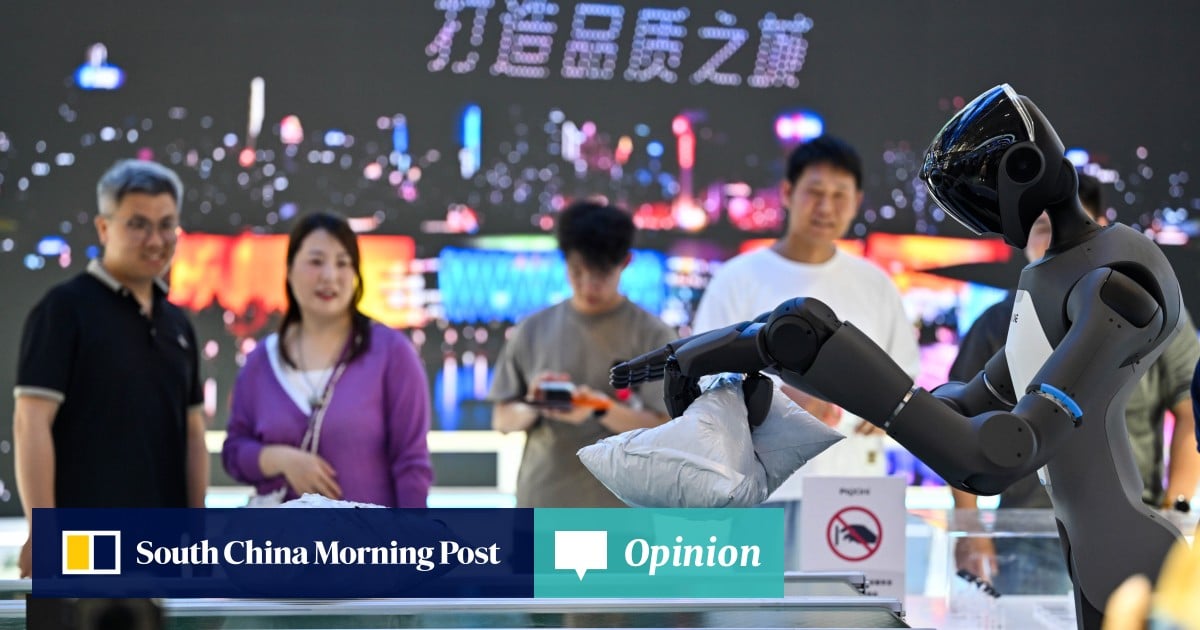
The article frames AI as more than a technology race: it is a test of whether major economies can build the institutions and economic systems needed to absorb intelligent machines. It argues Britain and China each bring different strengths, and that cooperation could help define the rules of the AI era.
The article says AI is like a new kind of city being built. Britain brings strong rules, ideas and schools, while China brings huge factory power and fast building. If they work together, the city could be safer and better for everyone.
Analysis
Main argument
Shaoshan Liu argues that AI should be understood as a broader societal and economic transition, not just a race for better models or faster chips. In that framing, the key challenge is how intelligent machines are integrated into human society through standards, institutions and workable economic systems.
Why Britain matters
The article says Britain enters this era with a long history of shaping modern science and political economy. It points to Isaac Newton’s work as a foundation for modern engineering, Adam Smith’s ideas on markets and specialization, and Alan Turing’s role in the intellectual origins of computation and machine intelligence. The point is not nostalgia; it is that Britain still has strengths in science, law, education and governance that can influence the rules of a new AI era.
Why China matters
China is described as having advanced rapidly and built major strengths in manufacturing, robotics, supply-chain resilience and large-scale application ecosystems. The article argues that this gives China a central role in AI deployment, especially where scale and engineering capacity matter.
Cooperation, not isolation
The core question posed is whether China and Britain can work together on problems neither can solve alone. The article presents the AI era as one where collaboration could help steer development toward safety, inclusion and prosperity rather than letting the field become only a competition between markets or technical speed. The source does not spell out a specific joint program, but it clearly frames cooperation as necessary if AI is to serve people first.
Key points
- The article frames AI as a test of institutions and economic systems, not just technology.
- Britain is presented as strong in science, law, education and governance.
- China is described as powerful in manufacturing, robotics and large-scale deployment.
- The author argues both countries have something important to contribute to the AI era.
- The central claim is that cooperation can help AI put people first.
If the article’s vision holds, China and Britain could help set practical rules and standards that make AI safer and easier to fit into everyday life. Their different strengths could also speed up useful deployment while keeping attention on people, not just machines.
If cooperation does not happen, AI development may stay trapped in rivalry, with each side working separately on standards and deployment. The article also implies that without shared institutions, the social and economic strain of AI could be handled unevenly.