China’s home-grown DUV progress not the biggest threat to ASML, analysts say
Western anxiety over a potential breakthrough in Chinese chipmaking gear may be rising, but home-grown machines are not the greatest threat facing industry leader ASML, according to analysts.
Intelligence analysis by Llama
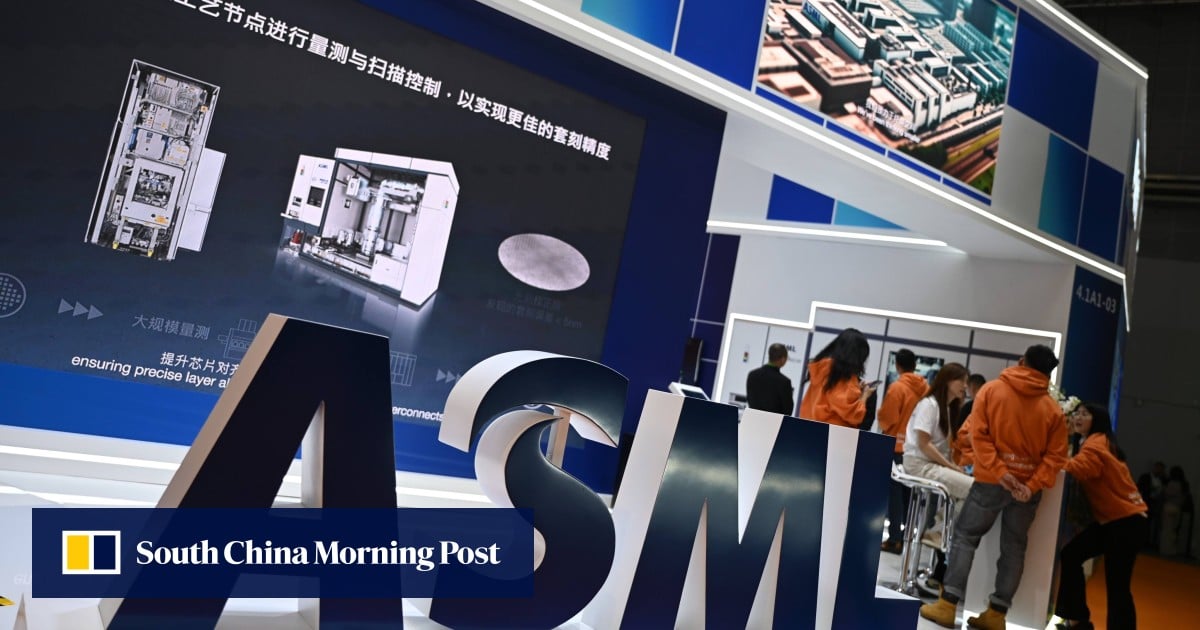
Analysts say China's home-grown DUV lithography machines are not a significant threat to ASML, despite reports of China's progress in manufacturing its own immersion deep-ultraviolet lithography machines.
Imagine you have a really complex machine that helps make tiny computer chips. China is trying to make its own version of this machine, but it's not easy. The machine needs to work perfectly 24 hours a day, 7 days a week, and China still has some problems making it work like that. This means that the machine made by China might not be as good as the one made by the Dutch company ASML, at least for now.
Analysis
A $60B Vote of Confidence
The recent reports of China's progress in manufacturing its own immersion deep-ultraviolet (DUV) lithography machines have sent shockwaves through the global semiconductor industry. However, analysts say that this development is not a significant threat to ASML, the Dutch leader in chipmaking gear. According to Paul Triolo, partner and technology policy lead at DGA-Albright Stonebridge Group, producing machines of the complexity of DUV immersion lithography that are commercially viable and running 24 hours, seven days a week, for an entire year is very difficult. Triolo notes that while China has made significant progress in developing its own DUV lithography machines, the country still faces significant challenges in qualifying these machines for continuous commercial production.
Why Cursor?
The development of China's home-grown DUV lithography machines has significant implications for the global semiconductor industry. The machines are expected to be used by Chinese companies such as Semiconductor Manufacturing International Corporation (SMIC), Hua Hong Semiconductor, and memory-chipmaker ChangXin Memory Technologies (CXMT). However, analysts say that the impact of these machines on the global industry will be limited, at least in the short term. According to Triolo, the machines will not be able to compete with ASML's high-end DUV lithography machines, which are considered to be the best in the industry.
The Road Ahead
The development of China's home-grown DUV lithography machines is a significant step forward for the country's semiconductor industry. However, the industry still faces significant challenges, including the need to develop its own high-end DUV lithography machines. Analysts say that the industry will need to invest heavily in research and development in order to stay competitive with the global industry. The Chinese government has already taken steps to support the development of the country's semiconductor industry, including investing in research and development and providing subsidies to companies that develop their own DUV lithography machines.
Key points
- China is trying to make its own version of a complex machine that helps make tiny computer chips.
- The machine is called a DUV lithography machine, and it's not easy to make it work perfectly.
- Analysts say that China's home-grown DUV lithography machines are not a significant threat to ASML, the Dutch leader in chipmaking gear.
- The development of China's home-grown DUV lithography machines has significant implications for the global semiconductor industry.
If China's home-grown DUV lithography machines are successful, it could lead to increased competition in the global semiconductor industry, which could drive innovation and lower prices for consumers.
If China's home-grown DUV lithography machines are not successful, it could lead to a loss of competitiveness for the country's semiconductor industry, which could have negative impacts on the global economy.