China’s telecoms giants bet on ‘token factories’ as AI drives revenue growth
China's three state-owned telecom giants are heavily investing in AI computing capacity, focusing on billable AI tokens as a key growth driver, leading to significant revenue increases in their intelligent computing and business segments.
Intelligence analysis by Gemini 2.5 Flash
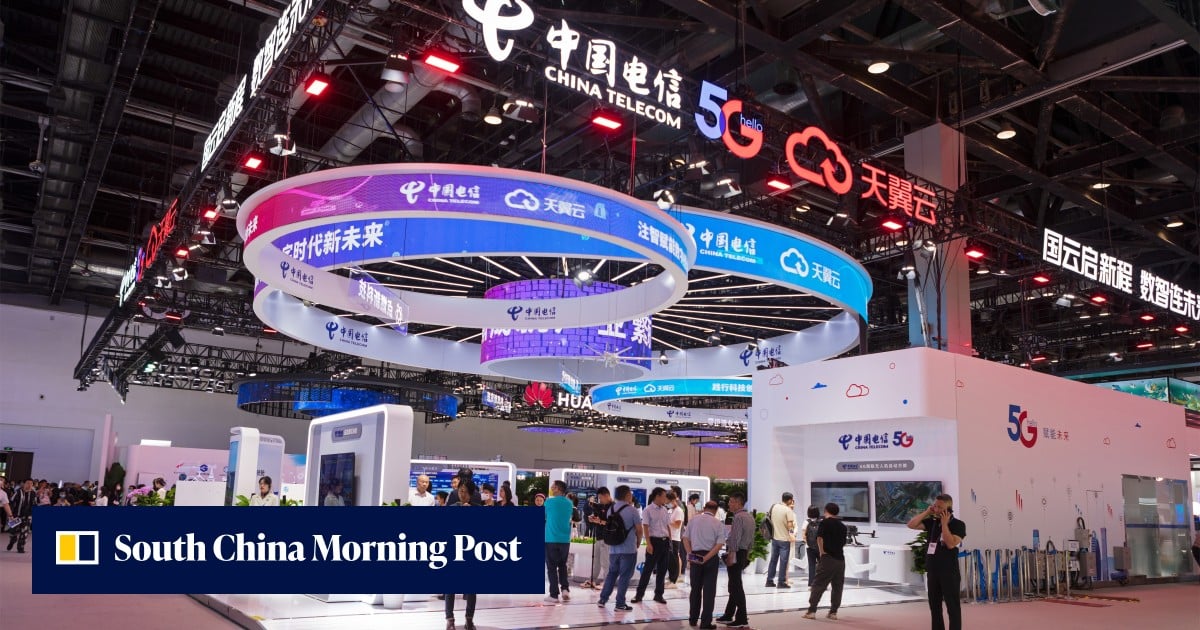
China Mobile, China Telecom, and China Unicom are strategically pivoting towards artificial intelligence, making AI tokens and robust computing power central to their business models. This shift is yielding substantial financial returns, with intelligent computing revenue surging as AI adoption accelerates across the country, highlighting a new era of monetization for these traditiona…
Imagine big phone companies in China are building special 'brain factories' for computers, where they make tiny pieces of computer thought called 'tokens.' When other companies or people use these computer brains to do smart things, like write stories or answer questions, they pay for these tokens. This new business is making the phone companies a lot of money, like selling special building blocks for smart robots.
Analysis
China Telecom's Surge
China Telecom has emerged as a frontrunner in leveraging AI for revenue growth, reporting a remarkable 95 per cent surge in intelligent computing revenue during the first half of the year. This impressive growth contributed to a 7.1 per cent increase in its broader "intelligent business" revenue, reaching 31.1 billion yuan (US$4.6 billion). The company's strategy includes offering token packages to mobile users nationwide, indicating a direct consumer-facing approach to AI monetization.
Beyond consumer offerings, China Telecom has significantly upgraded its underlying infrastructure. Its Xingchen TokenHub platform now hosts 142 large language models and over 420 industry-specific AI applications, creating a comprehensive ecosystem for AI development and deployment. Furthermore, the company's Xirang orchestration software, designed for compute resources and networks, has been enhanced to support more than 20 chip architectures, demonstrating a commitment to hardware versatility and scalability.
China Unicom's Ecosystem
China Unicom also reported strong performance in its computing-power segment, with revenue climbing 13 per cent to 41.9 billion yuan. This growth encompasses various services, including data centers, leased compute, business software, and cloud-based AI solutions. A key innovation highlighted by Unicom is the launch of its "token supermarket," which forms part of an end-to-end ecosystem designed for the creation, transfer, storage, and utilization of AI tokens.
This "token supermarket" concept underscores a strategic vision to streamline the entire lifecycle of AI token management, making it easier for developers and businesses to access and utilize AI resources. Complementing this, Unicom's UniAI platform connects over 200 large language models and has amassed more than 500 terabytes of high-quality data. This extensive data collection and model integration position UniAI as a robust platform for diverse AI applications, fostering innovation and adoption across various industries.
Xingchen TokenHub and Xirang
The technological backbone supporting these revenue surges is critical. China Telecom's Xingchen TokenHub platform exemplifies the "token factory" concept, acting as a central repository and marketplace for AI models and applications. By hosting a vast array of large language models and industry-specific AI tools, it provides a scalable and accessible environment for AI development and deployment, directly contributing to the increased usage of billable AI tokens.
Similarly, China Telecom's Xirang orchestration software plays a pivotal role in managing the complex computing resources required for AI operations. Its expanded support for over 20 chip architectures ensures that the company can efficiently utilize diverse hardware, optimizing performance and cost-effectiveness. These platforms, alongside China Unicom's UniAI and "token supermarket," represent a concerted effort by China's telecom giants to build comprehensive, integrated AI ecosystems that drive both technological advancement and significant financial returns.
Key points
- China's three state-owned telecom giants are making billable AI tokens a core part of their growth strategies.
- China Telecom reported a 95% surge in intelligent computing revenue, driving a 7.1% increase in its 'intelligent business' revenue to 31.1 billion yuan.
- China Telecom's Xingchen TokenHub platform hosts 142 large language models and over 420 industry-specific AI applications.
- China Unicom posted 41.9 billion yuan in computing-power revenue, a 13% increase, and launched a 'token supermarket' as part of its AI ecosystem.
- Both companies are investing in platforms like UniAI and Xirang to connect LLMs, collect data, and manage compute resources across various chip architectures.
The heavy investment by China's telecom giants in AI computing capacity and token-based services could lead to accelerated AI innovation and widespread adoption across various sectors in China. This strategic focus is likely to drive sustained revenue growth for these companies and solidify China's position as a leader in AI infrastructure and application development.
Despite the current growth, the intense competition within China's AI sector, coupled with potential regulatory shifts or the high capital expenditure required for continuous infrastructure upgrades, could pose challenges. The sustainability of such rapid revenue growth might also be tested by market saturation or the emergence of more cost-effective AI solutions.
Market signals
- 0728.HK The company reported a 95% surge in intelligent computing revenue and a 7.1% increase in broader intelligent business revenue, indicating strong growth in a strategic area.
- 0762.HK The company posted a 13% increase in computing-power revenue, driven by investments in data centers, cloud-based AI, and a new 'token supermarket'.
- 0941.HK As one of China's 'big three' telecoms operators, China Mobile is also investing heavily in AI computing capacity, suggesting similar positive strategic shifts and potential for future revenue growth.
AI-generated analysis of potential market relevance. Not financial advice.