Chinese armed trainer jets drive away Philippine aircraft over Scarborough Shoal
China deployed armed JL-10 trainer jets to intercept and drive away Philippine light aircraft over the disputed Scarborough Shoal, a move seen as a potentially more cost-effective tactic in the South China Sea.
Intelligence analysis by Gemini 2.5 Flash
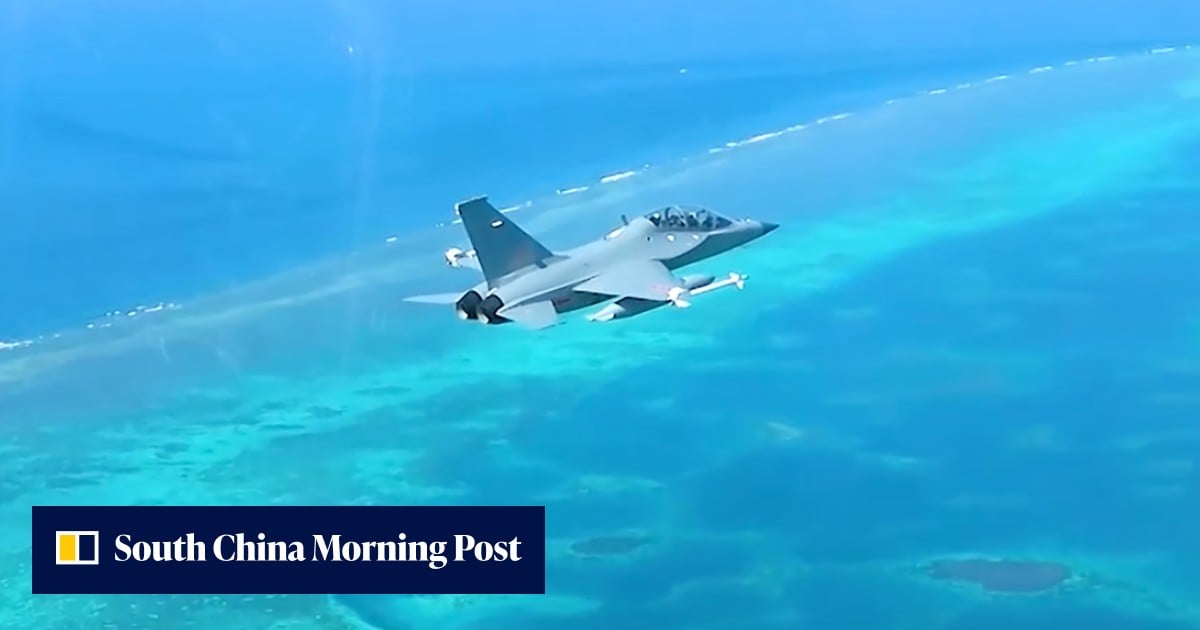
Chinese armed trainer jets, equipped with air-to-air missiles, confronted and warned off Philippine aircraft over the contested Scarborough Shoal. This incident, captured in a video released by the PLA, highlights escalating tensions in the South China Sea and suggests China is adopting new, potentially more economical, methods for asserting its territorial claims.
Imagine two kids arguing over a special sandbox. One kid, China, says it's theirs and has been playing there for a while. The other kid, the Philippines, also says it's theirs and keeps trying to play there too. This time, China sent some of its smaller, armed toy planes, usually used for practice, to fly really close to the Philippine planes and tell them to leave, or else. It's like China is trying a new, cheaper way to show who's boss in that sandbox.
Analysis
The recent confrontation over Scarborough Shoal, involving Chinese armed JL-10 trainer jets and Philippine light aircraft, marks a notable development in the ongoing South China Sea disputes. The People's Liberation Army Southern Theatre Command released video evidence showing the Chinese jets, armed with PL-5 air-to-air missiles, electronically locking onto the Philippine aircraft. This public display of force, coupled with a direct radio warning in both Chinese and English, demonstrates China's assertive stance and its willingness to use military assets to enforce its territorial claims.
JL-10s
The deployment of JL-10 trainer jets, rather than frontline combat aircraft, suggests a calculated strategic shift by China. These jets, while primarily designed for training, are capable of carrying armaments like the PL-5 missiles, making them a credible deterrent. This approach could be a more cost-effective method for China to conduct its increasingly frequent air confrontations over the South China Sea, conserving the operational hours and resources of its more advanced fighter fleets. The use of trainer jets also potentially lowers the immediate escalation risk compared to deploying high-end fighters, while still sending a clear message of deterrence and territorial assertion.
This tactic allows China to maintain a robust presence and respond to perceived intrusions without necessarily committing its most valuable assets. The electronic systems shown locking onto the Philippine aircraft, including a BN-2A Islander, a C-208, and a PA-31T, indicate a sophisticated level of surveillance and engagement capability. This demonstrates China's capacity to monitor and react to various types of aircraft operating within what it considers its territorial airspace, reinforcing its control over disputed areas like Huangyan Dao.
Scarborough Shoal
Scarborough Shoal, known as Huangyan Dao in China and Panatag Shoal in the Philippines, remains a critical flashpoint in the South China Sea. China has maintained de facto control over the coral atoll since 2012, a situation that the Philippines consistently challenges through various activities, including ship and aircraft patrols. The shoal's strategic location and rich fishing grounds make it highly valuable to both nations, fueling persistent tensions and diplomatic exchanges.
In 2024, China released baselines for the territorial sea around Scarborough Shoal, further solidifying its claims. The Philippines responded in July by filing its own territorial sea baselines for the shoal with the United Nations, directly challenging China's assertions. These competing claims and actions highlight the deep-seated disagreements over sovereignty and maritime rights in the region, with each side seeking to bolster its legal and practical standing through international bodies and on-the-ground presence.
People’s Liberation Army Southern Theatre Command
The People's Liberation Army Southern Theatre Command's decision to publicize the incident through a social media video underscores the propaganda and psychological warfare aspects of these confrontations. By releasing footage of the electronic lock-on and the pilot's verbal warning, China aims to project strength and deter future Philippine activities in the area. The pilot's bilingual warning, delivered in both Chinese and English, ensures that the message is clearly understood by the Philippine crew and the international community.
This incident is part of a broader pattern of assertive actions by the PLA in the South China Sea, which includes the construction of artificial islands, deployment of naval and coast guard vessels, and regular air patrols. The Southern Theatre Command is responsible for overseeing China's military operations in this strategically vital region, and its actions reflect Beijing's unwavering commitment to its expansive territorial claims. The public dissemination of such encounters serves to normalize China's presence and actions in the disputed waters, while simultaneously pressuring claimant states like the Philippines.
Key points
- China used armed JL-10 trainer jets to drive away Philippine light aircraft over Scarborough Shoal.
- The Chinese jets carried PL-5 air-to-air missiles and electronically locked onto the Philippine aircraft.
- A Chinese pilot issued a bilingual warning (Chinese and English) for the Philippine aircraft to leave.
- The incident, captured in a video by the PLA Southern Theatre Command, suggests a 'cost-effective tactic' for China.
- Scarborough Shoal (Huangyan Dao/Panatag Shoal) remains a major flashpoint, with both countries filing territorial sea baselines with the UN.
The use of armed trainer jets by China, even if intended as a 'cost-effective tactic,' risks miscalculation and escalation in the highly contested South China Sea. Continued aggressive maneuvers and direct warnings could lead to accidental collisions or more serious military confrontations, further destabilizing regional security and potentially drawing in other international actors.