Chinese researchers claim breakthrough in training household robots with AI-generated homes
Chinese researchers say Kairos-HomeWorld can generate whole-home scenes from simple prompts, aiming to speed training for household robots and humanoids.
Intelligence analysis by GPT-5.4 Mini
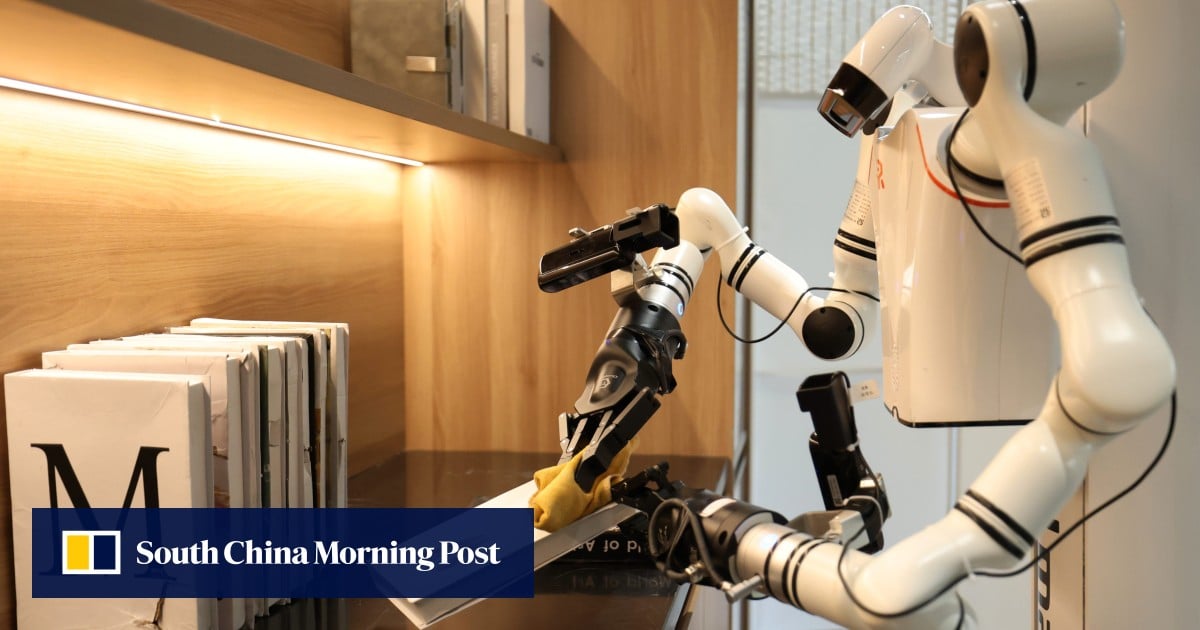
The story centers on a claimed first: a unified framework that builds simulation-ready, whole-home environments from text prompts. The researchers say it moves beyond single-room indoor scenes and could give domestic robots richer training data.
Researchers say they made a computer tool that can draw an entire house full of stuff from one short sentence, like building a practice dollhouse for robots. That could help robots learn faster before they try real homes.
Analysis
What the researchers claim
Chinese researchers say they have built Kairos-HomeWorld, a framework that can generate coherent, accurate, simulation-ready home environments from simple text prompts. The team comes from Ace Robotics, which is backed by SenseTime, along with the Multimedia Laboratory at the Chinese University of Hong Kong and the Shenzhen Loop Area Institute.
Why the system is different
The article says conventional indoor scene generation has mostly been limited to single-room layouts and weak interactivity. Kairos-HomeWorld is described as covering whole-home and object-level residential scenes, making it useful for training domestic robots and humanoids in settings that look more like real homes.
How it works
According to the report, the framework uses a four-stage pipeline: floor plan construction, 2D-to-3D conversion, furniture layout generation, refinement, and then final object-level generation. Each scene is said to include an average of more than 15 manipulable objects. Ace Robotics says these high-fidelity, large-scale simulations provide a foundation for embodied intelligence applications and could accelerate real-world robot training.
The article does not independently verify the technical claims, but it presents the work as an attempt to solve a long-standing data bottleneck in home robotics.
Key points
- Researchers say Kairos-HomeWorld generates simulation-ready home environments from text prompts.
- The framework is described as moving beyond single-room layouts to whole-home scenes.
- Ace Robotics says the system could help train domestic robots and humanoids.
- The pipeline includes floor plans, 2D-to-3D conversion, furniture layout, refinement, and object-level generation.
- Each generated scene reportedly includes an average of more than 15 manipulable objects.
If the system works as described, it could give robot builders a much richer set of practice homes than single-room scenes. That might help domestic robots and humanoids learn faster and make embodied intelligence research more practical.
The article presents the work as a claim, not an independently verified breakthrough, so the real-world performance is still uncertain. If the generated homes do not transfer well to real environments, the training gains could be smaller than advertised.