Chinese researchers extend future memory endurance 100-fold in semiconductor advance
Chinese researchers have significantly improved the durability of wurtzite ferroelectrics, a promising next-generation memory material, achieving 10 billion writing cycles.
Intelligence analysis by Gemini 2.5 Flash
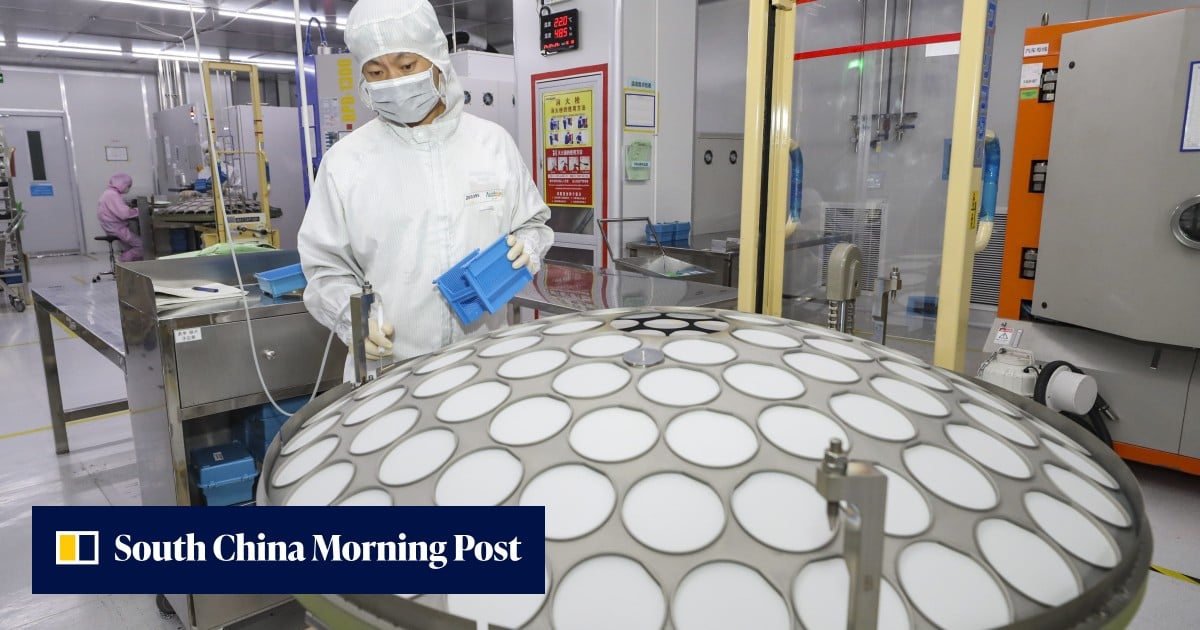
Scientists from Xidian University, City University of Hong Kong, and Fudan University have developed a method to make ferroelectric memory chips 100 times more durable. This breakthrough addresses a critical reliability issue, bringing the technology closer to practical application in high-performance computing and future AI systems.
Imagine your computer's memory as a tiny notepad where it writes down information. Usually, these notepads can only be written on and erased a certain number of times before they wear out, like a rubber band that snaps after too many stretches. But scientists in China have found a way to make a special kind of notepad, called ferroelectric memory, super strong, so it can be written on and erased billions of times without breaking! This means future computers, especially the super smart ones used for AI, can work much faster and last much longer.
Analysis
Chinese researchers have made a significant stride in semiconductor technology, specifically in the realm of next-generation memory. Their work focuses on wurtzite ferroelectrics, a class of materials that holds immense promise for future data storage due to its rapid switching speeds and low energy consumption. The core challenge with these materials, however, has been their endurance, as repeated electrical switching led to deterioration, limiting their commercial viability. This new research directly tackles that limitation, pushing the boundaries of what's possible for memory reliability.
10 Billion Writing Cycles
The most striking achievement of this research is the demonstration of over 10 billion writing cycles for wurtzite ferroelectrics. This figure represents a monumental leap in durability, being roughly 100 times greater than the previously achieved endurance for the same material. Such a high number of cycles is critical for commercial applications, where memory devices are expected to perform reliably over billions of operations throughout their lifespan. This breakthrough effectively removes a major barrier that has hindered the adoption of this advanced memory technology.
Achieving this level of endurance means that future memory chips could be far more robust and long-lasting, reducing the need for frequent replacements and improving the overall stability of computing systems. The enhanced reliability is particularly vital for applications that demand continuous, intensive data processing, such as those found in artificial intelligence and high-performance computing. This development could pave the way for more efficient and sustainable data storage solutions, impacting everything from consumer electronics to large-scale data centers.
Wurtzite Ferroelectrics
At the heart of this innovation are wurtzite ferroelectrics, specifically materials like aluminium scandium nitride (AlScN). These materials have garnered considerable attention in recent years due to their inherent advantages, including their ability to switch between two electric states to store data quickly and with minimal power consumption. Furthermore, AlScN is compatible with existing semiconductor manufacturing processes, which is a significant advantage for its potential integration into current production lines without requiring extensive retooling.
Despite their promising characteristics, the practical application of wurtzite ferroelectrics has been hampered by their susceptibility to deterioration after repeated electrical switching. Previous AlScN devices typically failed after approximately 100 million writing cycles, a figure far below the billions required for commercial use. The Chinese research team's success in restricting nitrogen-vacancy movement within these materials is the key to overcoming this fundamental limitation, unlocking the full potential of wurtzite ferroelectrics for next-generation memory devices.
Xidian University
The research was spearheaded by scientists at Xidian University, a prominent institution based in Xian, China. This leading role underscores China's growing capabilities and investment in advanced semiconductor research and development. The university collaborated with other esteemed institutions, including City University of Hong Kong and Fudan University, highlighting a concerted effort within the Chinese academic community to push the boundaries of technological innovation.
The findings were published in the prestigious journal Science, lending significant credibility and visibility to the breakthrough within the global scientific community. This publication in a top-tier journal indicates the high scientific rigor and impact of the research. The collaborative nature of the project, involving multiple universities, suggests a robust research ecosystem focused on addressing critical challenges in semiconductor technology, ultimately contributing to the global advancement of computing hardware.
Key points
- Chinese researchers achieved 10 billion writing cycles in wurtzite ferroelectrics, a 100-fold improvement in memory endurance.
- This advance addresses a critical reliability barrier for next-generation memory chips in high-performance computing and AI.
- The research focused on wurtzite ferroelectrics like aluminium scandium nitride (AlScN), known for rapid switching and low energy consumption.
- The breakthrough brings ferroelectric memory closer to practical commercial application, as previous devices failed after only 100 million cycles.
- The study was led by Xidian University in collaboration with City University of Hong Kong and Fudan University, published in the journal Science.
This breakthrough could significantly accelerate the development of more robust and efficient memory chips, directly benefiting high-performance computing and advanced AI systems. The enhanced durability of ferroelectric memory could lead to more reliable and long-lasting electronic devices, reducing waste and improving overall system stability.