Collective action urged as nation marks SAPS Commemoration Day
South Africa observed SAPS National Commemoration Day, honoring 12 police officers who died in the line of duty, with President Cyril Ramaphosa urging collective action to build safer communities and support the families of the fallen.
Intelligence analysis by Gemini 2.5 Flash
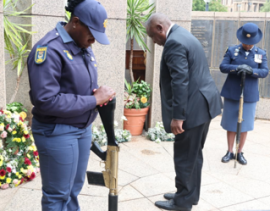
The annual SAPS Commemoration Day highlighted the human cost of attacks on police, remembering 12 officers who died between April 2025 and March 2026. President Ramaphosa called for a national commitment to remembrance, accountability, and renewal, emphasizing that attacks on police are an assault on the state and the rule of law, requiring a societal response beyond mere enforcement.
Imagine your town has special helpers, like superheroes in blue uniforms, who keep everyone safe. Sometimes, these helpers get hurt or even lose their lives while doing their important job. This story is about South Africa remembering 12 of these brave helpers who died and how the country is trying to make sure their families are looked after, especially their children, and asking everyone to help make the country safer so fewer helpers get hurt.
Analysis
President Cyril Ramaphosa
President Cyril Ramaphosa used the SAPS National Commemoration Day to issue a profound challenge to the South African populace, urging them to look beyond immediate responses to police killings and consider the fundamental nature of the society they wish to build. He framed attacks on police officers not merely as assaults on individuals, but as direct attacks on the integrity of the State, the rule of law, and the constitutional order itself. This perspective elevates the issue from a criminal justice problem to a national crisis demanding a comprehensive societal response.
Ramaphosa's call for collective action extends beyond law enforcement, advocating for a project of responsible citizenship. This includes respecting the law, actively rejecting corruption, reporting criminality, and instilling respect for human life in children as the bedrock of a stable democracy. He emphasized the need for proactive investment in foundational societal structures such as families, schools, early childhood development, youth programs, and sport, aiming to build resilience in young people before they become susceptible to criminal networks. This holistic approach suggests a long-term strategy to address the root causes of violence and crime.
South African Police Service Education Trust
The article highlights the critical role of the South African Police Service Education Trust (SAPSET) in providing tangible support to the children left behind by fallen officers. Established in 2010, SAPSET has significantly impacted the lives of 2,215 children, having raised over R25 million through sponsorships. This financial investment has enabled many children, who once faced uncertain futures, to pursue and complete their education, with some even achieving Master’s and PhD degrees.
President Ramaphosa made a direct appeal to corporate South Africa, urging them to provide sustainable donations and scholarship programs to SAPSET. This call for private sector partnership underscores the government's recognition that the burden of supporting these families cannot rest solely on public funds. The aim is to transform the experience of loss into opportunities for the children, ensuring they can build lives worthy of their parents' sacrifice, even though no amount of support can truly replace a lost loved one.
12 members
The commemoration served as a poignant reminder of the human cost of police killings, focusing on the 12 members who lost their lives between April 2025 and March 2026. President Ramaphosa stressed that these individuals should be remembered not as mere statistics, but as sons, daughters, mothers, fathers, colleagues, and friends whose lives were tragically cut short while serving their nation. The ceremony brought to light the deeply personal stories of these officers, including a pregnant wife whose husband was killed, a family left with infant twins, and the only woman on this year’s Roll of Honour, a mother of three from Temba Police Station.
The circumstances of their deaths varied, with several officers killed while responding to business robbery complaints, transporting awaiting-trial prisoners, or performing routine crime prevention and patrol duties. The youngest officer was just 25 years old, underscoring the vulnerability of those in uniform. These personal narratives compel the country to confront the harsh realities and dangers faced by police officers daily, and the profound impact their deaths have on their families and communities, permanently rewriting their life stories.
Key points
- South Africa commemorated 12 police officers who died in the line of duty between April 2025 and March 2026.
- President Cyril Ramaphosa urged collective action, emphasizing that attacks on police are an attack on the State and constitutional order.
- The President called for responsible citizenship, including respecting the law, rejecting corruption, and reporting criminality.
- The South African Police Service Education Trust (SAPSET) has supported 2,215 children of fallen officers, raising over R25 million.
- Ramaphosa appealed to corporate South Africa for sustainable donations and scholarship programs to support SAPSET.
The article notes a significant decline in police officers killed in the line of duty in recent years, reflecting progress in operational interventions and community partnerships. Furthermore, the success of the South African Police Service Education Trust (SAPSET) in supporting over 2,200 children of fallen officers offers a positive model for mitigating the long-term impact of these tragedies.
Despite progress, the continued killing of police officers highlights persistent societal violence and criminality in South Africa, posing a significant challenge to the rule of law. The deep-seated issues that lead to such attacks suggest that achieving a truly safe society requires profound and sustained societal transformation, which remains a difficult and lengthy endeavor.
