Did Hussam Louka Seize $1.3 Billion on the Day the Assad Regime Fell? Al-Nahar Fact-Checks
A social media claim that former Syrian General Intelligence director Hussam Louka stole $1.3 billion before fleeing on December 8, 2024, is debunked. Al-Nahar's fact-check reveals the original New York Times report cited $1.36 million, not billion.
Intelligence analysis by Gemini 2.5 Flash
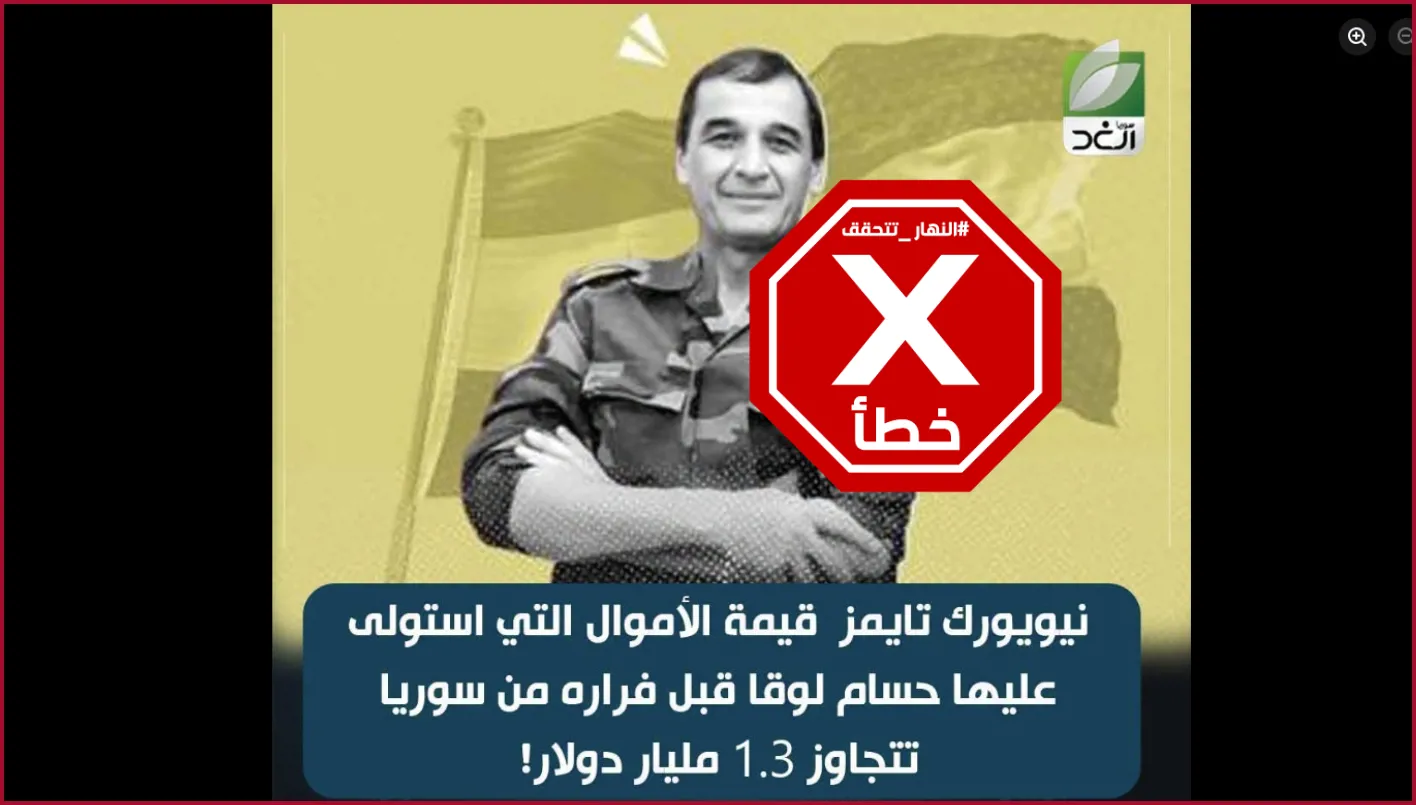
A viral social media post falsely attributed to The New York Times claimed that Major General Hussam Louka, a key figure in the fallen Assad regime, embezzled a staggering $1.3 billion from intelligence coffers before his sudden escape. However, an investigation by Al-Nahar confirms this figure is a thousand-fold exaggeration of the actual amount reported by the Times.
Imagine someone said a school principal stole a million dollars, but it turns out they only took a thousand dollars. That's what happened here: a big number about a Syrian official taking money was shared online, but a newspaper checked and found the real amount was much, much smaller.
Analysis
Hussam Louka
Major General Hussam Louka, a prominent security figure in the final decade of the Assad regime, served as the director of General Intelligence from July 2019 until the regime's collapse on December 8, 2024. Known by the moniker "The Spider" due to the extensive network of informants he cultivated during his tenure in Homs, Louka's actions during the regime's final hours have been a subject of intense scrutiny and widespread public discussion. His sudden disappearance amidst the chaos of the regime's fall left thousands of intelligence personnel unaware of their leader's flight, highlighting the disarray within the Syrian state apparatus.
The narrative surrounding Louka's escape suggests a hasty departure, prompted by the secret flight of Bashar al-Assad from Damascus to the Russian Hmeimim base. Accounts detail Louka receiving a reassuring call from a friend, only to hastily pack his bags at 2 AM. This sequence of events underscores the rapid and uncoordinated collapse of authority, with high-ranking officials prioritizing their own escape and financial security over the stability of the institutions they commanded.
The New York Times Investigation
The core of the misinformation surrounding Louka's alleged embezzlement stems from a misinterpretation of a New York Times investigation published on October 16, 2025. This comprehensive report tracked the movements and fates of approximately 55 senior officials from the former Syrian regime following its downfall. Crucially, the investigation detailed Louka's instruction to the intelligence department's accountant to open the vault and seize its contents, which were estimated at $1.36 million.
The widespread social media claim, however, inflated this figure to $1.3 billion, a thousand-fold increase that dramatically altered the perception of the alleged theft. This significant discrepancy highlights the ease with which figures can be distorted in online narratives, creating a sensationalized but inaccurate portrayal of events. Al-Nahar's fact-check meticulously traced the origin of this error, attributing it to rephrasing on social media platforms rather than an inaccuracy in the original journalistic reporting.
Syrian Authorities
In the aftermath of the regime's collapse, Syrian authorities have initiated a broader accountability process, specifically targeting figures like Hussam Louka. An arrest warrant has been issued against him, with efforts underway to circulate it internationally, aiming for his extradition and trial. The charges against Louka are severe, encompassing premeditated murder, killing under torture, and grave human rights violations, reflecting the brutality associated with the General Intelligence Directorate under his command.
Furthermore, Louka is already subject to international sanctions imposed by the United States, the United Kingdom, and the European Union, underscoring the global condemnation of his alleged actions. Investigative reports, including one by the BBC in August 2026, have corroborated information suggesting Louka's current residence in Moscow, having reportedly fled through Lebanon using a Russian passport under an assumed name. This situation presents a complex challenge for international justice, as Russia's stance on extradition for such figures remains a significant hurdle.
Key points
- A social media claim alleged Hussam Louka stole $1.3 billion from Syrian General Intelligence.
- Al-Nahar's fact-check found this figure to be incorrect and a thousand-fold exaggeration.
- The original New York Times investigation reported the amount as $1.36 million.
- Louka, a former head of General Intelligence, fled Syria on December 8, 2024, after the Assad regime's collapse.
- Syrian authorities have issued an arrest warrant for Louka on charges including murder and human rights violations.
The diligent fact-checking by Al-Nahar helps to clarify the truth and combat the spread of misinformation, which is a positive step for public discourse and media integrity in the region.
Despite the fact-check, the inflated figure may continue to circulate on social media, and the actual accountability for Hussam Louka and other officials remains uncertain, especially given his alleged presence in Russia.