Disasters like Nepal-Tibet floods could become more frequent with climate change: Experts
Experts warn of more frequent Himalayan floods and landslides due to climate change, highlighting the need for early warning systems.
Intelligence analysis by Qwen 2.5 (3B)
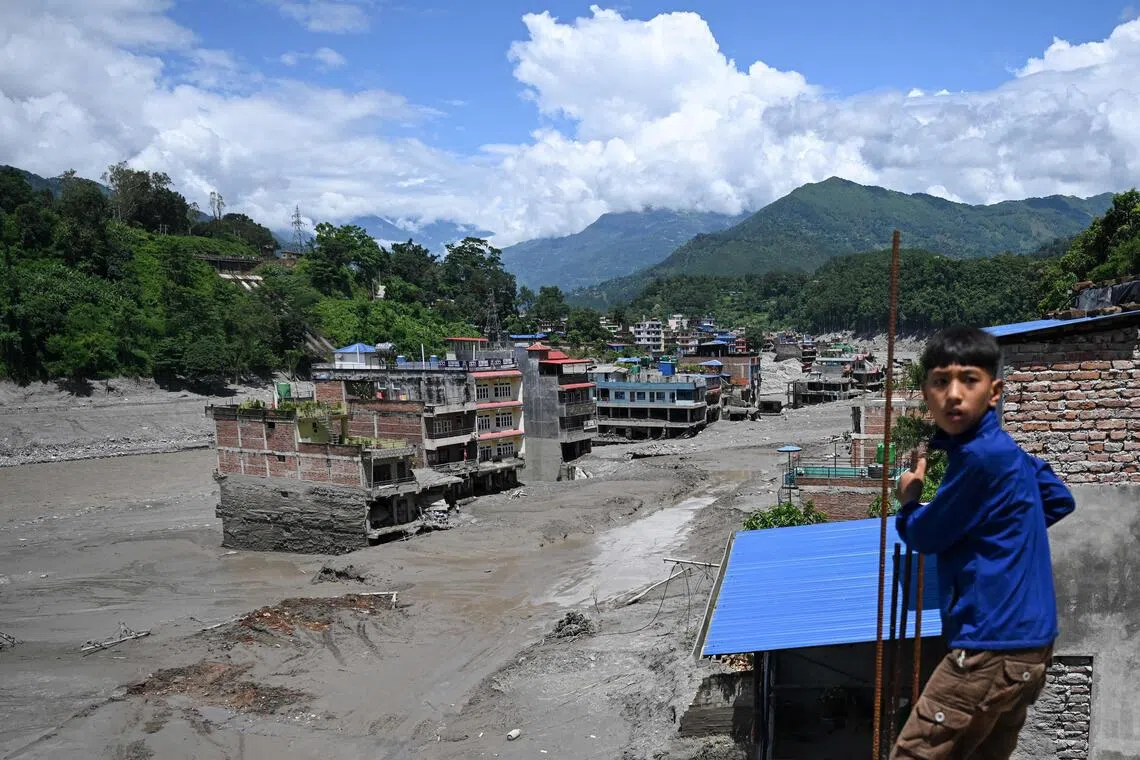
Experts say climate change is causing more frequent and severe Himalayan floods and landslides, emphasizing the need for early warning systems.
When glaciers melt, they can make the ground unstable. This can cause big rocks and ice to fall and cause big floods. To help, we need to make warning systems so people know when to be safe.
Analysis
Glacier Melt and Slope Instability
Glaciers across the Himalayan region are melting at an accelerating rate, with ice loss rates doubling since 2000. This rapid melting weakens mountain slopes, increasing the risk of rock-ice avalanches and cascading floods. [Lai Voon Hui, seismologist at NTU's Asian School of the Environment and Earth Observatory of Singapore] noted that melting glaciers can remove support from steep valley walls, thawing permafrost can weaken fractured rock, and meltwater can enter cracks or the glacier bed, making large rock-ice collapses and cascading floods much more probable. [Benjamin Horton, dean of the School of Energy and Environment at City University of Hong Kong] added that the Himalayas are already naturally predisposed to cascading hazards, such as the damaging transboundary flood in July 2025 associated with drainage from a glacial lake in Tibet.
Early Warning Systems
Implementing early warning systems is crucial to alert communities and reduce disaster risks amid rapidly changing mountain environments. [Lai Voon Hui] emphasized that monitoring and early-warning systems should also factor in unstable rock-ice slopes or scenarios where rivers get dammed up by debris. [Neera Shrestha Pradhan, Water and Disaster Risk Reduction lead at the International Centre for Integrated Mountain Development] highlighted the importance of cross-border cooperation and information dissemination for early warning systems to be effective.
Case Study: Nepal-Tibet Floods
On Aug 26, a collapsing glacier in the Himalayan region caused torrents of ice, rock, mud, and debris to race down rivers, slamming into bridges, villages, towns, power projects, and vehicles on both sides of the mountainous border between Nepal and Tibet, killing more than 500 people. Among the 1,500 missing are nine Singaporeans as of Aug 27. [Lai Voon Hui] explained that the precise sequence of events that led to the Nepal-Tibet disaster remains unresolved, but it occurred in a mountain system being rapidly destabilized by human-induced warming. [Benjamin Horton] noted that the mass movement of rockfalls, rock-ice avalanches, or landslides can generate a ground force that mimics signals from a slipping fault, which is what causes earthquakes. The speed of the mass movement can turn into a flash flood and debris flow, impacting downstream communities.
Key points
- Glaciers are melting faster in the Himalayan region
- This is making landslides and floods more frequent and severe
- Early warning systems are needed to alert people to potential disasters
- The Nepal-Tibet floods in 2026 were caused by a collapsing glacier
- The floods killed over 500 people and left 1,500 missing
With early warning systems, we can save more lives by alerting people to potential disasters.
If we don't have early warning systems, more people might get hurt or die in these big floods and landslides.