ESA satellite captures 2026 eclipse shadow from space
The European Space Agency has released a video showing the Moon's shadow moving across Europe during the total solar eclipse on Aug. 12, 2026. The footage provides a rare view of the eclipse, which briefly plunged parts of the continent into darkness.
Intelligence analysis by Llama
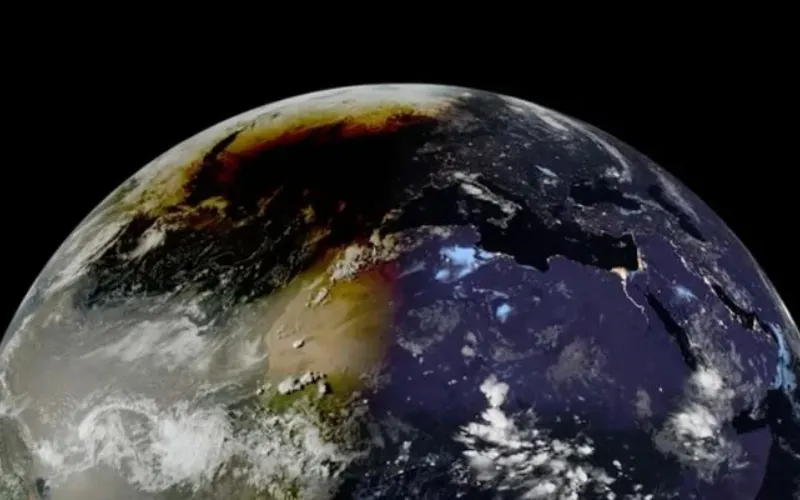
The European Space Agency has released a video showing the Moon's shadow moving across Europe during the total solar eclipse on Aug. 12, 2026. The footage provides a rare view of the eclipse, which briefly plunged parts of the continent into darkness. People on the ground were able to see the total eclipse for several minutes.
Imagine you're watching a big shadow move across the Earth from space. That's basically what the European Space Agency's satellite captured during the total solar eclipse on Aug. 12, 2026. The satellite was really far away, so it could see the whole shadow moving across the Earth, which is something people on the ground couldn't see. It's like a big cosmic dance between the Earth, the Moon, and the Sun.
Analysis
The European Space Agency's Satellite Footage of the 2026 Eclipse Shadow
The European Space Agency (ESA) has released an impressive video showing the Moon's shadow moving across Europe during the total solar eclipse on Aug. 12, 2026. The footage provides a rare view of the eclipse, which briefly plunged parts of the continent into darkness. The video was captured from geostationary orbit, with the satellite positioned about 36,000 kilometers above Earth and its sensors focused on Europe and northern Africa.
The footage clearly shows that the shadow appears much larger and moves much faster from space than it does to people watching the eclipse from the ground. This is because the satellite was much farther away, allowing it to capture the shadow's entire movement in a single video animation. The video also highlights the capabilities of the ESA's satellites in capturing and sharing such events with the public.
The Science Behind the Eclipse
A total solar eclipse occurs when the Moon passes directly between the Earth and the Sun, blocking the Sun's light and casting a shadow on the Earth's surface. The shadow is typically around 100 kilometers wide and moves at a speed of about 1,000 kilometers per hour. During the eclipse, the Moon's shadow falls on a narrow area of the Earth's surface, creating a path of totality. The path of totality is usually around 100 kilometers wide and can be several thousand kilometers long.
The Significance of the Eclipse
The total solar eclipse on Aug. 12, 2026, was a rare and awe-inspiring event that provided a unique perspective on the Moon's shadow moving across Europe. The eclipse also highlighted the capabilities of the ESA's satellites in capturing and sharing such events with the public. The footage of the eclipse shadow will be useful for scientists and researchers who study the Earth's atmosphere and the behavior of the Moon's shadow during eclipses.
Key points
- The European Space Agency has released a video showing the Moon's shadow moving across Europe during the total solar eclipse on Aug. 12, 2026.
- The footage provides a rare view of the eclipse, which briefly plunged parts of the continent into darkness.
- People on the ground were able to see the total eclipse for several minutes.
- The satellite was positioned about 36,000 kilometers above Earth and had its sensors focused on Europe and northern Africa.
- The footage clearly shows that the shadow appears much larger and moves much faster from space than it does to people watching the eclipse from the ground.
The footage of the eclipse shadow will be useful for scientists and researchers who study the Earth's atmosphere and the behavior of the Moon's shadow during eclipses. This could lead to new discoveries and a better understanding of the Earth's atmosphere and the Moon's behavior.
The total solar eclipse on Aug. 12, 2026, was a rare and awe-inspiring event, but it also highlighted the limitations of the ESA's satellites in capturing and sharing such events with the public. The footage of the eclipse shadow may not be as useful for scientists and researchers as it could have been if the satellite had been positioned closer to the Earth's surface.