Father of sailor aboard USS Abraham Lincoln detained by immigration authorities, family says
The immigrant father of a sailor on board the USS Abraham Lincoln was detained by immigration officials, family members said. Luis Manuel Aviles, originally from Nicaragua, was detained in Key West, Florida, where he lives.
Intelligence analysis by Llama
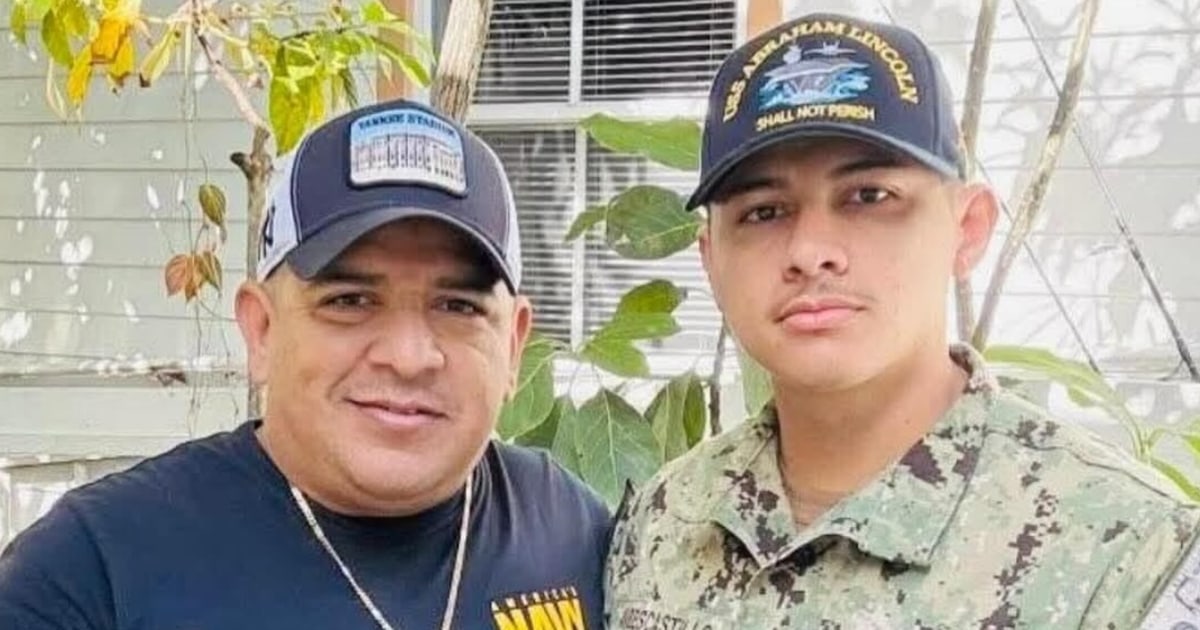
The father of a sailor on board the USS Abraham Lincoln was detained by immigration officials in Key West, Florida, despite having a work permit, a Social Security card, and a driver's license. The detention has sparked outrage among the sailor's family and has raised questions about the administration's immigration crackdown.
Imagine you have a family member who is serving in the military, and they are away from home for a long time. Now, imagine that their father, who has been living in the U.S. for 20 years and has a work permit and a Social Security card, is detained by immigration officials. This is what happened to the father of a sailor on board the USS Abraham Lincoln. It's a very sad and confusing situation for the family, and it highlights the need for a more compassionate and humane approach to immigration policy.
Analysis
Immigration Crackdown and Its Impact on Families of Service Members
The detention of Luis Manuel Aviles, the father of a sailor on board the USS Abraham Lincoln, has sparked outrage among the sailor's family and has raised questions about the administration's immigration crackdown. The incident highlights the impact of the administration's tough stance on immigration on families of service members.
The USS Abraham Lincoln has been on a prolonged stretch at sea, including its deployment to the Middle East to engage in the war with Iran. The sailor's father, Luis Manuel Aviles, has been in the U.S. for roughly 20 years and has a work permit, a Social Security card, and a driver's license. Despite this, he was detained by immigration officials in Key West, Florida, where he lives.
The detention has sparked outrage among the sailor's family, who are concerned about the impact it will have on their loved one's mental health. The sailor's brother, Joshua Aviles, has taken to Facebook to express his concerns and to call for his father's release. He wrote, 'This is heartbreaking for me. I don’t know how I can mentally continue working 12+ hour days knowing that my dad is somewhere, possibly being treated like a criminal.'
The incident has also raised questions about the administration's immigration crackdown and its impact on families of service members. The U.S. Citizenship and Immigration Services website says that those 'discretionary options' are offered on a 'case-by-case basis.' It was not immediately clear whether Luis Manuel Aviles was in the program.
The detention of the father of a sailor on board the USS Abraham Lincoln is a stark reminder of the administration's tough stance on immigration and the impact it has on families of service members. The incident highlights the need for a more compassionate and humane approach to immigration policy.
Key points
- The father of a sailor on board the USS Abraham Lincoln was detained by immigration officials in Key West, Florida.
- The sailor's father has a work permit, a Social Security card, and a driver's license.
- The detention has sparked outrage among the sailor's family and has raised questions about the administration's immigration crackdown.
- The incident highlights the impact of the administration's tough stance on immigration on families of service members.
The detention of the father of a sailor on board the USS Abraham Lincoln may lead to a re-evaluation of the administration's immigration crackdown and its impact on families of service members. This could lead to a more compassionate and humane approach to immigration policy, which would benefit many families who are struggling to stay together.
The detention of the father of a sailor on board the USS Abraham Lincoln may lead to further division and polarization on the issue of immigration. This could lead to more families being separated and more people being detained, which would have a devastating impact on many families.