FM spox: Attack on Iran’s Lamerd "clear example of US war crimes"
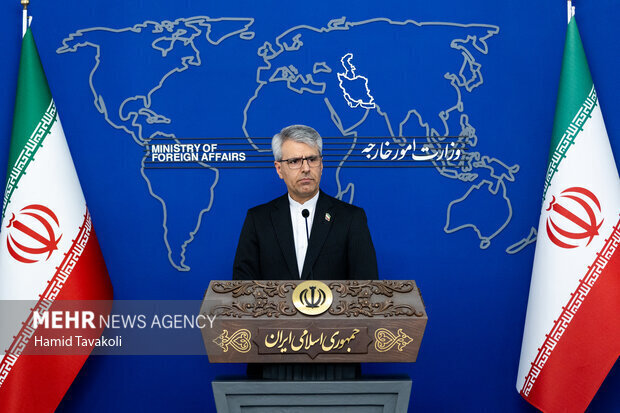
Iran's Foreign Ministry spokesman, Esmaeil Baghaei, condemned a US attack on the city of Lamerd as a clear war crime, citing the detonation of 2,000 kg of explosives over civilian areas.
Intelligence analysis by Gemini 2.5 Flash

During a press briefing, Iranian Foreign Ministry spokesman Esmaeil Baghaei accused the United States of committing war crimes in Lamerd, Fars province, by detonating 2,000 kilograms of explosives over civilian areas, resulting in 21 deaths. He also condemned a separate attack on an Iranian vessel near Hengam Island, which killed one and injured two Pakistani citizens, further critici…
Imagine a big country using super powerful, forbidden firecrackers that explode into tiny sharp pieces over a small town, hurting lots of innocent people and even kids. That's what Iran says America did in a city called Lamerd. Iran also says America attacked one of its boats near an island, hurting more people. Iran thinks America is causing trouble in their neighborhood, even though they're far from home, and wants other countries to talk things out peacefully instead of fighting.
Analysis
The Iranian Foreign Ministry's strong condemnation of alleged US actions in Lamerd and near Hengam Island underscores a significant escalation in rhetoric and accusations between the two nations. The detailed claims of civilian targeting and prohibited weapons use, if substantiated, would have profound implications for international law and regional security dynamics. Iran consistently frames these incidents as deliberate acts of aggression, aimed at intimidation and destabilization, further entrenching its narrative of resistance against foreign intervention.
Lamerd
Esmaeil Baghaei, the spokesman for the Iranian Foreign Ministry, provided a detailed account of the alleged attack on the city of Lamerd, describing it as a "clear example of a US war crime." He stated that 2,000 kilograms of explosives were detonated over the city within 35 seconds, targeting civilian areas including the city center, a stadium, residential neighborhoods, a blood transfusion center, and schools. Baghaei specifically mentioned the use of a missile classified as a cluster munition, packed with 180,000 pellets, fired from four missiles each weighing approximately 500 kilograms. This action, he asserted, constitutes a war crime due to both the weapon type and the targeting of non-military zones, resulting in the martyrdom of 21 innocent people, including an Afghan national, and leaving many disabled.
Baghaei's firsthand account from his visit to Lamerd emphasized the brutality of the incident, stating that the reality far surpassed media impressions and was incompatible with any human standard. He highlighted the city's population of about 30,000 people, stressing that it became a testing ground for advanced weapons. The spokesman's remarks aim to galvanize international attention on the humanitarian impact and legal ramifications of such alleged attacks, portraying the residents of Lamerd as symbols of patience and resistance against what Iran perceives as criminal acts.
Hengam Island
Beyond the Lamerd incident, Baghaei also addressed a recent attack on an Iranian vessel near Hengam Island, offering condolences for the latest martyr of the Iranian resistance against American crimes. He reported that this attack resulted in one fatality and several injuries, including two Pakistani citizens. This incident, according to Baghaei, serves as further evidence of the United States' aggressive military presence in the region, thousands of kilometers from its own borders.
He criticized the US for claiming concern over shipping safety while simultaneously attacking Iranian vessels off Iran's coasts. This narrative reinforces Iran's long-standing position that the US military presence in the Persian Gulf is a source of instability rather than security. The inclusion of Pakistani casualties also broadens the scope of the alleged impact, potentially drawing more regional attention to the consequences of such confrontations.
Oman
In a separate but related development, Baghaei discussed an understanding reached between Iran and Oman regarding the establishment of safe maritime routes. This agreement, he noted, followed weeks of negotiations between the two coastal states and was intended to be presented at a meeting attended by regional countries, reflecting a responsible and far-sighted approach to regional security. The Iran-Oman deal aimed to set safe navigation routes through the Strait of Hormuz, respecting the sovereignty of both nations.
However, Baghaei confirmed that the proposed meeting for regional dialogue had been postponed at the request of Saudi Arabia. He expressed disappointment, emphasizing that such opportunities for dialogue among regional states are crucial for establishing a secure region free from destructive foreign interference. Iran's foreign ministry spokesperson reiterated the Islamic Republic's readiness to assist in resolving disputes among regional countries without intervention, warning that continued conflict among Muslim nations only serves the goals of the "Zionist regime" by perpetuating tension and insecurity.
Key points
- Iran's Foreign Ministry spokesman accused the US of committing war crimes in Lamerd by detonating 2,000 kg of explosives over civilian areas.
- The alleged Lamerd attack involved cluster munitions, targeting residential zones, and resulted in 21 civilian deaths, including an Afghan national.
- A separate US attack on an Iranian vessel near Hengam Island killed one and injured two Pakistani citizens, according to Iran.
- Iran and Oman reached an agreement on safe maritime routes through the Strait of Hormuz, intended for regional presentation.
- A planned regional meeting to discuss security was postponed at Saudi Arabia's request, which Iran views as a missed opportunity for dialogue.
The agreement between Iran and Oman to establish safe maritime routes, despite the postponement of a broader regional meeting, indicates a potential pathway for de-escalation and diplomatic solutions. If regional countries eventually seize such opportunities for dialogue, it could lead to a more secure and stable Middle East, free from external interference.
The continued accusations of war crimes and attacks, coupled with Saudi Arabia's request to postpone regional dialogue, suggest a deepening of tensions and a lack of immediate progress towards de-escalation. This ongoing conflict among Muslim countries, as Iran notes, risks perpetuating insecurity that primarily benefits the "Zionist regime."