‘His love for Hong Kong was profound’: Tung Chee-hwa honoured at state funeral
Hong Kong held a state funeral for Tung Chee-hwa, its first postcolonial leader, with Chinese President Xi Jinping and other top leaders sending condolences. He was praised as an "outstanding contributor to 'one country two systems'" and a patriot.
Intelligence analysis by Gemini 2.5 Flash
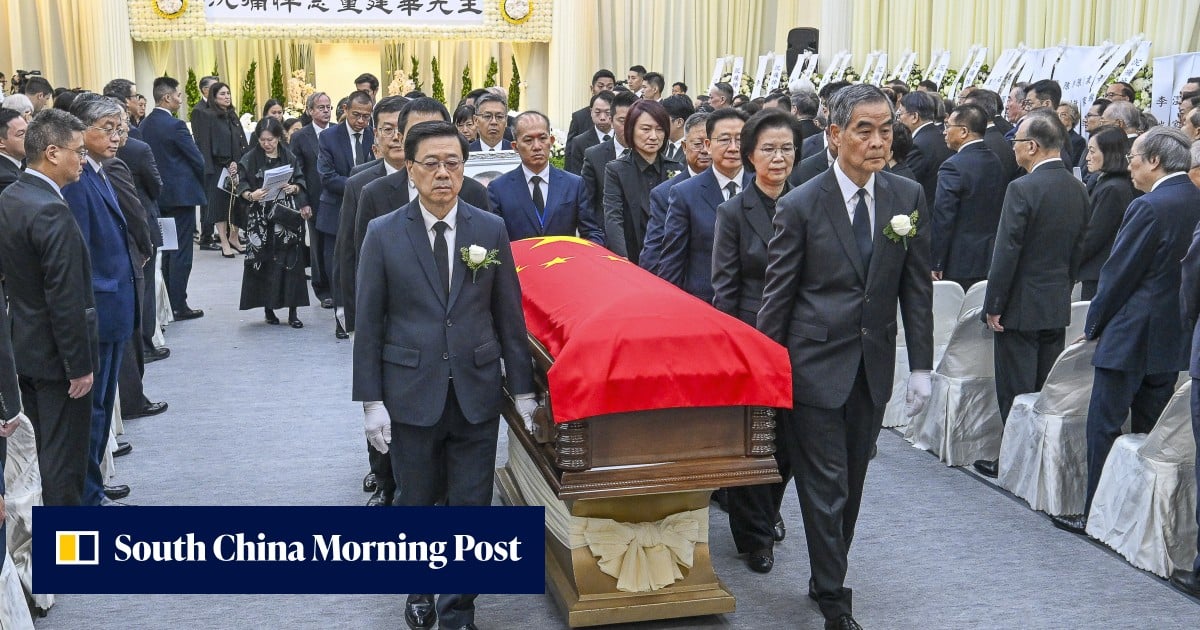
The city's political and business elite gathered for a solemn state funeral to pay tribute to Tung Chee-hwa, who passed away at 89. Beijing's leadership, including President Xi Jinping, acknowledged his significant contributions to the "one country two systems" framework and his patriotic role.
Imagine a very important leader named Tung, who was like the first captain of a special ship called Hong Kong after it joined a bigger country, China. When he passed away, everyone important, even the big boss of China, sent their goodbyes and said he did a great job helping Hong Kong stay special while being part of China.
Analysis
Tung Chee-hwa
Tung Chee-hwa, Hong Kong's inaugural postcolonial leader, was honored with a state funeral, marking a significant moment for the city's political history. His passing at 89 prompted a solemn ceremony attended by the city's elite, reflecting his stature. The event served as a formal recognition of his foundational role in the special administrative region.
The official Xinhua News Agency lauded Tung as an "outstanding contributor to 'one country two systems'," a "renowned patriot," and a "close friend of" the Communist Party of China. This commendation from Beijing underscores the central government's view of his legacy and his alignment with national objectives. His leadership during the early years of the handover was critical in shaping Hong Kong's trajectory under Chinese sovereignty.
Xi Jinping
Chinese President Xi Jinping, along with Premier Li Qiang and other central leaders, extended deep concern during Tung's illness and expressed profound grief following his death. This high-level attention from Beijing signifies the importance placed on Tung's contributions to the "one country two systems" framework. It also demonstrates the central government's direct engagement with significant political figures in Hong Kong.
The condolences conveyed by Xi and other leaders, as reported by Xinhua, highlight the symbolic weight of Tung's role in bridging Hong Kong's colonial past with its post-handover future. Such gestures from the highest echelons of power reinforce the narrative of a unified nation and acknowledge individuals who facilitated this integration. The state funeral itself, with Beijing's explicit involvement, elevates the event beyond a local commemoration.
One Country Two Systems
Tung Chee-hwa's legacy is inextricably linked to the "one country two systems" principle, which governs Hong Kong's unique status within China. His leadership as the first Chief Executive was instrumental in navigating the initial implementation of this framework, aiming to preserve Hong Kong's distinct legal and economic systems while integrating it into the People's Republic of China. The official praise for his contributions reinforces the central government's commitment to this policy.
The narrative surrounding Tung's funeral, particularly the emphasis on his patriotism and contributions to "one country two systems," serves to reaffirm Beijing's vision for Hong Kong. It frames his tenure as a successful period of transition and stability, aligning with the central government's long-term objectives for the special administrative region. This public recognition helps solidify the historical interpretation of Hong Kong's post-handover development.
Key points
- Hong Kong held a state funeral for its first postcolonial leader, Tung Chee-hwa, who died at 89.
- Chinese President Xi Jinping and Premier Li Qiang sent condolences, expressing deep grief.
- Xinhua News Agency praised Tung as an "outstanding contributor to 'one country two systems'" and a "renowned patriot."
- The ceremony was attended by Hong Kong's political and business elite.
- Tung was recognized for his role as a "close friend of" the Communist Party of China.
The state funeral and high-level condolences from Beijing could be seen as a reaffirmation of the "one country two systems" principle, potentially signaling continued stability and a clear framework for Hong Kong's governance. This unified recognition of a foundational leader might foster a sense of continuity and shared purpose.
The strong emphasis on Tung's patriotism and his role in "one country two systems" as defined by Beijing could be interpreted by some as a reinforcement of central government control, potentially overshadowing Hong Kong's distinct identity and autonomy. This narrative might raise concerns about the future interpretation and implementation of the "two systems" aspect.