How Google used Gemini and other AI products to build I/O 2026
Google says it used Gemini, Nano Banana, Lyria and other AI tools to help create I/O 2026, from film to branding and interactive demos.
Intelligence analysis by GPT-5.4 Mini
The company frames I/O 2026 as both an AI showcase and an AI-built production, using its own models and tools to speed up creative work while keeping humans in control.
Google made its big event like a playground for its own AI tools. Instead of only talking about AI, it used AI to help make a movie, design the event look, and build games and music.
A good way to picture it is a movie set where people still act, draw, and direct, but smart tools help color in the background and try out new ideas fast. The tools did not replace the people; they helped the people work quicker.
The main idea is that AI can be like a very fast helper. It can test lots of choices, make rough drafts, and turn simple ideas into something bigger, while humans still decide what feels right.
Analysis
What Google says it did
Google says it used Gemini and other AI products to help build multiple parts of I/O 2026, including a short film, the event's visual identity, and interactive pre-show experiences. The throughline is not full automation; the company emphasizes blending human craft with experimental AI tools.
Film and design workflow
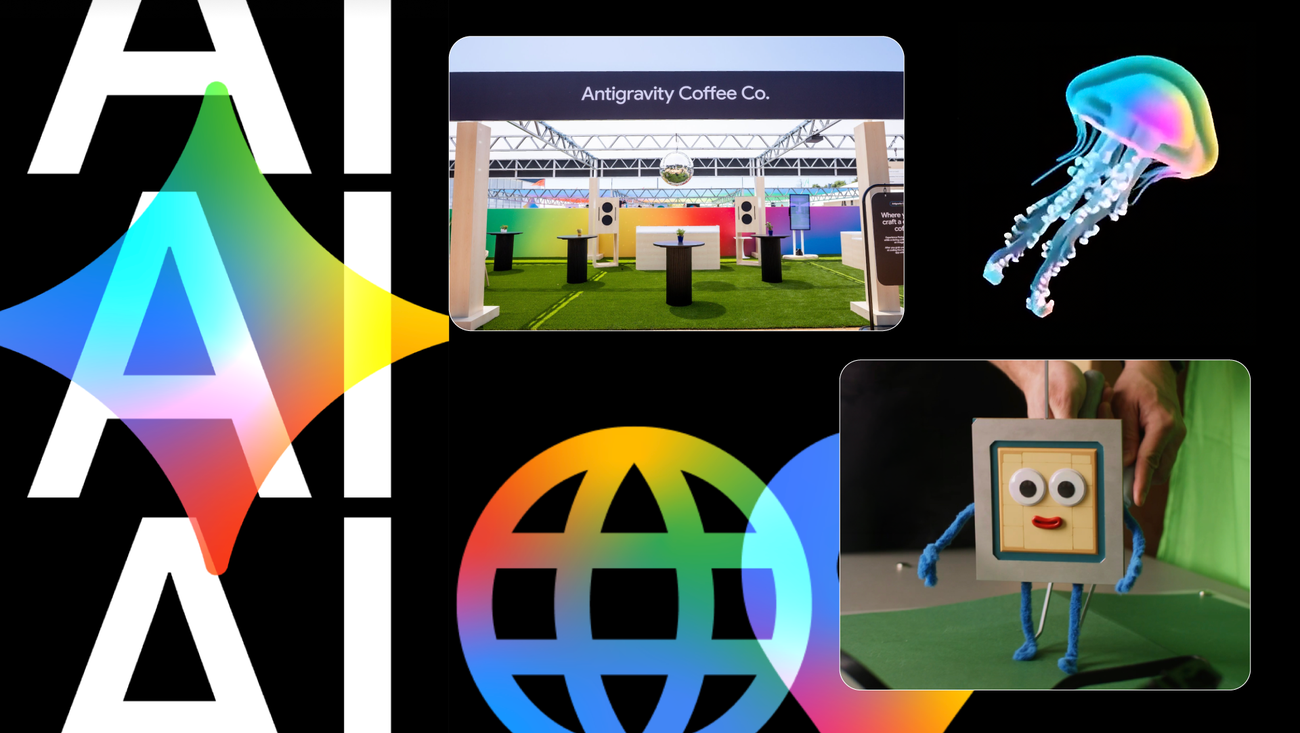
For the "TPU Training Day" film, Google says it started with puppetry and simple 3D animation, then used Nano Banana to generate stylized first frames. It built a custom tool in Google AI Studio to test those frames at scale and used Gemini Omni and other experimental models to merge the base animation with stylized output. The company says it wanted to preserve the small imperfections that make puppet films feel handmade.
For the I/O brand identity, Google says it fed Gemini models past brand guidelines and five years of I/O recaps, then iterated with Nano Banana until it landed on a four-color gradient and a system of interlocking icons. The same visual language was then used across the keynote, signage, and apps.
Interactive and music experiments
The article also describes Jellectronica, a pre-show piece made with the Monterey Bay Aquarium, where jellyfish movement was translated into sound using a YOLOv8 model, Coral NPU, Google Flow Music, and the Lyria API. Another pre-show game, Infinite Scaler, used Nano Banana, Gemini API, AI Studio, Google Antigravity, and Lyria 3 to let players generate and explore worlds while they played.
The editorial point is clear: Google wants to show that AI can help teams move faster, prototype in real time, and spend more time on the creative parts that matter most.
Key points
- Google says it used Gemini, Nano Banana, Lyria, AI Studio, and other tools to help create I/O 2026.
- The "TPU Training Day" film combined puppetry, 3D animation, and AI-generated stylization.
- The I/O 2026 brand identity was developed through iterative prompting and image experimentation.
- Interactive pre-show pieces used AI for music generation, motion tracking, and game-world creation.
- The company frames AI as a way to accelerate creative work without removing human artistry.
If this approach works well, AI tools could help creative teams prototype faster and spend more time on the parts only humans can do well. The article also suggests these systems can be used across film, branding, music, and games in a single event pipeline.
The workflow still depends on careful human direction, and the article implies early outputs were not always strong enough on their own. There is also a risk that pushing AI too far could flatten the handmade details the team says it wanted to preserve.