How Spain's migration surge tested E.U. border policy
A late-July 2026 surge sent roughly 72,000 migrants from Morocco into Spain's Ceuta enclave, testing the EU's new Pact on Migration and Asylum. Washington and 22 EU states criticized Spain's migration policies as a pull factor.
Intelligence analysis by Llama
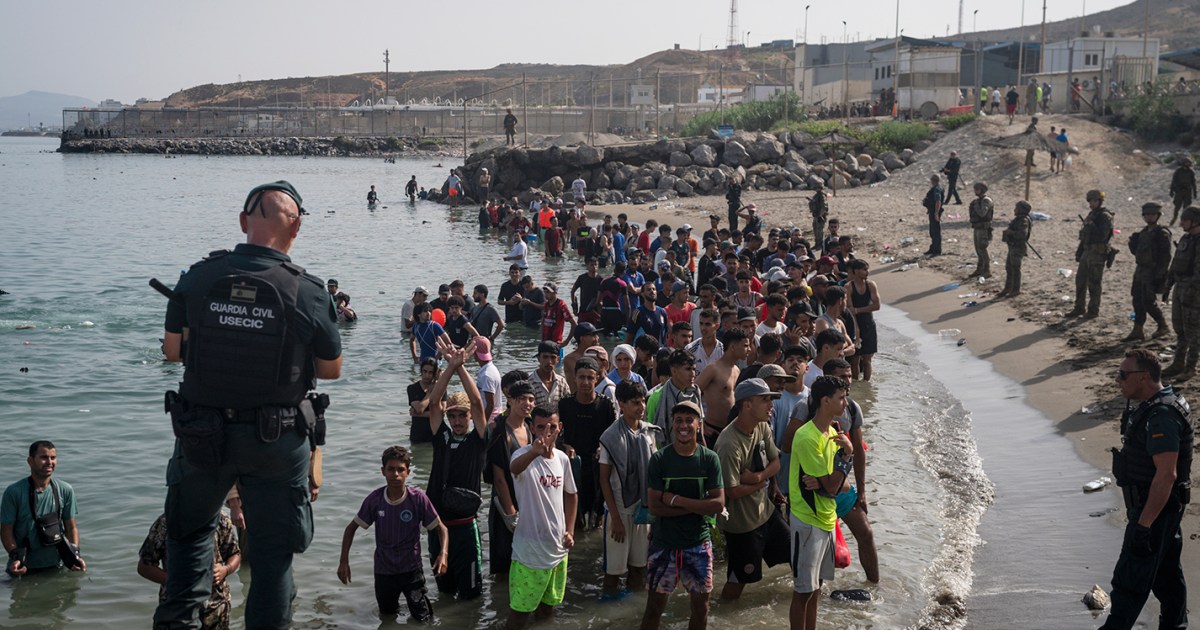
Tens of thousands crossed from Morocco into Ceuta in late July 2026, overwhelming the 84,000-person Spanish exclave and exposing sharp divisions in Europe over border policy. The U.S. State Department joined Denmark, Italy, and 20 other EU member states in criticizing Spain's progressive migration framework as a pull factor, while Madrid defended its policies and deployed troops and a…
Imagine a tiny town by the sea, and suddenly 72,000 people show up in two days asking for help. That's what happened in Ceuta, a Spanish town in Africa, when people from nearby Morocco tried to cross the border. Spain had to push most of them back, other countries got angry at Spain's rules, and now everyone is arguing about how to handle big crowds like this in the future.
Analysis
Ceuta's 84,000 Residents Overwhelmed
The two Spanish exclaves on Africa's northern coast, Ceuta and Melilla, have historically been migration pressure points, but the late July 2026 crossing broke every prior record. According to Spain's interior minister, roughly 72,000 people streamed across the border on July 30 and 31, though some reporting put the figure between 50,000 and 60,000. That compares to roughly 12,000 arrivals during the worst previous spike, in 2021. Most migrants reached Ceuta by sea, swimming or using makeshift flotation devices, and more than 80 people died on both sides of the border through drowning and stampedes. With Ceuta's official population sitting at just 84,000, the logistical challenge of absorbing such a wave was insurmountable: the city's migrant reception center was already operating above its maximum capacity before the surge even began.
Pedro Sánchez's Regularization Program as a Pull Factor
External criticism concentrated on Prime Minister Pedro Sánchez's progressive migration posture. In April 2026, his administration launched a regularization program through which more than 1 million undocumented migrants applied for one-year residency and work permits before the window closed in late June. Combined with a Spanish Supreme Court ruling earlier in the year that ended expedited "hot returns" for sea arrivals, critics argued Madrid had created incentives for irregular crossings. Council on Foreign Relations migration expert Rita Fernández pointed to social media misinformation as the trigger, noting that many migrants believed a rumor that Ceuta arrivals would not be deported, and CFR's Charles Kupchan observed that Spain is "a bit of an exception" within an EU that is otherwise tightening its borders. The combination of policy signals and viral misinformation produced what Fernández called an unusually potent recipe for a mass crossing.
The 1,640-Foot Floating Sea Barrier and the Transatlantic Fallout
Madrid's response combined physical infrastructure with diplomatic pushback. Spain deployed armed forces and police to Ceuta, where migrants were met with water cannons and tear gas and escorted back into Morocco, and shortly afterward installed a 1,640-foot floating sea barrier off the coast. Internationally, the crisis widened cracks in EU cohesion: a letter co-signed by 22 member states and led by Denmark and Italy accused Spain of weakening the bloc's frontier, while the U.S. State Department went further, claiming Madrid had "led efforts to enable and facilitate mass illegal migration into Europe." That unusually pointed public criticism from Washington, alongside the still-unresolved status of roughly 1,100 unaccompanied minors remaining in Ceuta, suggests the E.U.'s new migration pact will face a difficult early operating environment and a more polarized political backdrop than its authors anticipated.
Key points
- Roughly 72,000 migrants crossed from Morocco into Spain's Ceuta enclave on July 30-31, 2026, exceeding the prior 2021 record roughly sixfold.
- The U.S. State Department and 22 EU member states publicly criticized Spain's migration policies, calling them a 'pull factor' for irregular crossings.
- A Spanish Supreme Court ruling ending 'hot returns' and viral social media misinformation contributed to the surge, according to CFR experts.
- Spain deployed armed forces, water cannons, and tear gas, and installed a 1,640-foot floating sea barrier to deter future crossings.
- Roughly 1,100 unaccompanied minors remain in Ceuta, and more than 80 people died during the crossings.
- Prime Minister Pedro Sánchez defended his policies, including an April 2026 regularization program that drew over 1 million applications.
The episode could accelerate coordinated EU-wide border management and information-sharing frameworks, refining the new Pact on Migration and Asylum under real-world conditions. Spain's rapid military response and physical barriers may also produce a useful playbook for future surges elsewhere on the bloc's external frontier.
Misinformation-driven migration surges may become a recurring pattern, with viral rumors able to overwhelm even well-prepared border infrastructure in hours. The political fallout could empower far-right parties across Europe, harden member-state divisions, and push more governments toward restrictive deterrence policies that complicate humanitarian protections for the 1,100 unaccompanied minors still stranded in Ceuta.