Huawei unveils Ascend 960 SuperPoD with NPO technology to power next-generation AI infrastructure
Huawei has introduced the Ascend 960 SuperPoD, an AI computing cluster featuring Near-Packaged Optics (NPO) technology, designed to overcome data exchange bottlenecks in large-scale AI models.
Intelligence analysis by Gemini 2.5 Flash
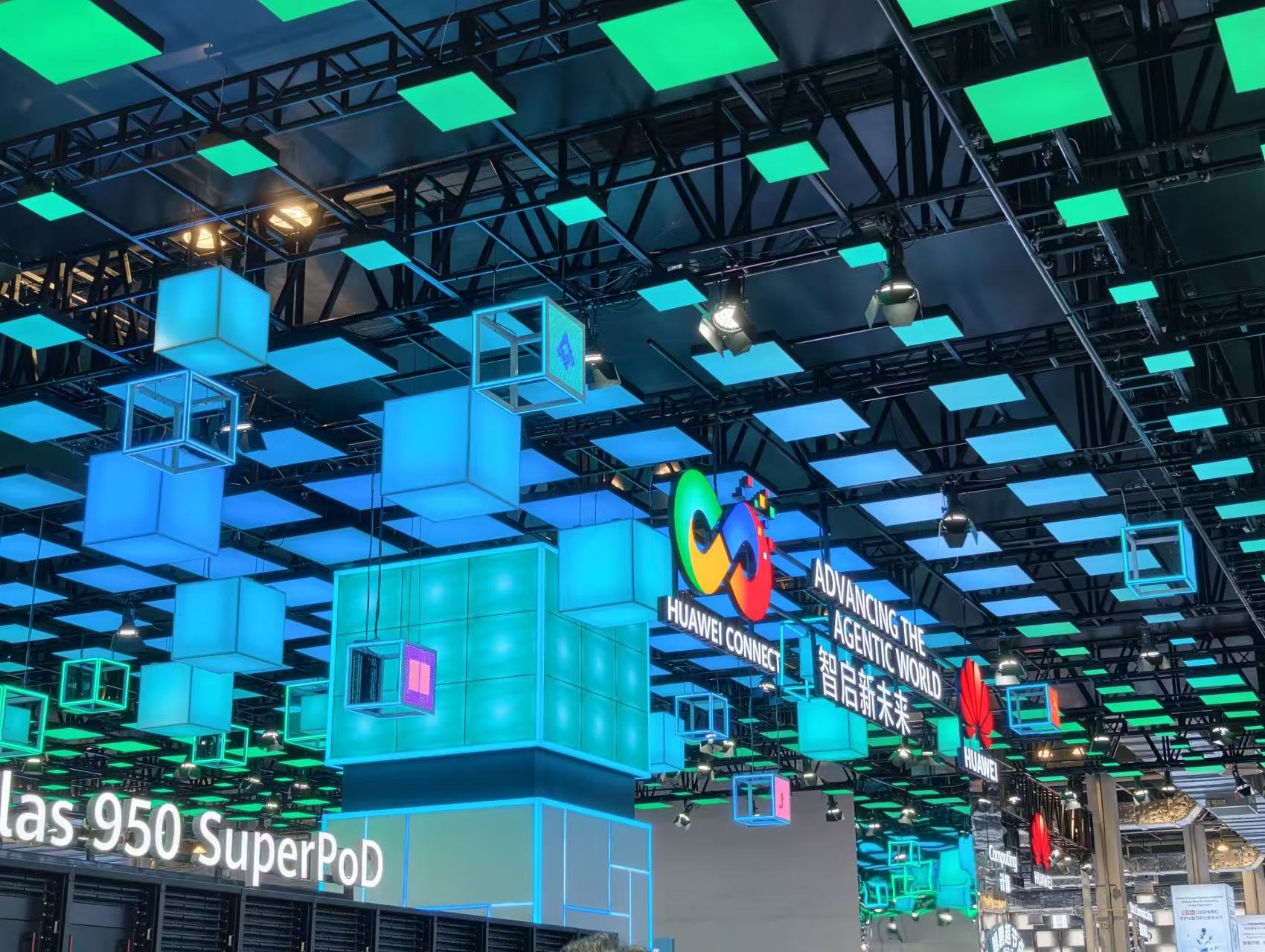
At HUAWEI CONNECT 2026, Huawei's Deputy Chairman Wang Tao unveiled the Ascend 960 SuperPoD, emphasizing a shift from individual chip performance to integrated system architecture for next-generation AI. This innovation aims to address the escalating demand for computing power by optimizing interconnects and memory sharing for models reaching the 10-trillion-parameter scale.
Imagine building a super-smart robot brain, but instead of one big brain, it's made of thousands of tiny brains working together. If these tiny brains have to shout messages across a big room, it takes a lot of time and energy. Huawei built a special super-computer called the Ascend 960 SuperPoD that puts these tiny brains much closer together and uses super-fast light signals, like tiny light-speed highways, to send messages. This makes the robot brain much faster and more efficient, so it can learn and do amazing things much quicker.
Analysis
Huawei's introduction of the Ascend 960 SuperPoD marks a significant evolution in AI infrastructure, moving beyond the traditional focus on individual chip performance to a more integrated, system-level approach. As AI models scale to trillions of parameters, the bottleneck shifts from raw processing power to the efficiency of data exchange between chips. Huawei's solution directly addresses this by rethinking how computing resources are organized and interconnected, aiming to transform multiple nodes into a cohesive, single computing entity.
Ascend 960 SuperPoD
The Ascend 960 SuperPoD is designed to support up to 4,096 NPU cards, delivering an impressive 8E FP8 computing power and 1PB of HBM capacity. This massive scale is critical for handling the computational demands of future AI models, which are projected to reach unprecedented sizes. The SuperPoD architecture is Huawei's answer to the challenge of communication overhead, which can consume over 40% of training time in traditional 100,000-card AI clusters. By integrating high-speed interconnects and unified memory, the SuperPoD allows computing nodes to operate as a single, highly efficient system, thereby significantly reducing latency and improving overall training efficiency.
NPO Technology
Central to the Ascend 960 SuperPoD's innovation is its use of Near-Packaged Optics (NPO) technology. As AI clusters grow, the volume of data moving between chips rapidly increases, pushing traditional copper connections and pluggable optical modules to their limits in terms of bandwidth, latency, power consumption, and connection density. NPO tackles these issues by bringing optical components much closer to the computing chips, drastically shortening the electrical signal path. This proximity minimizes signal degradation and power loss, enabling higher data rates and lower latency, which are paramount for the real-time demands of advanced AI applications like autonomous driving and agentic systems.
Hi-ONE
Huawei's specific NPO product, Hi-ONE, plays a pivotal role in the SuperPoD's efficiency gains. Each Hi-ONE unit delivers 7.2T of transmission capacity, and approximately 5,500 of these units are deployed within the Ascend 960 SuperPoD. This integration allows Huawei to replace an estimated 48,000 800G traditional optical modules, leading to a substantial reduction in power consumption by over 550kW. Beyond energy savings, the adoption of Hi-ONE and NPO technology is projected to double the system's mean time between failures and boost its availability to 99.8%. This focus on reliability and efficiency underscores Huawei's comprehensive approach to building robust and sustainable AI infrastructure for the future.
Key points
- Huawei unveiled the Ascend 960 SuperPoD, an AI computing cluster designed for next-generation AI infrastructure.
- The SuperPoD supports up to 4,096 NPU cards, delivering 8E FP8 computing power and 1PB HBM capacity.
- It features Near-Packaged Optics (NPO) technology to address bandwidth, latency, and power consumption challenges in large AI clusters.
- Huawei's Hi-ONE NPO product replaces thousands of traditional optical modules, reducing power consumption by over 550kW and increasing system availability.
- The innovation signifies a shift from focusing on single chip performance to optimizing entire AI system architectures for super-large-scale models.
Huawei's integrated system approach, particularly with NPO technology, could significantly accelerate AI development by removing critical computational bottlenecks. This could enable the creation of larger, more sophisticated AI models and agents, fostering breakthroughs in areas like autonomous driving and widespread AI integration into everyday devices.
Despite these advancements, the sheer complexity and scale of managing such vast, interconnected AI infrastructure could introduce new unforeseen challenges in deployment and maintenance. Furthermore, the proprietary nature of some of Huawei's technologies might limit broader industry adoption or create dependencies for developers seeking to leverage these cutting-edge capabilities.


