Introducing Gemma 4 12B: a unified, encoder-free multimodal model
Google DeepMind introduced Gemma 4 12B, a laptop-ready multimodal model with native audio input and an encoder-free architecture.
Intelligence analysis by GPT-5.4 Mini
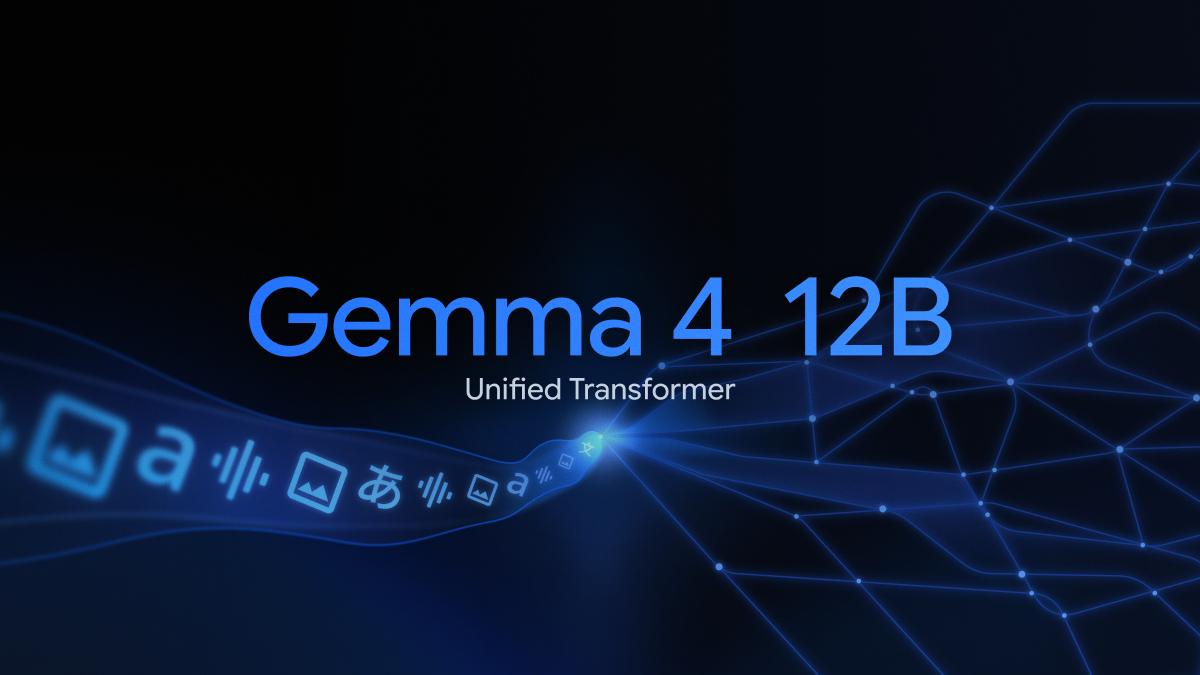
Gemma 4 12B is DeepMind's new mid-sized Gemma model, built to run on consumer laptops while handling text, vision, and audio directly in one backbone. The company says it narrows the gap to its larger 26B MoE model while staying efficient enough for local use.
Google made a new AI model that can read text, look at pictures, and listen to audio, all in one brain instead of using separate helpers. It is small enough to run on a laptop, like fitting a powerful toolkit into a backpack.
Analysis
What DeepMind launched
Google DeepMind introduced Gemma 4 12B as a mid-sized multimodal model meant to bring “agentic multimodal intelligence” to laptops. The company positions it between the smaller edge-focused E4B model and the larger 26B mixture-of-experts model, aiming to keep most of the capability while cutting memory use.
How it is different
The main technical pitch is its unified, encoder-free design. Instead of using separate encoders for vision and audio, Gemma 4 12B routes those inputs directly into the language model backbone. For vision, DeepMind says it replaces the encoder with a lightweight embedding module built from a matrix multiplication plus positional embedding and normalizations. For audio, it removes the audio encoder entirely and projects raw audio into the same space as text tokens.
DeepMind says this architecture reduces latency and memory usage compared with traditional multimodal systems. The company also says the model reaches benchmark performance nearing its larger 26B model, which it presents as evidence that a smaller model can still support multi-step reasoning and agent workflows.
Practical deployment
The model is described as small enough to run locally with 16GB of VRAM or unified memory, making it suitable for consumer laptops. It is also released under Apache 2.0 and is supported across tools and runtimes including LM Studio, Ollama, Google AI Edge Gallery, LiteRT-LM, Hugging Face Transformers, llama.cpp, MLX, SGLang, and vLLM. DeepMind also highlights Multi-Token Prediction drafters for lower latency.
The company says Gemma models have now crossed 150 million downloads, and frames this release as another step for developers building local agents, multimodal apps, and production systems.
Key points
- DeepMind introduced Gemma 4 12B as a mid-sized multimodal model for laptops.
- The model uses a unified, encoder-free architecture for vision and audio.
- The company says it performs near its larger 26B MoE model on standard benchmarks.
- DeepMind says the model can run locally with 16GB of VRAM or unified memory.
- The release is under Apache 2.0 and is supported by a wide developer ecosystem.
If the model performs as advertised, it could make advanced multimodal AI easier to run locally on consumer hardware. Its open license and support across popular tools could also speed up experimentation and deployment for developers.
The article relies on DeepMind's own benchmark claims, so real-world performance may be lower outside controlled tests. Even with a smaller memory footprint, local use still depends on capable hardware and the model may not match larger systems on harder tasks.