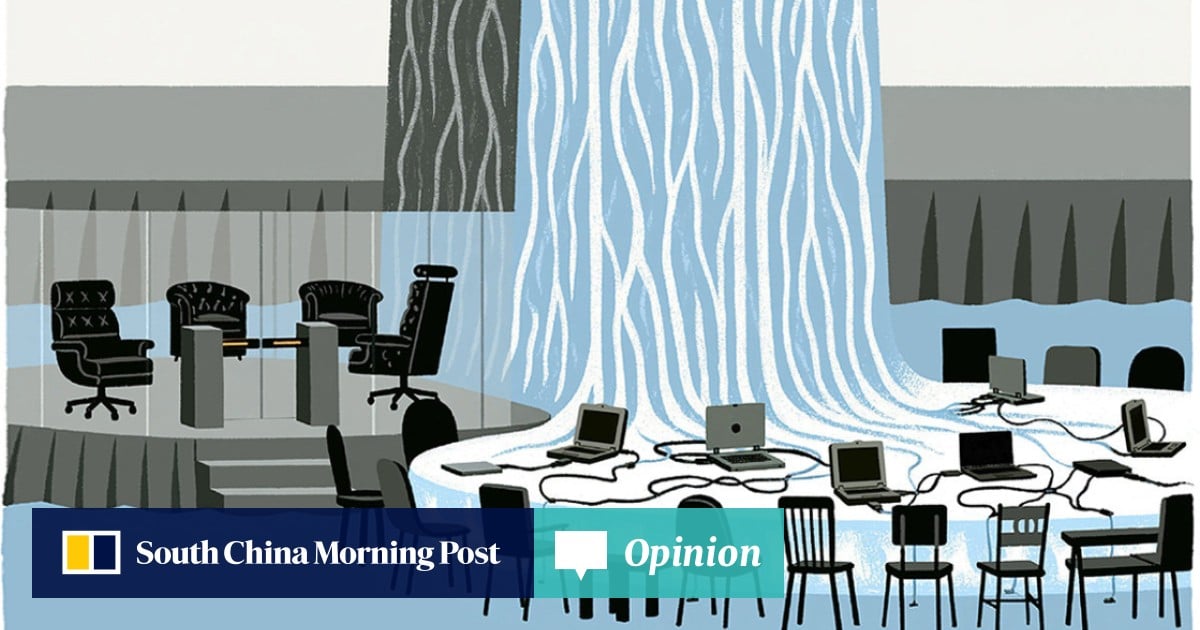
Investment with Chinese characteristics: how Beijing’s money is reshaping tech ventures
China's tech sector is being funded by the Chinese state, blurring the line between public policy and private equity. State-affiliated investors supplied more than 90% of the committed capital in China's private-equity market last year.
Intelligence analysis by Llama

China's tech sector is being funded by the Chinese state, with state-affiliated investors supplying more than 90% of the committed capital in China's private-equity market last year. This has sparked a debate about balancing risk and innovation.
China's government is investing a lot of money in its tech sector, which is making it hard for private companies to get funding. This could make China a big player in tech, but it also raises concerns about the government controlling too much of the market.
Analysis
A $60B Vote of Confidence
China's tech sector thrives on state-backed investment, reshaping funding dynamics and sparking a debate about balancing risk and innovation. On the surface, China's cutting-edge tech sector – from the algorithmic breakthroughs of DeepSeek and Zhipu AI to the hardware of Unitree Robotics and ChangXin Memory Technologies (CXMT) – mirrors Silicon Valley's venture capital-backed ecosystem. But a closer look at their financing histories reveals a common investor: the Chinese state. Beijing's strong presence underscores a more profound structural shift in how China's frontier technology is being funded. As Western venture capital and domestic private wealth retreat, the government has been steadily expanding its role in the market, constructing a state-capitalist apparatus which blurs the line between public policy and private equity. Rather than operating via a single entity, this public capital flows through a layered matrix of national funds, local investment vehicles, state-owned enterprises (SOEs) and privately managed funds. It is a system that converts top-down policy priorities into private-market bets, with an alternative perspective on what can be considered a return on investment. Last year, state-affiliated investors supplied more than 90 per cent of the committed capital tracked in China's private-equity market, a surge from just under 79 per cent in 2021, according to domestic data provider Zerone. This mandate comes directly from the top. At a high-level national science and technology gathering in Beijing on July 8, President Xi Jinping urged financial capital firms to “invest early, invest small, invest for the long term and invest in hard technology”. How this capital is deployed could determine whether China will succeed in its ambitions to become a self-reliant tech superpower – or suffocate its economy under the weight of state-engineered overcapacity.
Why Cursor?
China's state-backed investment in its tech sector has sparked a debate about balancing risk and innovation. The government's role in the market has been steadily expanding, with state-affiliated investors supplying more than 90% of the committed capital in China's private-equity market last year. This has raised concerns about the potential for state-engineered overcapacity and the impact on the country's ambitions to become a self-reliant tech superpower.
The Road Ahead
The way China's tech sector is being funded has significant implications for the country's future. The government's role in the market has been steadily expanding, with state-affiliated investors supplying more than 90% of the committed capital in China's private-equity market last year. This has raised concerns about the potential for state-engineered overcapacity and the impact on the country's ambitions to become a self-reliant tech superpower.
Key points
- China's tech sector is being funded by the Chinese state, blurring the line between public policy and private equity.
- State-affiliated investors supplied more than 90% of the committed capital in China's private-equity market last year.
- The government's role in the market has been steadily expanding, with state-affiliated investors supplying more than 90% of the committed capital in China's private-equity market last year.
- This has raised concerns about the potential for state-engineered overcapacity and the impact on the country's ambitions to become a self-reliant tech superpower.
If China's state-backed investment in its tech sector is deployed effectively, it could help the country become a self-reliant tech superpower. However, there are concerns about the potential for state-engineered overcapacity and the impact on the country's ambitions.
The government's control over China's tech sector could lead to state-engineered overcapacity, stifling innovation and hindering the country's ambitions to become a self-reliant tech superpower.