Iran highlights culture as key to peace at BRICS Culture Ministers' Meeting
Iran's Deputy Culture Minister Mohsen Javadi represented Iran at the 11th BRICS Culture Ministers' Meeting in Bhopal, India, stressing culture as a common language for peace.
Intelligence analysis by Llama
Iran's deputy culture minister told the 11th BRICS Culture Ministers' Meeting in Bhopal that culture is the only common and effective language among nations for addressing peace and global challenges. The two-day gathering set the stage for the 18th BRICS Summit in New Delhi in September.
Iran sent a top culture helper to a big meeting in India with other big countries called BRICS. He told everyone that sharing music, art, and traditions is the best way for countries to get along, like how kids become friends by playing together on a playground.
Analysis
Bhopal setting
The 11th BRICS Culture Ministers' Meeting was held on August 8 and 9 in Bhopal under the theme "Resilience, Innovation, Cooperation and Sustainability," part of India's calendar of BRICS activities before it hosts the leaders' summit. India's choice of Bhopal, a city with layered Mughal-era heritage, is itself a soft-power gesture, and the warm reception extended to Iran's deputy minister reflects New Delhi's interest in keeping dialogue channels with Tehran open even as India deepens ties with Gulf partners and Western capitals. For Iran, appearing at a ministerial track of BRICS rather than only the leaders' track gives Tehran a lower-stakes venue to reinforce its membership narrative without taking on new binding commitments.
Gajendra Singh Shekhawat's reception
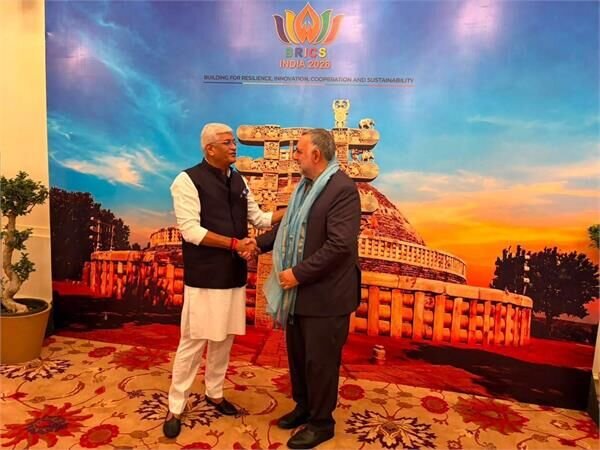
On the sidelines, Javadi was received by Indian Culture and Tourism Minister Gajendra Singh Shekhawat, who welcomed him with a turquoise-colored shawl, a traditional Indian gesture of respect for distinguished guests. Beyond the ceremony, the two officials used the bilateral window to discuss expanding cultural and artistic exchanges, framing culture as the connective tissue among BRICS members. The exchange matters because cultural cooperation is one of the few areas where Iran and India can move quickly on deliverables, ranging from film festivals and translations to joint heritage exhibitions, without getting tangled in the geopolitical disputes that dominate their other diplomatic files.
18th BRICS Summit
The Bhopal meeting feeds directly into the 18th BRICS Summit scheduled for New Delhi in September, where heads of state are expected to cover a broad range of cooperation issues. Culture ministers traditionally feed communiqués and project pipelines up to the leaders, so Iran's framing of culture as the "only common and effective language among nations" is designed to land in the summit's final declaration. If the leaders endorse cultural diplomacy as a pillar of BRICS work, Tehran gains institutional cover to expand people-to-people exchanges with Russia, China, Brazil, South Africa, and the newer members, useful at a moment when Iran is looking for non-Western platforms to project influence.
Key points
- Iran's Deputy Culture Minister Mohsen Javadi represented Iran at the 11th BRICS Culture Ministers' Meeting in Bhopal on August 8-9.
- Javadi said culture is the "only common and effective language among nations" for peace and solving economic and political problems.
- The meeting ran under the theme "Resilience, Innovation, Cooperation and Sustainability" as part of India's BRICS calendar.
- Javadi held sideline meetings with Indian Culture and Tourism Minister Gajendra Singh Shekhawat, who welcomed him with a traditional turquoise shawl.
- The gathering feeds into the 18th BRICS Summit scheduled for New Delhi in September.
If the BRICS leaders' summit in New Delhi endorses cultural diplomacy as a standing workstream, Iran gains a low-cost channel to deepen ties with Russia, China, India, and other members without triggering Western sanctions friction. Expanded film, heritage, and academic exchanges could also give Tehran soft-power wins that help offset its diplomatic isolation elsewhere.
Culture ministers' communiqués rarely translate into binding action, so the Bhopal meeting risks producing little more than photo opportunities. Tensions between BRICS members over other files, including Iran's nuclear dossier and India-China border issues, could also spill over and limit how far cultural cooperation actually advances before the September summit.