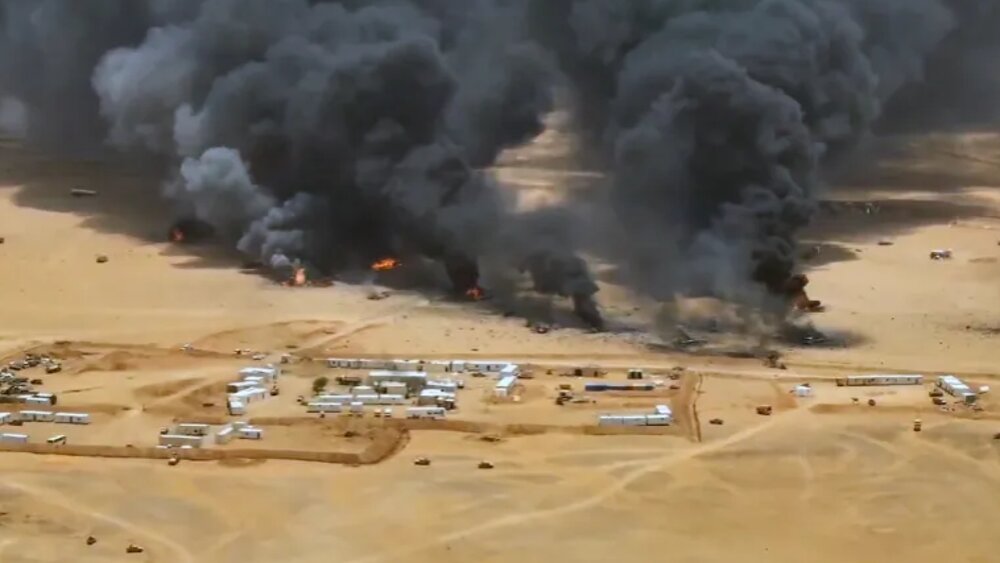
Iran's Oil Blockade and a $100 Billion Bill for Americans
The US naval blockade has severely cut Iran's oil revenues, pushing its economy deeper into crisis, while simultaneously imposing an estimated $100 billion in additional energy costs on American consumers due to rising gasoline and diesel prices.
Intelligence analysis by Gemini 2.5 Flash

The article details the dual impact of the US's "maximum pressure" policy against Iran: crippling Iran's oil and petrochemical exports, leading to severe economic contraction and inflation, and causing record-high fuel prices in the US, which have burdened American households and businesses with significant additional costs.
Imagine two kids playing with a hose. One kid (the US) is trying to stop the water (oil money) from reaching the other kid (Iran). This makes it hard for Iran to buy things. But because the water flow is messed up, everyone else (Americans) has to pay more for their own water (gasoline), like an extra $100 billion, which makes their parents grumpy.
Analysis
The ongoing US naval blockade against Iran has triggered a complex web of economic repercussions, impacting both the Iranian economy and American consumers. The "maximum pressure" policy, as described by former National Security Council official Alex Gray, aims to cripple Iran's financial lifelines and increase the cost of its regional activities. This strategy has led to a significant reduction in Iran's oil and petrochemical exports, its primary sources of foreign exchange, while simultaneously contributing to a substantial increase in energy costs for American households and businesses.
Iran's Drying Oil Dollars
Data from Kepler reveals a drastic decline in Iran's oil exports since the re-imposition of the naval blockade in mid-July. Iran's oil reserves held in tankers outside the blockade zone, largely destined for Chinese buyers, have plummeted from approximately 90 million barrels to 29 million barrels. If the current rate of nearly one million barrels per day continues, these reserves are projected to be depleted by mid-October, with payments for prior shipments potentially ceasing by mid-December.
The Wall Street Journal reports that Iran loaded only about 255,000 barrels of oil per day in August, an 85% reduction compared to the February-April average. Land transport alternatives are insufficient, with a maximum capacity of 40,000 barrels per day, far below Iran's pre-conflict exports of nearly two million barrels daily. Furthermore, petrochemical exports, Iran's second-largest foreign exchange earner, have also fallen by two-thirds. This financial squeeze is exacerbating Iran's economic woes, which include inflation exceeding 80%, a depreciating rial, and an International Monetary Fund forecast of a 5.4% contraction in the Iranian economy.
$100 Billion Cost
The economic fallout from the US-Iran tensions extends directly to American consumers, who have collectively borne an estimated $100 billion in additional energy costs since the conflict began. Calculations from Brown University's "Cost of War Project's Energy Tracker" indicate that the surge in gasoline and diesel prices has imposed an average additional burden of over $760 on each American household. This figure, according to Axios, is increasing by approximately one million dollars every two minutes.
Geographically, states like Texas, California, and Florida have been particularly hard hit, incurring $11 billion, $8 billion, and $5 billion in extra costs, respectively. CBS reported that the average price of regular gasoline reached $4.15 per gallon on Labor Day, a record for the holiday, while diesel prices climbed to $5.85 per gallon. The reliance of transportation networks on diesel suggests that these rising fuel costs will likely translate into higher prices for food, package deliveries, and other consumer goods, further fueling inflation, which remains a top concern for US voters.
Strait of Hormuz
The strategic Strait of Hormuz remains a focal point of the conflict, with US actions, including attacks on Iranian oil tankers, directly targeting Tehran's revenue streams and its capacity to fund military operations. Alex Gray highlighted that these measures are not merely retaliatory but are designed to systematically dismantle Iran's financial infrastructure. In response, Iran has attempted to assert its influence by declaring a "prohibited zone" in the Strait, aiming to demonstrate its ability to restrict shipping traffic despite the US naval presence and mine-clearing operations.
However, the efficacy of Iran's efforts to regain initiative in the Strait is questioned by US officials, who claim that Iran's capabilities to identify, intercept, and target vessels have been compromised by recent US actions. The ongoing naval maneuvers and counter-maneuvers underscore the volatile nature of the region, where any miscalculation could lead to a broader escalation. The interplay between economic pressure and military posturing in this critical waterway continues to shape global energy security and regional stability.
Key points
- US naval blockade has drastically reduced Iran's oil exports, with reserves for Chinese customers dwindling rapidly.
- Iran's oil loading in August was 85% lower than earlier months, and petrochemical exports also fell by two-thirds.
- The blockade contributes to Iran's over 80% inflation and a projected 5.4% economic contraction.
- US gasoline prices hit a record for Labor Day, and diesel prices also surged, partly due to reduced tanker traffic in the Strait of Hormuz.
- American consumers have incurred an estimated $100 billion in additional energy costs since the "war with Iran" began, averaging over $760 per household.
- US actions, including attacks on Iranian tankers, are part of a "maximum pressure" policy to cut Iran's revenue and finance military activities.
- Iran's declaration of a prohibited zone in Hormuz is seen as an attempt to regain control, though its effectiveness is questioned by US officials.
If the US blockade successfully pressures Iran into new negotiations, it could potentially lead to a diplomatic resolution that eases tensions, stabilizes global oil markets, and reduces the economic burden on American consumers.
The continued "maximum pressure" policy risks further destabilizing Iran's economy, potentially leading to increased social unrest within Iran or more aggressive actions by Tehran in the Strait of Hormuz, escalating regional conflict and driving global energy prices even higher.
Market signals
- OIL Reduced tanker traffic in the Strait of Hormuz and US actions against Iranian oil supply are cited as primary drivers for surging oil and fuel prices.
AI-generated analysis of potential market relevance. Not financial advice.