James Webb telescope discovers changing water clouds on a frozen brown dwarf
Astronomers used the James Webb Space Telescope to spot fast-changing water clouds on WISE 0855, the coldest brown dwarf ever found. The study found two things shape WISE 0855's changing atmosphere.
Intelligence analysis by Qwen 2.5 (3B)
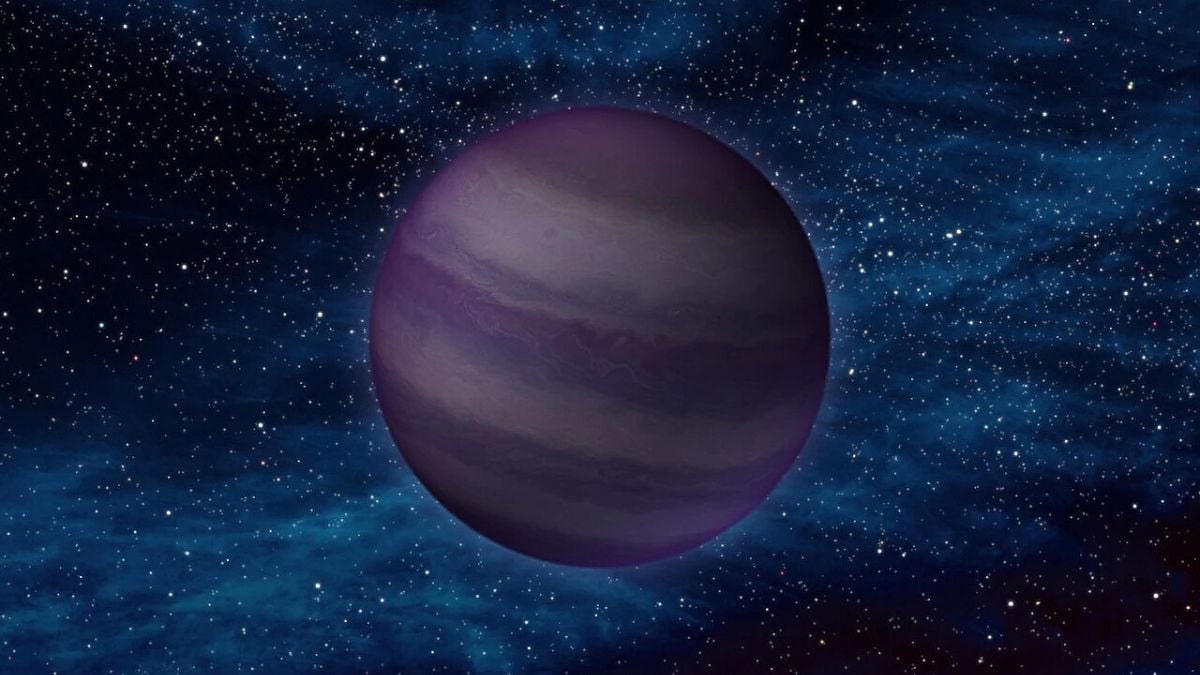
Astronomers used the James Webb Space Telescope to observe changing water clouds on WISE 0855, a frozen brown dwarf, revealing complex atmospheric dynamics.
Imagine a very cold planet that looks like a star but isn't one. Astronomers used a super telescope to see that this planet has clouds made of water that move around and change over time, just like clouds on Earth.
Analysis
{"#high-altitude-water-clouds":"The James Webb Space Telescope observed that high-altitude water clouds on WISE 0855 move around as the object spins. This motion contributes to the changing water clouds.","#convection-driven-atmosphere":"Heat from inside the brown dwarf pushes gases like carbon monoxide and phosphine upward through convection, similar to how hot liquid stirs in a boiling pot. This process shapes the atmosphere.","#telescope-sensitivity":"Earlier telescopes were not sensitive enough to separate these complex signals. The JWST's advanced spectrograph allowed scientists to track small temperature changes and chemical shifts in real time."}
Key points
- James Webb Space Telescope observed changing water clouds on WISE 0855
- High-altitude water clouds move as the object spins
- Heat from inside pushes gases through convection
- Earlier telescopes couldn't see these changes
- The discovery could help understand gas giant planets throughout the galaxy
This discovery could help us understand more about planets and stars in our galaxy, and it might lead to new ways to study distant worlds.
If the planet's weather patterns are as complex as those observed, it could make it even more difficult to study and understand these distant objects.