Judiciary chief: Iranian officials united against US hostility
Iran's Judiciary Chief Gholamhossein Mohseni-Ejei has reiterated that there is absolute alignment among the country's high-ranking officials regarding resistance against foreign hostility, dismissing any claims of internal division.
Intelligence analysis by Llama
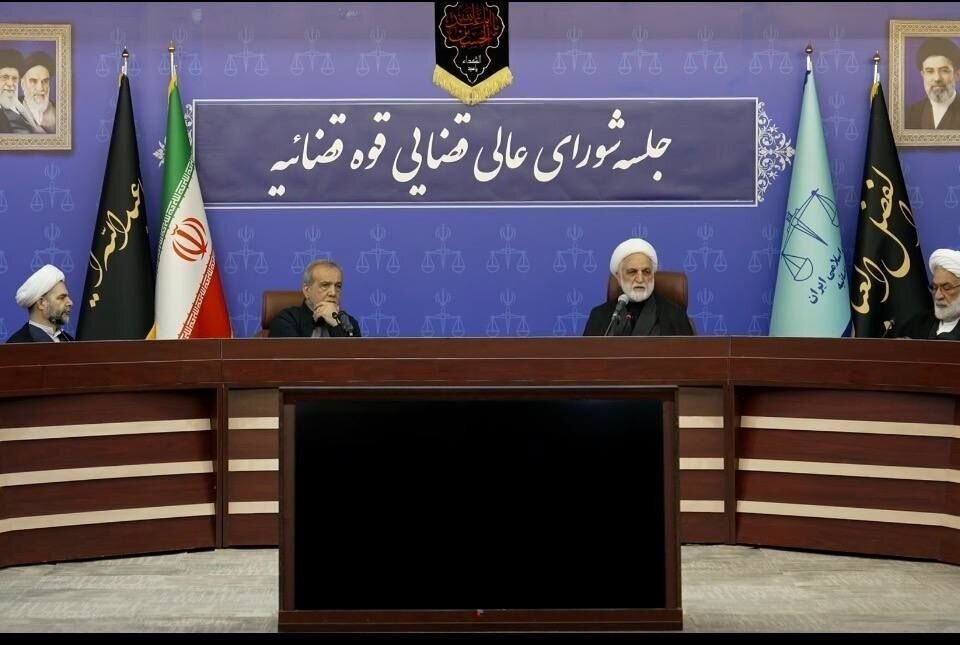
Iran's Judiciary Chief Gholamhossein Mohseni-Ejei has stated that there is no disagreement among the country's officials on resisting US hostility, emphasizing the collective resolve to counter external aggression.
Iran's top judge says that all government officials are united in resisting US hostility. He emphasizes that there is no disagreement among them on this matter, and that they will stand firm against external threats.
Analysis
A United Front Against US Hostility
Iran's Judiciary Chief Gholamhossein Mohseni-Ejei has reiterated the country's unified stance against US hostility, dismissing claims of internal division. The top judge emphasized that there is absolute alignment among the country's high-ranking officials regarding resistance against foreign aggression. This stance is not limited to the judiciary, but is shared by the executive and legislative branches of government. The administration maintains that all state apparatuses operate under a monolithic consensus, emphasizing that internal institutional solidarity remains the primary mechanism for defending the state against foreign pressure.
The Leader's Directives
President Masoud Pezeshkian has been described by the Judiciary Chief as a sincere, devoted, and revolutionary figure. The president is committed to advancing the interests of Islam, Iran, and the Iranian people. The entire establishment should extend full support and cooperation to the administration. The Judiciary Chief has praised President Pezeshkian's stance on the Leader's directives, emphasizing that the country's Armed Forces must receive the strongest possible backing.
A Monolithic Consensus
The Judiciary Chief's comments come amid an escalation in the direct military confrontation between Iran and the United States. The recent breakdown of the Pakistani-mediated Islamabad memorandum of understanding has led to a resumption of US airstrikes against Iranian infrastructure and military facilities. Iran has subsequently suspended its commitments under the agreement, citing US aggression and a total breach of the diplomatic framework. The administration has dismissed claims of internal division, categorizing them as external psychological operations designed to disrupt national cohesion.
Key points
- Iran's Judiciary Chief has reiterated the country's unified stance against US hostility.
- The top judge emphasized that there is absolute alignment among the country's high-ranking officials regarding resistance against foreign aggression.
- The administration maintains that all state apparatuses operate under a monolithic consensus.
- President Pezeshkian has been praised for his commitment to advancing the interests of Islam, Iran, and the Iranian people.
If Iran's unified stance against US hostility continues, it may lead to increased international support for the country's position. This could potentially reduce the impact of US aggression and lead to a more stable regional environment.
The ongoing military confrontation between Iran and the US may lead to increased human casualties and damage to infrastructure. The situation may also escalate into a wider regional conflict, with potentially devastating consequences.