Khawaja Asif calls Fazlur Rehman’s NA speech ‘blackmailing’ to secure share in KP govt
Defence Minister Khawaja Asif accused JUI-F chief Maulana Fazlur Rehman of blackmailing the government for a share in the Khyber Pakhtunkhwa government through his National Assembly speech.
Intelligence analysis by Gemini 2.5 Flash Lite
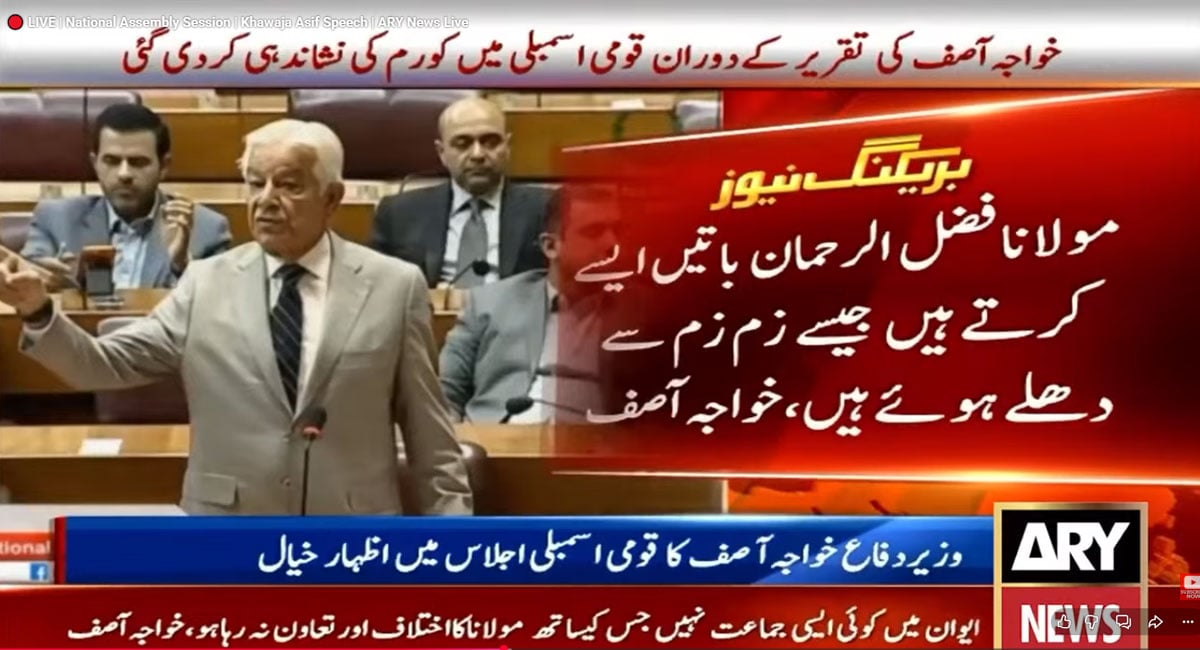
Defence Minister Khawaja Asif has directly accused JUI-F chief Maulana Fazlur Rehman of using his National Assembly speech as a tool for blackmail, aiming to secure a stake in the Khyber Pakhtunkhwa provincial government. Asif suggested that Fazlur Rehman's critical remarks were contingent on his party's inclusion in the provincial administration.
Imagine two kids arguing over who gets to play with a toy. One kid (Fazlur Rehman) says something mean about the other kid's game (Maulana's speech). The other kid (Khawaja Asif) says, "You're only saying that because you want to play with my toy too! You're trying to trick me into sharing."
Analysis
Khawaja Asif's Accusations
Defence Minister Khawaja Muhammad Asif has leveled serious allegations against Jamiat Ulema-i-Islam-Fazl (JUI-F) chief Maulana Fazlur Rehman. Asif contends that Fazlur Rehman's recent address in the National Assembly was not a genuine critique but rather a calculated act of blackmail. The primary objective, according to Asif, was to pressure the federal government into granting JUI-F a significant share in the provincial administration of Khyber Pakhtunkhwa (KP).
Asif specifically referenced Fazlur Rehman's questioning of his (Asif's) role during discussions on defense agreements and regional security matters in Tehran. Asif clarified that the meeting in Tehran did not involve Pakistan's defense arrangements and was attended by the Saudi defense minister and Turkish intelligence chief, making his presence unnecessary. This explanation aimed to counter Fazlur Rehman's implied criticism that sensitive matters were being handled without the Defence Minister's direct involvement.
KP Power-Sharing Dynamics
The core of Asif's argument is that Fazlur Rehman's parliamentary speech was directly linked to his party's desire for inclusion in the KP government. Asif stated unequivocally that had the JUI-F been offered a share in the provincial government, Fazlur Rehman would not have delivered the critical speech. This suggests a transactional view of political alliances, where cooperation is contingent upon tangible gains in power and resources.
Asif expressed regret over past political alliances with Fazlur Rehman, advocating for a more principled approach to politics. He suggested that it is more dignified to remain in opposition than to form coalitions with parties that allegedly resort to blackmailing tactics to secure their interests. This sentiment underscores a perceived shift in political strategy, where ideological alignment might be taking a backseat to pragmatic power-sharing arrangements.
Fazlur Rehman's Political Record
Khawaja Asif also took aim at Maulana Fazlur Rehman's extensive political history, criticizing his frequent shifts in alliances. Asif pointed out that Fazlur Rehman has been associated with various political parties over the years, implying a pattern of opportunism aimed at personal and party benefit. He specifically challenged Fazlur Rehman to account for his contributions during his decade-long tenure as chairman of the National Assembly's Kashmir Committee, questioning the tangible outcomes of that role.
Furthermore, Asif recalled Fazlur Rehman's past role as opposition leader during the era of former military ruler Pervez Musharraf. This historical reference serves to contextualize Fazlur Rehman's political career within different regimes, suggesting a pragmatic approach to power that transcends specific political ideologies. Asif's critique implies that Fazlur Rehman's political actions are driven by a consistent pursuit of power and privilege, regardless of the political landscape.
Key points
- Defence Minister Khawaja Asif accused JUI-F chief Maulana Fazlur Rehman of blackmailing the government.
- Asif alleged that Fazlur Rehman's National Assembly speech was aimed at securing a share in the Khyber Pakhtunkhwa government.
- Fazlur Rehman had questioned Asif's role during discussions on defense agreements in Tehran.
- Asif criticized Fazlur Rehman's past political alliances and tenure as chairman of the Kashmir Committee.
If the political parties can move past these accusations and engage in constructive dialogue, it could lead to more stable governance in Khyber Pakhtunkhwa. A resolution might foster a more cooperative political environment, allowing for focused efforts on provincial development and public service.
The continued political infighting and accusations of blackmail could further destabilize the political landscape in Pakistan. This could lead to a breakdown in inter-party relations, hindering effective governance and potentially impacting the stability of the provincial government in KP.