Kiarostami commemoration highlights art diplomacy as tool for international relations
A commemoration event honoring the late master filmmaker Abbas Kiarostami was held at the Cinema Museum of Iran. The event aimed to examine the global standing of Kiarostami’s cinematic legacy and introduce a new approach to art diplomacy to enhance international relation…
Intelligence analysis by Llama
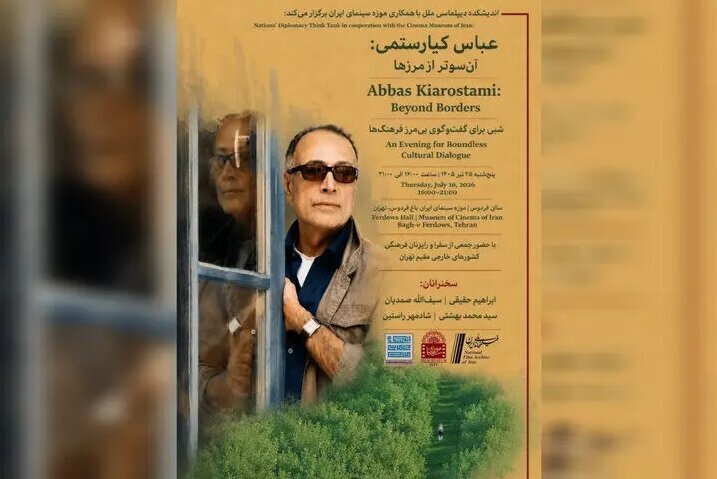
The event, titled 'Abbas Kiarostami: Beyond Borders,' aimed to introduce a new approach to art diplomacy to enhance international relations through culture and the arts. It was attended by prominent artistic figures, members of the press, and cultural attachés from various countries.
Abbas Kiarostami was a famous Iranian filmmaker who made many movies that showed the beauty of Iran. A group of people got together to remember him and talk about how art can help people from different countries understand each other better.
Analysis
A Master of Poetic Cinema
Abbas Kiarostami was a renowned Iranian film director, screenwriter, poet, photographer, and film producer. He was an active filmmaker from 1970 and had been involved in the production of over 40 films, including shorts and documentaries. Kiarostami attained critical acclaim for directing the 'Koker' trilogy (1987–1994), 'Close-Up' (1990), 'The Wind Will Carry Us' (1999), and 'Taste of Cherry' (1997), which was awarded the Palme d'Or at the Cannes Film Festival that year.
Art Diplomacy as a Tool for International Relations
The event aimed to introduce a new approach to art diplomacy to enhance international relations through culture and the arts. Seyyed Mohammad Ali Seyyed Hanai, President of the Nations Diplomacy Think Tank, emphasized that in the modern era, art serves as a universal language and a form of 'soft power' capable of bridging political divides and humanizing diplomacy. He described Kiarostami as a 'passport-less ambassador' whose authenticity and humanism projected a profound image of Iran to the world.
The Global Standing of Kiarostami’s Cinematic Legacy
The event served as an opportunity to further introduce the global artist to new audiences. Fatemeh Mohammadi, Director of the Cinema Museum of Iran, referred to Kiarostami as the 'Master of Poetic Cinema,' noting that the event was a chance to showcase his cinematic legacy to a broader audience. The event was attended by cultural attachés from Japan, Italy, Turkey, Kazakhstan, Lebanon, the United Kingdom, Malaysia, and Romania, highlighting the global recognition of Kiarostami’s work.
Key points
- Abbas Kiarostami was a renowned Iranian film director, screenwriter, poet, photographer, and film producer.
- The event aimed to introduce a new approach to art diplomacy to enhance international relations through culture and the arts.
- The event was attended by prominent artistic figures, members of the press, and cultural attachés from various countries.
- Kiarostami’s cinematic legacy has a significant impact on international relations and cultural exchange.
- Art diplomacy can be a powerful tool for bridging political divides and humanizing international relations.
The event highlights the potential of art diplomacy to bridge political divides and humanize international relations. It also showcases the global standing of Kiarostami’s cinematic legacy and its impact on international relations. If this approach is adopted, it could lead to increased cultural exchange and cooperation between nations.
However, the event also raises concerns about the lack of representation of Kiarostami’s work in Iranian educational texts. This could indicate a lack of appreciation for his cinematic legacy in Iran, which could hinder the adoption of art diplomacy as a tool for international relations.