Landmark insurance policy clears Shenzhen’s flying vehicle for Hong Kong lift-off
A groundbreaking cross-border insurance policy has been secured for a Shenzhen-based electric vertical take-off and landing (eVTOL) aircraft, enabling it to operate in Hong Kong.
Intelligence analysis by Gemini 2.5 Flash
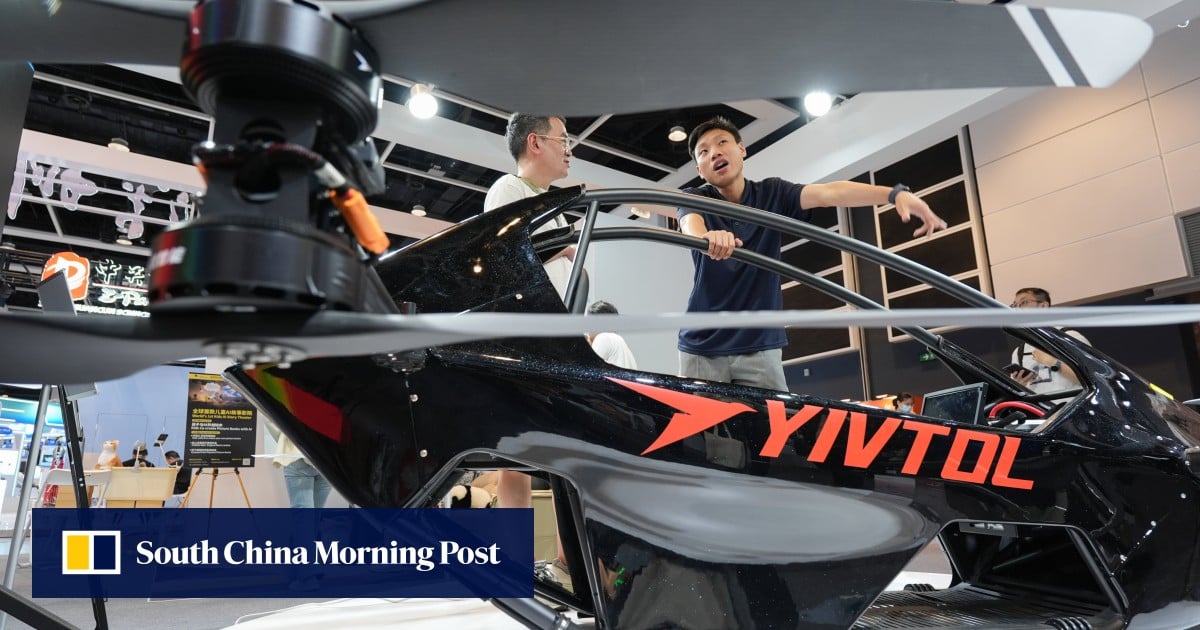
Shenzhen's Yivtol has obtained the first cross-border insurance policy for China's low-altitude economy, covering its S-Zero eVTOL aircraft for flights into Hong Kong. This collaboration between Chinese and Hong Kong insurers removes a significant regulatory barrier, paving the way for advanced air mobility in the Greater Bay Area.
Imagine a super cool, small electric flying car that wants to fly from one city, Shenzhen, to another, Hong Kong. Before it can fly, it needs a special permission slip, like a safety promise, called insurance, to make sure everyone is safe if anything goes wrong. Now, two big insurance companies, one from each city, have worked together to create the very first special permission slip that works in both places! This means the little flying car can now legally and safely zoom between the cities, showing how new flying machines can connect places.
Analysis
A Cross-Border Regulatory Breakthrough
The recent securing of a cross-border insurance policy for Shenzhen-based Yivtol's S-Zero eVTOL aircraft marks a pivotal moment for the burgeoning low-altitude economy in the Greater Bay Area. This policy, underwritten in Shenzhen by the People’s Insurance Company of China Group and issued in Hong Kong by its local unit, addresses a significant regulatory hurdle. Hong Kong's aviation regulations mandate compliant local insurance for aircraft operations, a requirement that has historically complicated market entry for mainland developers.
The collaboration between the two insurance entities highlights an innovative approach to bridging regulatory gaps across different jurisdictions. The Shenzhen branch handled the risk assessment and underwriting, leveraging its understanding of the mainland developer, while the Hong Kong unit ensured local compliance and formal issuance. This dual-pronged strategy provides a template for future cross-border operations of advanced air mobility vehicles, demonstrating how regulatory and financial frameworks can adapt to new technologies.
Fueling the Greater Bay Area's Low-Altitude Ambitions
The policy's approval is not merely a win for Yivtol but a significant boost for the entire Greater Bay Area's ambition to develop a robust low-altitude economy. This sector encompasses various applications of drones and eVTOLs, from logistics and tourism to emergency services. By enabling the S-Zero, a one-seater aircraft with specific operational parameters, to fly in Hong Kong, the policy sets a precedent for other developers looking to expand their reach across the region.
The HK$20 million (US$2.6 million) liability coverage for a one-year period underscores the financial commitment and risk assessment involved in integrating these novel aircraft into existing airspaces. This initial step, though for a single-seater aircraft with limited payload and flight duration, is foundational. It signals a willingness from both regulatory bodies and the insurance industry to support the growth of advanced air mobility, which could eventually lead to more complex and larger-scale operations.
Paving the Way for Future Air Mobility
This landmark insurance policy is a critical enabler for the future of urban air mobility, particularly in densely populated and economically vibrant regions like the Greater Bay Area. It provides a tangible example of how regulatory frameworks can evolve to accommodate technological advancements, moving beyond theoretical discussions to practical implementation. The success of this cross-border insurance model could inspire similar initiatives in other regions globally, where eVTOLs face similar challenges in navigating diverse regulatory landscapes.
For the broader AI and robotics industry, this development is a testament to the increasing maturity of eVTOL technology and the growing confidence in its safety and operational viability. As AI systems become more sophisticated in managing flight paths, navigation, and autonomous operations, robust insurance and regulatory policies will be indispensable for scaling these innovations. This policy represents a crucial step towards realizing the vision of widespread, safe, and efficient air travel using electric vertical take-off and landing vehicles.
Key points
- Shenzhen-based Yivtol secured the first cross-border insurance policy for an electric vertical take-off and landing (eVTOL) aircraft.
- The policy, underwritten in Shenzhen and issued in Hong Kong, covers Yivtol's S-Zero aircraft for flights into Hong Kong.
- It has a total liability of HK$20 million (US$2.6 million) for a one-year period ending June 2027.
- This collaboration between Chinese and Hong Kong insurers clears a key regulatory obstacle for China's low-altitude economy.
- The S-Zero is a one-seater aircraft with a maximum payload of 90kg, capable of flying for up to 50 minutes at 75km/h.
This landmark insurance policy could significantly accelerate the development and deployment of eVTOL technology, fostering innovation and creating new, efficient transport links within the Greater Bay Area. It sets a crucial precedent for cross-border regulatory cooperation, potentially paving the way for broader adoption of advanced air mobility solutions globally.
While a positive step, the current policy's limited scope to a one-seater aircraft with specific flight parameters suggests that widespread adoption and larger-scale eVTOL operations may still face significant regulatory and logistical hurdles. The complexity of extending such policies to multi-passenger or autonomous vehicles across diverse jurisdictions could slow broader market integration.