Lithuania briefs EU allies after drone shot down by Nato jets overnight – Europe live
Lithuania has informed NATO allies about a drone shot down by Italian fighter jets over its territory, sparking discussions on strengthening the alliance's eastern flank amid rising security incidents across Europe.
Intelligence analysis by Gemini 2.5 Flash Lite
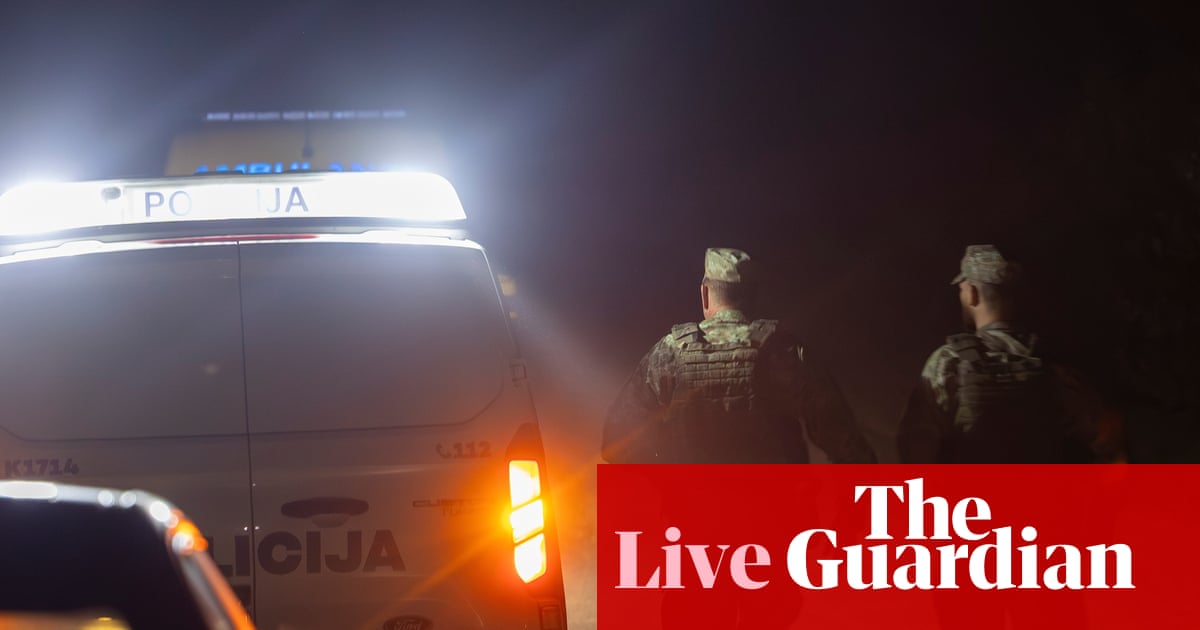
A drone shot down by NATO jets in Lithuania, coupled with suspected sabotage disrupting Dutch trains and a Russian warship incident involving a Danish helicopter, has heightened security concerns across Europe. Lithuania is seeking enhanced NATO and EU discussions on bolstering eastern flank defenses.
Imagine a neighborhood where some houses are suddenly getting strange noises and lights from a neighbor who's been acting a bit grumpy. One house's special alarm (a drone) was taken down by a friendly neighborhood watch plane (NATO jets). This makes everyone in the neighborhood worried, so they're talking about how to make their fences stronger together.
Analysis
Lithuania
The downing of a drone by Italian fighter jets over Lithuanian airspace, conducted under a NATO mission, has prompted immediate diplomatic action from Vilnius. Defense Minister Kęstutis Budrys has briefed NATO allies and signaled intent to raise the issue within both NATO and the EU. The incident underscores the heightened security environment on NATO's eastern flank, a region increasingly scrutinized due to its proximity to Russia and Belarus. Lithuania's call for "discussions on these topics both in the EU and Nato" highlights a perceived need for enhanced collective security measures and a unified response to what are being framed as aggressive Russian actions. The involvement of Italian jets signifies the multinational nature of NATO's air policing missions in the region, demonstrating alliance solidarity but also the complex operational coordination required.
Russia
Several recent incidents across Europe have been attributed to Russia, fueling concerns about its assertive posture and potential for destabilization. In Denmark, a Russian warship fired emergency flares at a Danish army helicopter during a routine monitoring mission, an act described by Prime Minister Mette Frederiksen as "reckless" and intended to "intimidate and divide." This naval provocation, alongside the drone incident in Lithuania and suspected sabotage in the Netherlands, paints a picture of a Russia actively testing the boundaries of NATO and EU member states. Former Danish defense minister Troels Lund Poulsen warned that these events are further proof of Russia's "extremely aggressive" behavior aimed at provoking conflicts. The cumulative effect of these incidents is a heightened state of alert and a demand for a robust, unified response from Western allies.
Europe
The surge in security incidents across Europe, ranging from aerial incursions to infrastructure disruption, is forcing a re-evaluation of regional security architectures. The suspected sabotage of Dutch railway systems, where objects placed on tracks caused widespread disruption, adds a new dimension to the threat landscape, moving beyond traditional military provocations to potential attacks on critical civilian infrastructure. Meanwhile, the ongoing tight parliamentary election in Sweden, with results potentially delayed, adds a layer of domestic political uncertainty to the broader European security picture. The confluence of these events—the drone incident in Lithuania, the Danish naval encounter, and the Dutch rail disruption—creates a sense of escalating, multi-faceted pressure on European security, necessitating urgent dialogue and strategic adjustments within both the EU and NATO frameworks to bolster resilience and deterrence.
Key points
- Lithuania reported a drone shot down by Italian NATO jets, prompting calls for enhanced eastern flank security.
- Russia's ambassador was summoned by Denmark following a warship's actions towards a Danish helicopter.
- Suspected sabotage disrupted Dutch railway systems, with authorities investigating.
- Swedish election results are delayed, with a close race between blocs.
- These incidents are seen as part of a pattern of aggressive Russian behavior.
The increased focus on security incidents could lead to a more unified and robust defense posture across NATO and the EU, strengthening collective security and deterring further aggressive actions. Enhanced cooperation and resource allocation to the eastern flank may improve early warning systems and response capabilities.
The string of incidents could signal a deliberate escalation by Russia, leading to a more volatile security environment in Europe and potentially triggering a costly arms race or a dangerous miscalculation. The disruption of critical infrastructure also raises concerns about the vulnerability of civilian systems to hybrid warfare tactics.