Live updates: Bitcoin flat near $63,500, but the flows have quietly turned
Bitcoin's price remains stable around $63,500, but underlying institutional investment flows have quietly shifted from selling to buying, particularly in US spot ETFs. This reversal comes amidst low trading volumes and volatility, suggesting a potential market bottom.
Intelligence analysis by Gemini 2.5 Flash
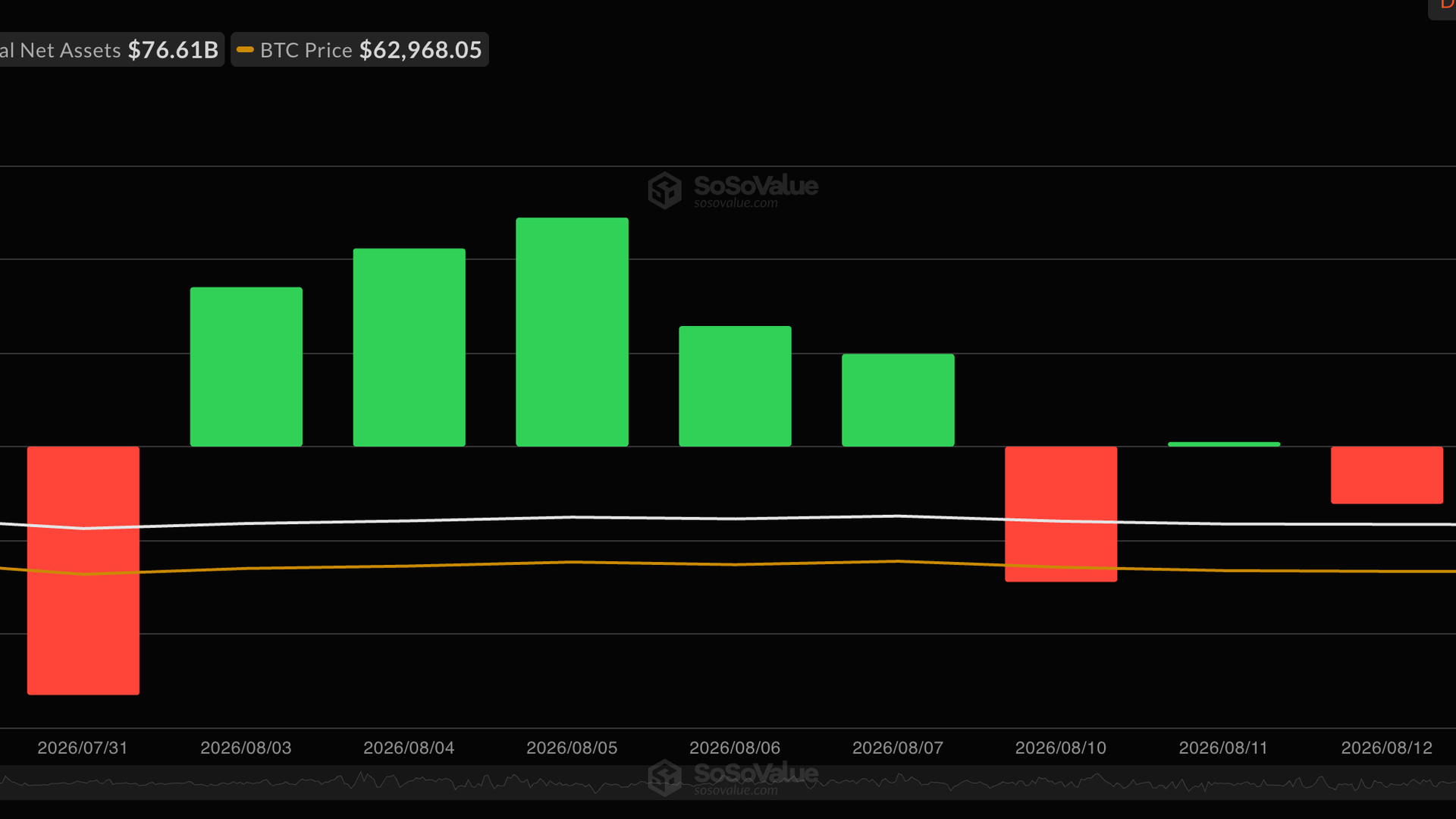
Despite Bitcoin's seemingly flat price action, a significant change in institutional investment patterns indicates a potential shift in market dynamics. US spot Bitcoin ETFs have recorded substantial net inflows in early Q3, reversing the heavy outflows seen in Q2, while overall trading volumes and volatility are at multi-year lows, interpreted as apathy rather than further deteriorat…
Imagine Bitcoin's price is like a car that's been parked for a while, not moving much. But underneath, the big, important drivers (like big investment companies) who were selling their cars are now quietly buying them again. This is happening when not many people are paying attention, which often means the car is getting ready to start moving forward again, especially since another big currency, the U.S. dollar, is getting a bit weaker, making Bitcoin look more appealing.
Analysis
ARP Digital's Analysis
According to Yusuf Fakhro, a partner at ARP Digital, Bitcoin's current price stability near $63,500 belies a crucial shift in underlying market flows. While the price appears to be in a summer torpor, capped below $64,000, institutional selling that characterized the second quarter has now flipped to buying. US spot ETFs, for instance, absorbed over 14,000 BTC in the first five days of August, marking the strongest inflow period since May and contrasting sharply with the 110,000 BTC of outflows in the latter half of Q2.
This reversal is particularly noteworthy given the current market conditions. Spot volumes have plummeted to two-and-a-half-year lows, perpetual volumes to three-year lows, and volatility is near multi-year troughs. Fakhro interprets this environment not as deterioration, but as apathy, suggesting that fresh demand entering such a thin market often precedes the formation of durable bottoms. He points to Bitcoin's six-month consolidation between $60,000 and $80,000, holding near a 50% drawdown without grinding lower like previous bear markets in 2014, 2018, and 2022, as evidence of this shift in sentiment from panic to caution, with on-chain data beginning to show bottoming characteristics.
Dollar Index (DXY)
The broader macroeconomic landscape also presents a potentially bullish signal for Bitcoin. The Dollar Index (DXY), which measures the U.S. dollar against a basket of major fiat currencies, recently dropped to 99.29, its lowest level since June 5. This decline represents a bearish breakdown of a bullish trendline that had defined the dollar's ascent from its January low of 95.55. Such a technical breakdown typically suggests further losses for the greenback.
Historically, weakness in the dollar tends to bode well for risk assets, including Bitcoin. When the dollar depreciates, assets priced in dollars, like cryptocurrencies, often become more attractive to international investors, and the perceived store of value of alternative assets can increase. This macro tailwind could provide additional support for Bitcoin, complementing the positive shift in institutional flows and potentially aiding its breakout from the current trading range.
HIVE's GPU Cloud Deal
In a separate but related development within the crypto ecosystem, HIVE (HIVE) experienced a significant surge, climbing 9% in Monday pre-market trading. This jump followed the announcement of a substantial $350 million, five-year GPU cloud deal. This agreement is projected to boost HIVE's contracted annual recurring revenue to approximately $180 million, with the company targeting $200 million by Q4 2026.
The deal underscores the growing demand for high-performance computing resources, particularly GPUs, which are crucial for various applications including AI and potentially crypto mining or related infrastructure. The announcement builds on HIVE's strong Q1 FY2027 results, which reported a 73.5% year-over-year revenue increase to $79.1 million, with high-performance computing revenue specifically climbing 52% to $7.1 million. This corporate success highlights specific areas of growth and investment within the broader digital asset and computing sectors, even as the flagship cryptocurrency, Bitcoin, navigates a period of price consolidation.
Key points
- Bitcoin's price is flat near $63,500, but institutional flows have quietly turned positive.
- US spot Bitcoin ETFs recorded over 14,000 BTC in net inflows in early August, reversing Q2 outflows.
- Trading volumes and volatility for Bitcoin are at multi-year lows, interpreted as market apathy rather than deterioration.
- The Dollar Index (DXY) dropped to its lowest since early June, a bearish breakdown that typically benefits Bitcoin and other risk assets.
- HIVE surged 9% after announcing a $350 million, five-year GPU cloud deal, boosting its recurring revenue targets.
The significant reversal from institutional selling to buying in US spot Bitcoin ETFs, combined with multi-year lows in volatility and volumes, suggests a potential durable bottom for Bitcoin. This renewed demand, coupled with a weakening Dollar Index, could set the stage for future price appreciation as fresh capital enters a market currently characterized by apathy.
Despite the positive flow shift, Bitcoin remains stuck in a narrow range, and the elevated perpetual open interest amidst collapsed volumes creates a market exposed to sharp liquidation moves. This leverage could lead to significant price volatility and potential drops if market sentiment shifts negatively, trapping traders in either direction.