Loosened nightlife rules for Boat Quay, Clarke Quay to be formalised after year-long pilot
Extended liquor trading hours and a weekend car-free zone at Boat Quay and Clarke Quay will be formalised after a successful year-long pilot. Since August 2025, 37 new nightlife venue applications were approved, ending a 16-year moratorium in the historic district.
Intelligence analysis by Llama
The Singapore Government will formalise extended liquor trading hours and a weekend car-free zone at Boat Quay and Clarke Quay after a successful year-long pilot. The measures aim to boost nightlife vibrancy and create good jobs in the sector.
Imagine a place where people can go out and have fun at night. That's what the Singapore Government is trying to create at Boat Quay and Clarke Quay. They're making it easier for people to go out and have a good time, and they're also making sure that everyone is safe. It's like a big party, but with rules to keep everyone safe.
Analysis
Extended Liquor Trading Hours and Weekend Car-Free Zone to be Formalised
The Singapore Government has announced that extended liquor trading hours and a weekend car-free zone at Boat Quay and Clarke Quay will be formalised after a successful year-long pilot. The measures aim to boost nightlife vibrancy and create good jobs in the sector.
Since August 2025, 37 new nightlife venue applications were approved, ending a 16-year moratorium in the historic district. The authorities had also announced that businesses would be able to submit proposals for new bars, pubs, and nightclubs along the Boat Quay waterfront, Circular Road, Lorong Telok, and Canton Street.
The pilot programme yielded encouraging results, with strong interest from businesses. The Ministry of Trade and Industry, Ministry of National Development, and Ministry of Home Affairs said in a joint statement that the measures will help Singapore's tourism and nightlife offerings become more attractive, support business vibrancy, and create good jobs in the sector.
Minister of State for National Development and Foreign Affairs Alvin Tan said the Government will formalise these initiatives, which will help Singapore's tourism and nightlife offerings become more attractive, support business vibrancy, and create good jobs in the sector. He added that the Government will continue to work with the different stakeholders to maintain a safe environment for businesses, patrons, and residents alike.
Businesses said formalisation of the pilot rules signals an openness by the authorities to new concepts for the historic precinct. President of the Singapore Nightlife Business Association Danny Loong said this was a good step, and that the association will continue to engage the authorities on ways to drive footfall for businesses and events in the waterfront zone.
Michelle Koh, who is executive director of Singapore River One (SRO), said the certainty provided by the latest announcement will give both operators and landlords the wiggle room to experiment with new business models. She added that the car-free zone for Circular Road will return in late October for Halloween, marking the first time the street will be pedestrianised since the Covid-19 pandemic.
The bill for the additional manpower comes up to $20,000 a month, and is fully borne by SRO. Koh said the car-free zone will be pedestrianised once every quarter, with some form of programming onto the street, be it a Halloween party or an after-work mingle session.
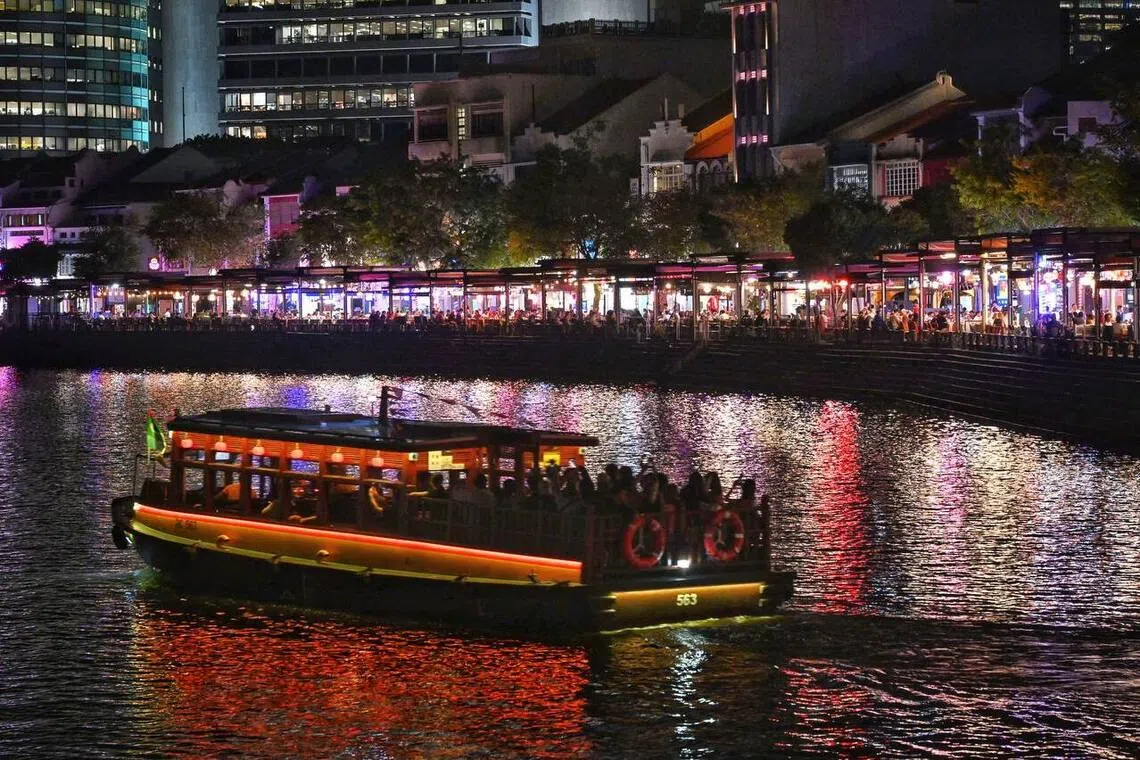
Guests dining at restaurants and bars at Clarke Quay by the Singapore River on Aug 17. ST PHOTO: CHONG JUN LIANG CQ @ Clarke Quay centre manager Nicholas Lee also welcomed the cementing of the revitalisation initiatives, noting that Clarke Quay's vibrant night scene remains a defining part of the precinct's identity. At the same time, the CapitaLand-managed property has evolved into a lifestyle destination that offers diverse dining, wellness, entertainment, and waterfront experiences throughout the day.
Safety and Security
Law-and-order concerns over the licensing changes have been allayed, with five additional police officers deployed between 7pm and 3am around Circular Road and Boat Quay. The bill for the additional manpower comes up to $20,000 a month, and is fully borne by SRO.
Boosting Nightlife Vibrancy
The formalisation of the pilot rules signals an openness by the authorities to new concepts for the historic precinct. President of the Singapore Nightlife Business Association Danny Loong said this was a good step, and that the association will continue to engage the authorities on ways to drive footfall for businesses and events in the waterfront zone.
Michelle Koh, who is executive director of Singapore River One (SRO), said the certainty provided by the latest announcement will give both operators and landlords the wiggle room to experiment with new business models. She added that the car-free zone for Circular Road will return in late October for Halloween, marking the first time the street will be pedestrianised since the Covid-19 pandemic.
Key points
- Extended liquor trading hours and a weekend car-free zone at Boat Quay and Clarke Quay will be formalised after a successful year-long pilot.
- 37 new nightlife venue applications were approved since August 2025, ending a 16-year moratorium in the historic district.
- The authorities will continue to work with stakeholders to maintain a safe environment for businesses, patrons, and residents alike.
- The car-free zone for Circular Road will return in late October for Halloween, marking the first time the street will be pedestrianised since the Covid-19 pandemic.
- The bill for the additional manpower comes up to $20,000 a month, and is fully borne by SRO.
If the formalisation of the pilot rules is successful, it could lead to increased tourism and business activity in the area. This could create more jobs and opportunities for people in the sector. Additionally, the car-free zone and extended liquor trading hours could make the area more attractive to visitors and locals alike.
However, there are also potential downsides to the formalisation of the pilot rules. For example, the increased foot traffic and noise could lead to concerns from residents and businesses in the area. Additionally, the additional police presence could be seen as a negative by some, especially if it's perceived as overly restrictive.